

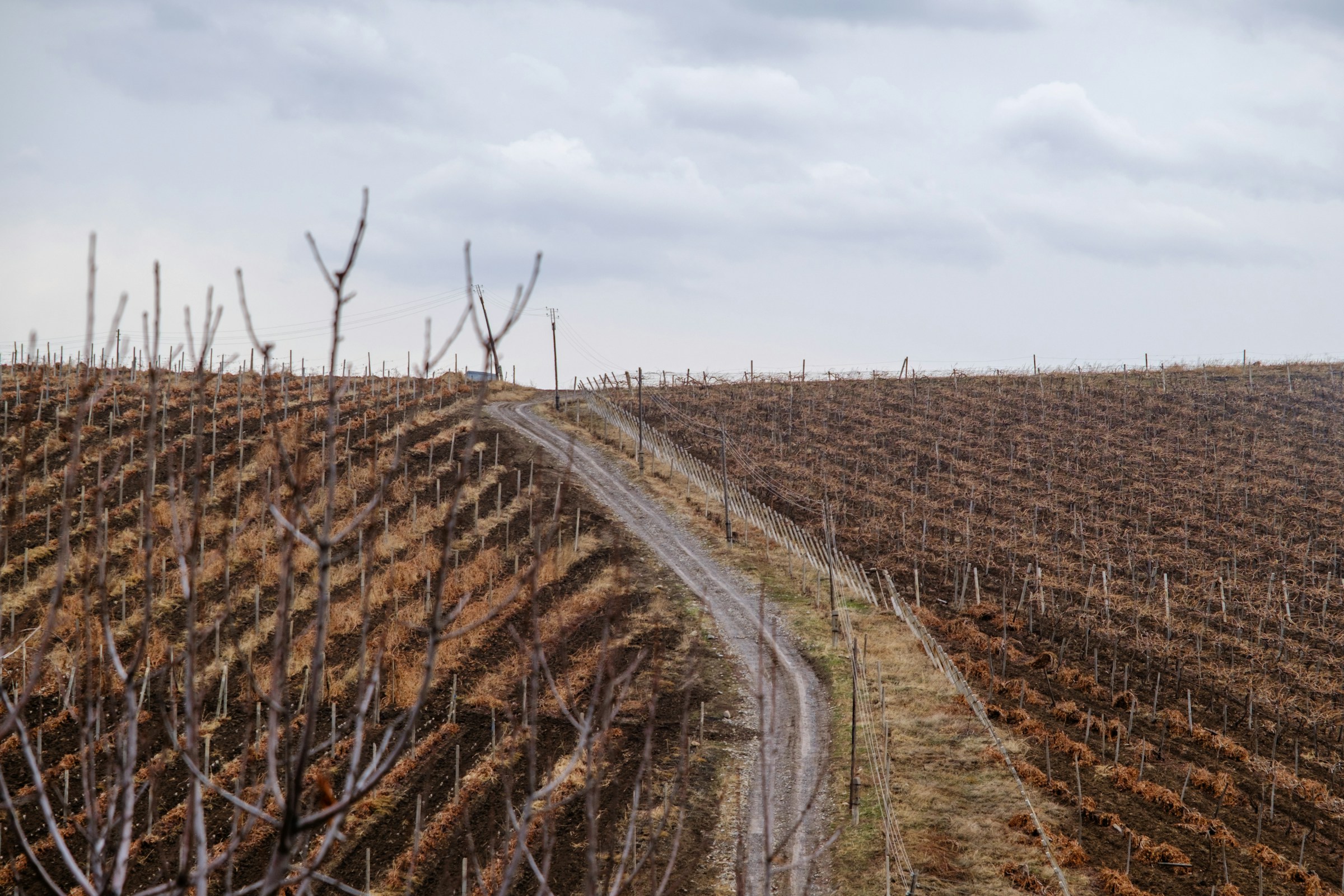
The sentence arrives near the end of the paperwork, after the parcel has been measured and the compensation calculated. A grower who takes the European Union‘s money to remove a vineyard “shall not be eligible to apply for new planting authorisations in accordance with Article 64 during the 10 marketing years following the one in which the grubbing up took place.” Any planting authorization already in hand “shall be revoked” the moment the application is approved. Sign, and a decade of rights leaves the farm with the vines.
Then the sentence appears a second time, in a different regulation, with three small changes. “Eligible” becomes “entitled.” The bare reference to Article 64 acquires its parent regulation’s full legal name. “Application for grubbing up” becomes “application for support of grubbing up.” The wording is not identical, and that is the point. It is the same lock, fitted to two different doors.
The Same Lock, Twice
For decades the EU managed its wine surplus with tools designed to be undone. Crisis distillation turned unsold wine into industrial alcohol until the crisis passed. Green harvesting destroyed grapes before they became wine, one vintage at a time. Planting restrictions could be loosened whenever demand returned. Regulation (EU) 2026/471, adopted on February 24, 2026 and in force since March 18, breaks with that tradition: it builds a tool not meant to be undone, and it builds it twice.
Like this? The TERROIR Letter arrives every Thursday.
The first route runs through national payments. An amended Article 216 of the EU’s agricultural markets regulation now lets Member States pay their own growers to grub up vines “in justified cases of crisis,” and attaches the decade-long bar and the revocation clause quoted above. The second route is new in kind: a named intervention in the Common Agricultural Policy itself, defined as “permanent grubbing up of productive vineyards, meaning the complete elimination of vine stocks on a relevant area.” It carries its own version of the same two conditions, in the mirrored language of the second sentence.
A single clause of this severity might be read as a drafting accident. A matched pair cannot, and the preamble removes any doubt about intent. The new intervention, recital 43 explains, is “like the permanent grubbing up measure funded by national payments, referred to in Article 216,” and should be subject to the same specific conditions, a prohibition on planting authorizations among them. The Union is on record copying its own lock.
Whose Money
The two routes differ in their financing, and the formulas resist shorthand, so here they are in full. Under the national route, a Member State may cover the direct cost of the grubbing up plus compensation of up to 100 percent of the grower’s estimated revenue loss for one year. There is no overall annual ceiling: “For grubbing up,” recital 30 states, “given the structural nature of the measure and its higher costs, it is not appropriate to set an overall maximum amount of national payments.” Under the CAP route, Union financial assistance may not exceed 70 percent of the sum of the direct costs and one year’s estimated revenue loss, and the Member State may add a national contribution of up to 30 percent of that same sum.
The difference, in other words, is not the size of the check. It is whose money writes it, national treasuries end to end in one lane, mostly Brussels in the other, and what sits above it: the national route has no annual cap, while the CAP route draws on each country’s fixed strategic-plan allocation. One asymmetry runs the other way. Where a Member State has used the national crisis measures for three consecutive years, it must suspend new planting authorizations across the production area concerned. The CAP intervention carries no such trigger. The national lane, the one closest to political pressure, is the one wired to shut the whole door.
No Route Back
A third clause closes the circle, and it names both routes in a single sentence. Growers who have grubbed up under either the national payments or the CAP intervention “shall not be entitled to apply for and to receive a replanting authorisation for that area.” Two lanes in, no lane back.
The EU has paid growers to remove vines before, and the comparison is instructive precisely because of what it lacked. The grubbing-up premium that ran from 2008 to 2011 removed 160,550 hectares on a budget of $1.5 billion (€1,074 million), according to the European Court of Auditors. But under the rules of that era, grubbing up generated an individual replanting right, “granted to a farmer following the grubbing-up of previously existing vines.” The vineyard left; the right to plant one remained. What 2026/471 creates, stated narrowly, is something that earlier scheme never was: permanent removal as a named instrument of European farm policy, with the return journey legally barred for a decade under both funding routes.
The politics of the change are as striking as the law. Parliament adopted the regulation by 625 votes to 15, with 11 abstentions. Its rapporteur, Esther Herranz García, called it “a timely and effective response to the crisis the wine sector is facing.” Recital 1 supplies the underlying arithmetic in a single flat sentence: “Wine consumption in the Union is at its lowest level in three decades.” A near-unanimous vote to fund permanent removal means there is no meaningful constituency left in Brussels arguing that the surplus is temporary.
Which Vineyards Are Landscape
The regulation does leave one discretion open, and it may prove the most consequential clause of all. Member States may exclude from removal areas where vineyards play “an important environmental, landscape preservation or socio-economic role.” The provision reads as a safeguard. It is also a sorting mechanism: region by region, somebody is now going to decide which vineyards are landscape and which are merely supply.
That decision will not be made in Brussels. It will be made wherever a grower is weighing one year’s compensated losses against a decade of foreclosed choices, and wherever a national ministry is drawing the line between a hillside worth protecting and a hectare worth retiring. The grower who signs is not riding out a cycle; the regulation has stopped pretending there is one. What remains, once the stumps are cleared, is the question the law cannot answer for the landscape it is about to redraw: not how many vines Europe removes, but which ones it decides to keep.
The TERROIR Letter
The story behind every bottle.
One feature. One dispatch. One bottle worth opening. Every Thursday — free.