

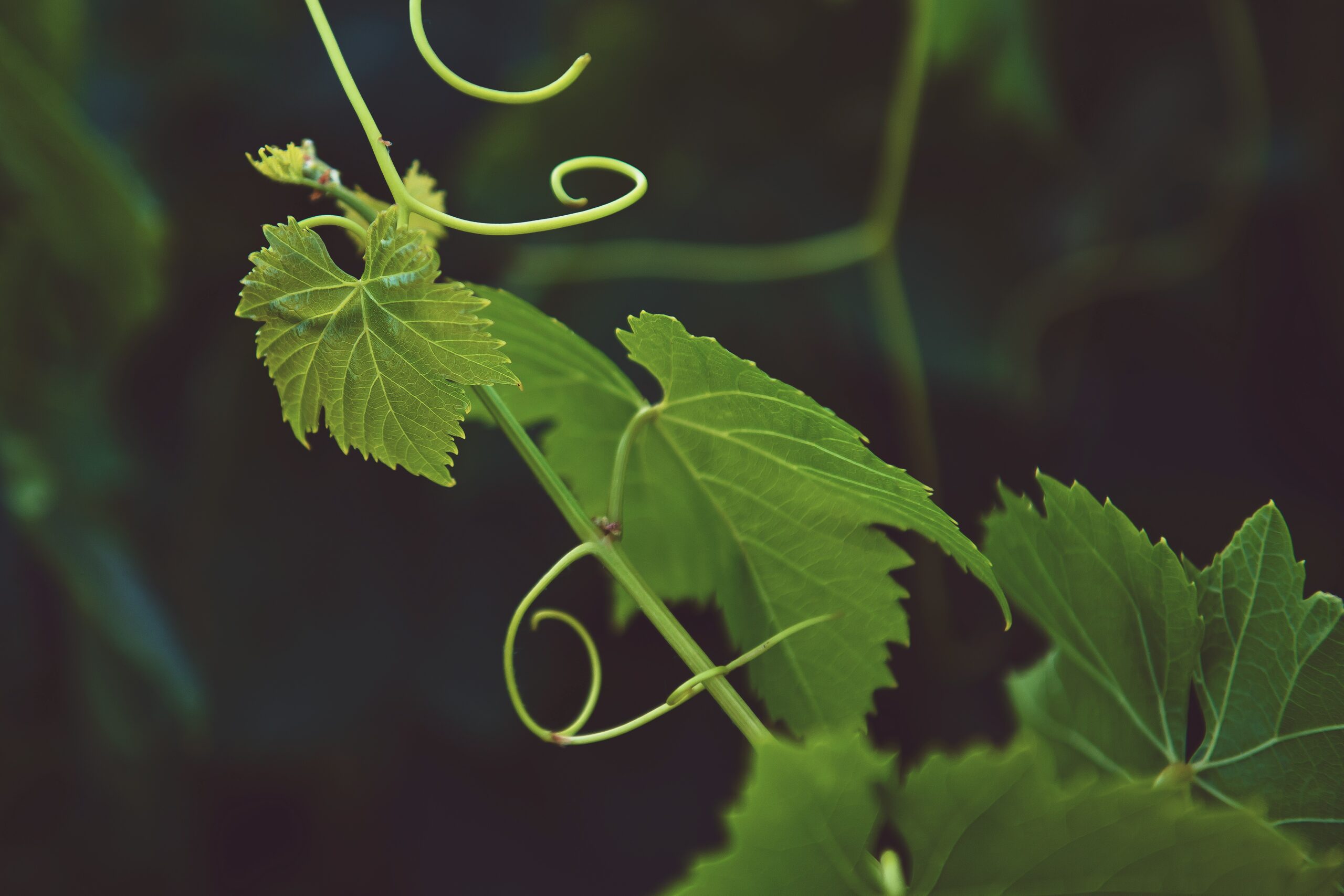
By August of a wet European season, an organic grower may have climbed the same rows a dozen times, tank in tow, laying down another pass against the two imported American fungi that have shadowed the continent’s vineyards since the nineteenth century. Powdery mildew first, then downy. Organic certification changes the chemistry in the tank; it does not change the arithmetic of the calendar. Vitis vinifera, the species behind nearly every wine the world drinks, has little natural defense against either disease, so defense arrives by tractor, week after week, diesel and drift included.
There is another answer, and it was bred rather than sprayed. PIWI grapes, from the German Pilzwiderstandsfähig, “fungus-resistant,” are crosses of vinifera with wild American and Asian Vitis species that carry the resistance vinifera never had. They are conventional crosses, not genetic engineering: pollen, seedlings, and decades of patient selection. The German Wine Institute puts the payoff plainly: plant-protection measures cut by up to 80 percent. For a category the trade still files under curiosity, that is not a small number. It is the difference between a spray program and a spray habit.
The Arithmetic of the Nursery
The science has stopped being speculative. In April 2026, researchers publishing in Science of The Total Environment ran a full life-cycle assessment on an experimental vineyard in Luxembourg, setting two resistant cultivars, Cabaret Noir and Sauvignac, against Pinot Noir and Rivaner. The resistant vines cut environmental impact by up to a factor of three, with the sharpest gains in the climate and freshwater toxicity categories, and saved an average of roughly $790 (€685) per hectare per year, most of it unspent fungicide.
Like this? The TERROIR Letter arrives every Thursday.
The finding lands hardest on organic viticulture’s quiet dependency: copper. Lacking synthetic options, organic and biodynamic growers rely on copper compounds against downy mildew, and copper does not biodegrade. It accumulates in vineyard soils, which is why EU rules cap applications at 28 kilograms per hectare over any seven-year period. The paradox is an awkward one for the movement’s self-image: the certification on the label promises soil health while the sprayer delivers a heavy metal to it. PIWIs do not manage that problem more gracefully. They remove the reason it exists.
The Gatekeepers
What held the category back was never horticulture; it was law. Europe’s appellation systems were built on rosters of approved vinifera varieties, and hybrids were shut out by definition. The door moved in June 2021, when the EU’s plant-variety office classified a set of the new crosses as Vitis vinifera in their own right. Bordeaux has since admitted Floréal, Vidoc, Sauvignac, and Souvignier Gris to its appellation under tight blend caps. The starker signal came from Champagne, which approved Voltis, the first resistant variety ever admitted to a French AOC: capped at 5% of a grower’s vineyard and 10% of any blend, on trial until a full decision due in the early 2030s. The first Voltis pressing, at a single house in 2025, came to roughly 114 liters. Champagne does not hurry. Champagne has, however, started.
The plantings tell the same story at a different speed. Germany, the category’s heartland, counted roughly 3,500 hectares of resistant varieties in 2024, about 3.5% of its vineyard area, and reached some 4,000 hectares in 2025. Souvignier Gris, a white bred at the state institute in Freiburg, was the year’s largest single gainer, adding 170 hectares in a single season to stand at 766. The percentages are small. The direction has not wavered.
What the Glass Remembers
Two obstacles remain, and honesty requires both. The first is memory. The word “hybrid” still carries the foxy taint of the Concord era, when early American crosses produced wines Europe learned to despise. Modern PIWIs are several generations of backcrossing away from that history and overwhelmingly vinifera by parentage, and the category now runs its own international wine challenge, with entries from Germany to the Czech Republic. Geisenheim University’s marketing research suggests the hesitation now sits less with drinkers than with the trade that has not yet poured for them.
The second obstacle is biology. Resistance is a position in an arms race, not a victory. Researchers have documented a downy mildew strain that overcame the resistance gene in Regent, an early PIWI, and breeders have answered by stacking multiple resistance genes into each new cross, so that no single mutation clears the wall. A resistant vine still wants a protective pass or two each season. The spray diary does not go blank. It goes quiet.
Which is, in the end, the right way to read the category. Wine’s sustainability conversation is crowded with certifications, seals, and cellar-side gestures; this one was settled in a nursery decades before any label was printed. Come the wet Augusts, on parcels planted to the new crosses, the tractor mostly stays in the barn, and the season closes on a quieter document: a spray diary with very little written in it.
The TERROIR Letter
The story behind every bottle.
One feature. One dispatch. One bottle worth opening. Every Thursday — free.