

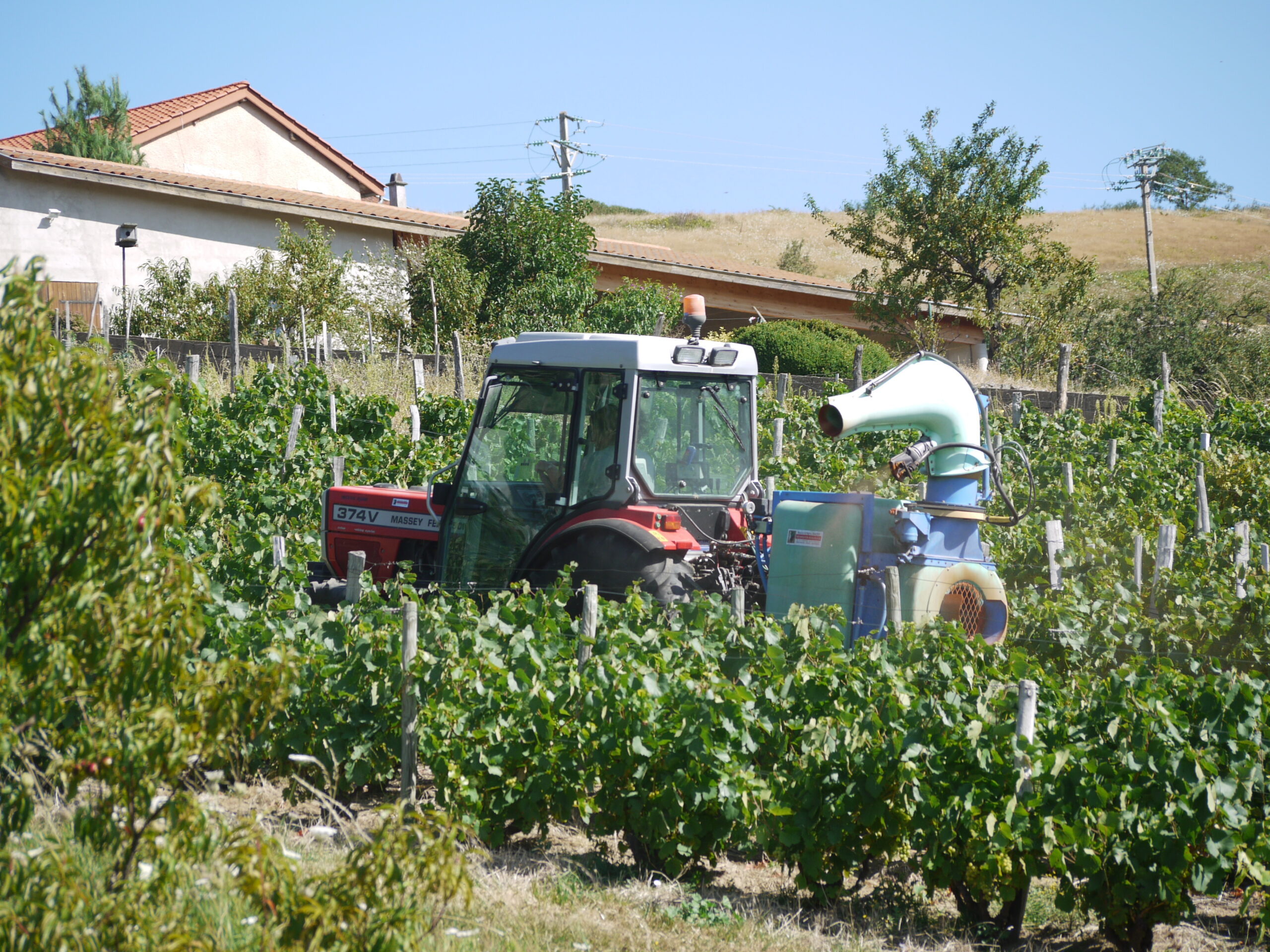
On the Olgaberg, a hill above Singen near Lake Constance, the summer of 2024 was spent spraying between showers. The site belongs to Staatsweingut Meersburg, a winery owned by the state of Baden-Württemberg, and it is the estate’s one organic vineyard. Rain came, the crew treated the vines, and more rain took the treatment off the leaves before it could do its work. By August the estate’s technical director, Otto Kopp, was estimating that 80 percent of the crop had gone to downy mildew. “It is a painful loss,” he told the Schwäbische Zeitung, “really almost a total failure.” The estate’s two conventional sites, at Meersburg and Gailingen, had no such problem.
The variable was the spray list. On an organic site in Europe, the fungicide against downy mildew is copper, and copper does not stay on a leaf in a wet year. That is its old weakness. Its newer one is legal: copper is, in the language of EU pesticide law, a candidate for substitution, a substance the regulator has formally flagged for replacement. Whether it ever will be is a more tangled question.
A Substance Flagged for Replacement
“Candidate for substitution” sounds like a countdown. It is not one. Under EU pesticide law it means approvals of no more than seven years at a time, against up to fifteen for an ordinary substance, and a test at product level: when a copper fungicide is authorized, and again at renewal, a member state must compare it with the alternatives and refuse or restrict it if something significantly safer does the job without serious cost. When the Commission renewed copper in 2018 under that label, it also imposed a cap: 28 kilograms of copper per hectare over seven years, an average of four a year, “in order to minimise the potential accumulation in soil.”
Like this? The TERROIR Letter arrives every Thursday.
The label has not produced a decision. The applications to renew copper past 2025 were filed in December 2022. By the summer of 2025, according to the Commission’s own implementing regulation, the member state assigned to review them was “still in the process of assessing the admissibility of the application for renewal.” Rather than let the approval lapse, the Commission extended it by 42 months, to 30 June 2029.
Meanwhile the flag itself is under review. The Commission’s expert group on organic production, EGTOP, wrote in its July 2025 report that it “expects that copper compounds will no longer be classified as ‘candidates for substitution’ in the future,” citing a presentation by the Commission’s health directorate in December 2024. The copper industry’s own account, in slides shown in Berlin in November 2025, is that the Commission and most member states appear to agree, but that a minority (Germany, Denmark, the Netherlands, and Austria) does not, and that the change may only take effect at renewal. The renewal is the file whose formal assessment, at the Commission’s last public word, had not yet begun.
What the Soil Keeps
Sprayed on leaves, copper washes to the ground and stays there. The Commission’s Joint Research Centre has mapped the result: vineyard topsoil across the EU carries a mean of 49.26 milligrams of copper per kilogram, against 16.85 for all land, the highest of any land-use category in the survey. At EU scale the same researchers put the net export of copper from soil at 0.29 kilograms per hectare, two orders of magnitude below a net accumulation of 24.8.
Concentration is not the same as harm, and the EGTOP report is careful on the point: “There is evidence that use of copper fungicides in organic viticulture at the currently allowed doses has limited or no impact on soil life.” Both findings can hold. The metal builds up; the biology, so far, appears to cope. Markus Dietz, an organic grower in Rheinhessen, put it to a regional broadcaster in the same wet August of 2024: “Actually we farmers ourselves want to get away from copper, because it accumulates in the soil. Three kilos of pure copper on 10,000 square meters is not a large quantity, but it builds up over the years, and really we do not want that at all.”
That instinct has produced a patchwork of private caps below the EU ceiling. Demeter International holds its members to an average of 3 kilograms per hectare per year over seven years, though vineyards and hop gardens in high-pressure regions may be granted up to 4. Bio Suisse balances 15 kilograms per hectare across the whole farm over five years. German press reports often cite a 3-kilogram limit; the regulator’s product conditions put the vineyard ceiling at 4 kilograms a year and 17.5 over five, with a reporting duty above 3. And as of 2022, five member states (Denmark, Sweden, Finland, the Netherlands, and Estonia) did not register copper as a plant-protection substance at all.
The Alternative That Keeps Being Refused
Ask an organic grower in Germany what would replace copper and the answer is a compound: potassium phosphonate. German organic viticulture used it as a “plant strengthener” from the 1990s until 2013, when the EU registered it as a pesticide active substance and the organic rules shut it out. In November 2024 Germany formally asked the Commission to admit it, backed by associations in Luxembourg, Austria, the Netherlands, and the Czech Republic.
In its July 2025 report, a majority of the Commission’s expert group advised against, not for the first time. The objection is not toxicity but identity. Phosphonate residues cannot be told apart analytically from those of fosetyl, a conventional fungicide, and the group warned that “the combination of synthetic manufacture, residues and similarity to conventional production might impact the credibility of organic production.” A dissenting expert cited research suggesting phosphonate could cut copper use by up to half. A French MEP, in a written question, argued the other side: admit a synthetic and consumers “cannot be told ‘no synthetic pesticides used’, which is the main promise organic farming makes to EU citizens.” In March 2026 two German MEPs from rival parties wrote to the agriculture commissioner asking for a science-based decision.
The other alternative is the vine itself. Fungus-resistant varieties, the PIWIs, need a fraction of the copper, but EGTOP adds a caution: “the shift of varieties is a medium- to long-term process that requires a redesign of the viticultural system and sometimes clashes with tradition and market requests.” Klaus Rummel, a Pfalz grower whose family estate has PIWIs on 80 percent of its 16 hectares, told SWR in 2024 that the remaining fifth, planted to classic varieties, could not do without copper.
Copper’s approval now runs to the end of June 2029. The Olgaberg will see two more full growing seasons before then, and half of a third, and any of them could be wet. In the dry ones the copper will stay on the leaves and do its work, and nobody will notice. In the wet ones the crew will be back out between showers, watching the rain take the metal off the vines and into vineyard soil of the kind that, across Europe, already holds nearly three times the continent’s topsoil average. The label may come off the compound long before the compound comes off the hill.
The TERROIR Letter
The story behind every bottle.
One feature. One dispatch. One bottle worth opening. Every Thursday — free.