

Late in the season, on the terraces of the Arroscia valley in western Liguria, the bunches of Pigato take on rust-colored freckles. The name records the fact. The Italian variety register’s 1964 description traces it to the Ligurian dialect word pigau, “which means spotted, precisely because of the presence of rusty patches on the berries,” and adds that the vine differs from the very similar Vermentino “in several botanical and fruit characteristics.” The freckles are the most visible of those differences.
In 1995 a paper in the journal Vitis ran Favorita from Piedmont, Pigato from Liguria, and Vermentino through DNA microsatellite analysis. Every cultivar in the study could be told apart “except Favorita, Pigato and Vermentino, thus supporting the hypothesis that all three are the same cultivar.” The same paper noted that the method “is in general not suitable for characterizing clonal differences.” So the freckles are real, the identity is settled, and the test that settled it was not built to see the freckles.
Italy’s register now reflects that. Vermentino, Pigato, and Favorita each hold a separate entry, and each entry lists the other two as official synonyms. One genome, three passports. What the passports record is not genetics but place, and the rulebook that comes with it. Follow the grape through its three western Mediterranean homes, two islands and a mainland coast, and the rock underfoot explains more than the name on the label.
Like this? The TERROIR Letter arrives every Thursday.
Sardinia: Granite, Written Into Law
Sardinia grows more Vermentino than any other region. The regional agency Laore counts 5,086 hectares in 2022, up from 2,486 in 1990, out of roughly 18,000 hectares worldwide. Italy holds about 9,860 of those and France about 8,130, which makes France a close second. That point returns below.
The fuller Sardinian style that gets described belongs to one corner of the island. Vermentino di Gallura, in the northeast, is Sardinia’s only DOCG, and its production rules put geology in the text: the only eligible vineyards are those “formed as a result of granitic decomposition and located at an altitude not exceeding 500 meters above sea level.” The technical file describes a granite subsoil under coarse sand, less than 700 millimeters of rain a year, and, near the coast, a wind that is “particularly salty.” The wine must be at least 95 percent Vermentino and reach 12 percent alcohol, 13 for Superiore. The island-wide Vermentino di Sardegna DOC is looser on both counts, asking 10.5 percent alcohol and allowing 16 tonnes of grapes a hectare against Gallura’s 10, so a bottle from Sardinia is not a bottle from Gallura.
Even in Gallura the name is negotiable. Capichera, at Arzachena, has made a pure Vermentino since 1980 and labels its flagship IGT Isola dei Nuraghi, not DOCG.
Liguria: Terraces, and a Quarrel About Texture
Across the Ligurian Sea, on the Riviera di Ponente, the vine grows under both of its Italian names at once. The Riviera Ligure di Ponente DOC keeps Pigato and Vermentino as separate wines, each at least 95 percent of the named grape, on vineyards “for the most part on terraced slopes, some of them steep.” The substrate changes valley by valley: conglomerate, limestone, and quartzite in the Savona hills and the western edge of Genoa province, calcareous-marl and clay turbidites around Albenga.
Some growers treat the two names as two crops. At Bruna, in Ranzo in the Arroscia valley, the only white grape is Pigato; Vermentino, PUNCH reported in 2016, “has never been planted in this region.” Francesca Bruna told the magazine that outside the area Pigato “loses its typical characteristics.” Which characteristics is the argument. In a blind panel PUNCH assembled that year, the Vermentinos “tended to be higher in acid, salty and herb-scented,” while the Pigatos were “richer in texture.” Paolo Ruffino of Punta Crena went further: Pigato “has more structure and can age 10 to 15 years,” while Vermentino “is meant to be drunk younger.” The writer admitted she had heard precisely the opposite. A single small tasting does not settle a style, and producers on the same coast do not agree with each other. Dario Cantù of UC Davis would not call Pigato a biotype at all, “rather ‘clones’ or ‘clonal variants’ of the same variety.” Whether a clone can carry a texture is the question the 1995 test declined to answer.
Corsica: Two Rocks, One Island
Corsica’s institutions make no claim to a separate grape. The island’s viticultural research center, the CRVI, states that “Vermentinu is identical to Rolle,” the name the variety carries in Provence, and the appellation texts register it as “vermentino B (malvoisie de Corse).” What is Corsican is the name and the ground.
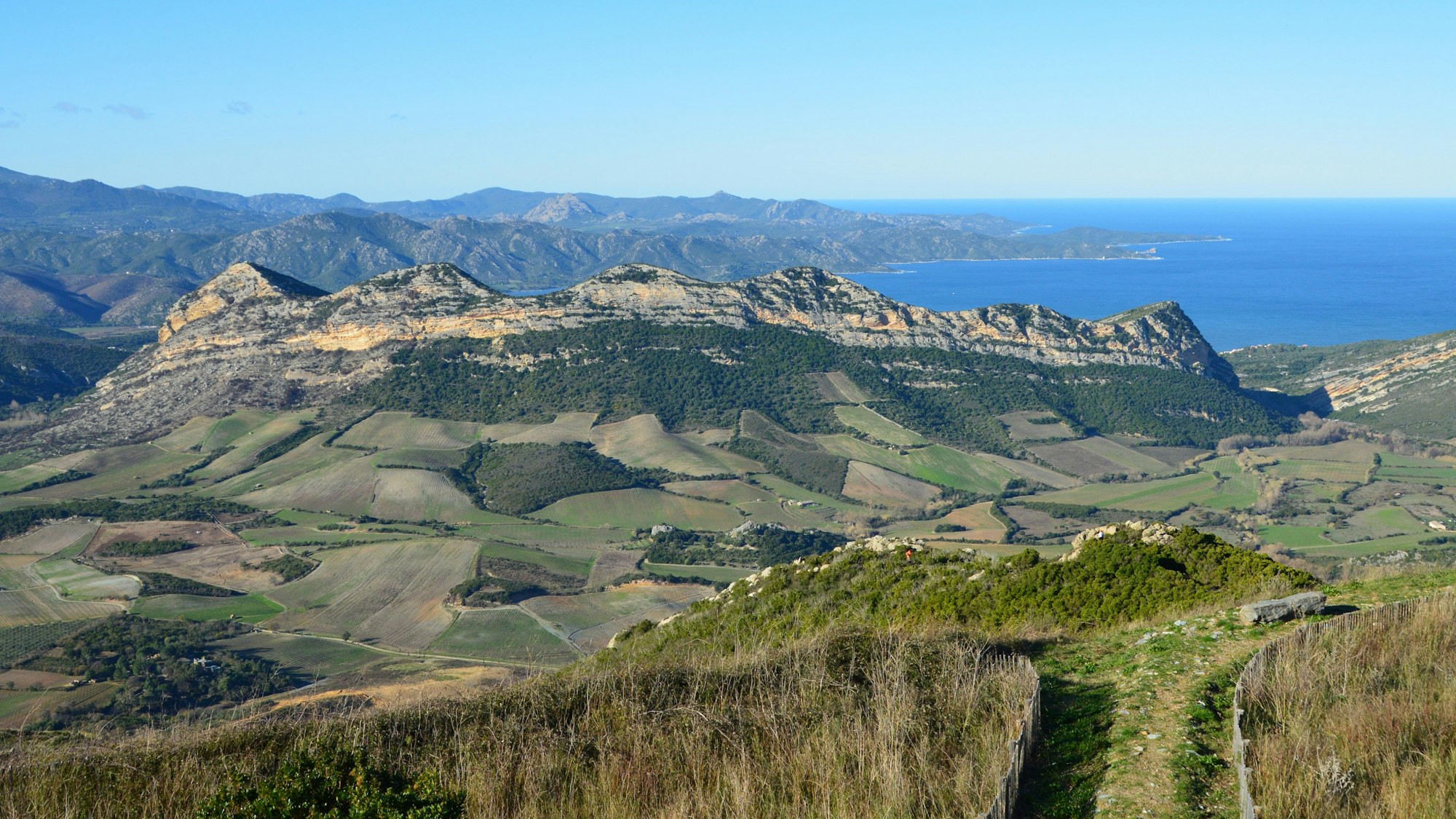
Patrimonio, in the north, requires its whites to be 100 percent Vermentino, on soils the appellation describes as “clay-limestone for the most part, to the west, very stony and schistous toward Poggio-d’Oletta, to the east.” Growers first asked for an appellation in 1942 and received it in 1968. Ajaccio, on the west coast, sits on ground “dominated by granitic terrain,” with “poor, dry, draining soils, with little water reserve,” and asks only that whites be at least 80 percent Vermentino. Corsica thus reproduces the Italian contrast within a single island: schist and limestone at Patrimonio, granite sand at Ajaccio, as in Gallura. Most Corsican volume comes from neither. INAO places 95 percent of the regional Corse appellation’s production on the eastern seaboard from Bastia to Solenzara.
Corsica is also a smaller part of the French story than its reputation suggests. The University of Adelaide’s vineyard database puts the island at about 1,370 hectares of France’s 8,130; the rest grows on the mainland. France now plants more than four-fifths as much of this grape as Italy, and in Provence, its largest French home, growers often call it Rolle.
What the Label Promises
Back in Sardinia, the boom has a cost. Laore’s 2026 report found Vermentino “the only variety showing an increase in cultivated area,” and over the same span since 1990 the native Nuragus fell from 8,658 hectares to 1,839. Ian D’Agata warned in 2018 that producers “are uprooting old vines to make way for more Vermentino plantings.”
The freckles on a Pigato bunch in the Arroscia valley are a fair emblem for the whole grape. They are visible, they are real, and the test that settled the grape’s identity was not designed to account for them. What the tests do show is that the varietal name promises less than it seems to. Vermentino, Pigato, Vermentinu: one variety. Granite below 500 meters, a terrace of turbidite, schist toward Poggio-d’Oletta: three wines. Read the appellation before the grape.
The TERROIR Letter
The story behind every bottle.
One feature. One dispatch. One bottle worth opening. Every Thursday — free.