

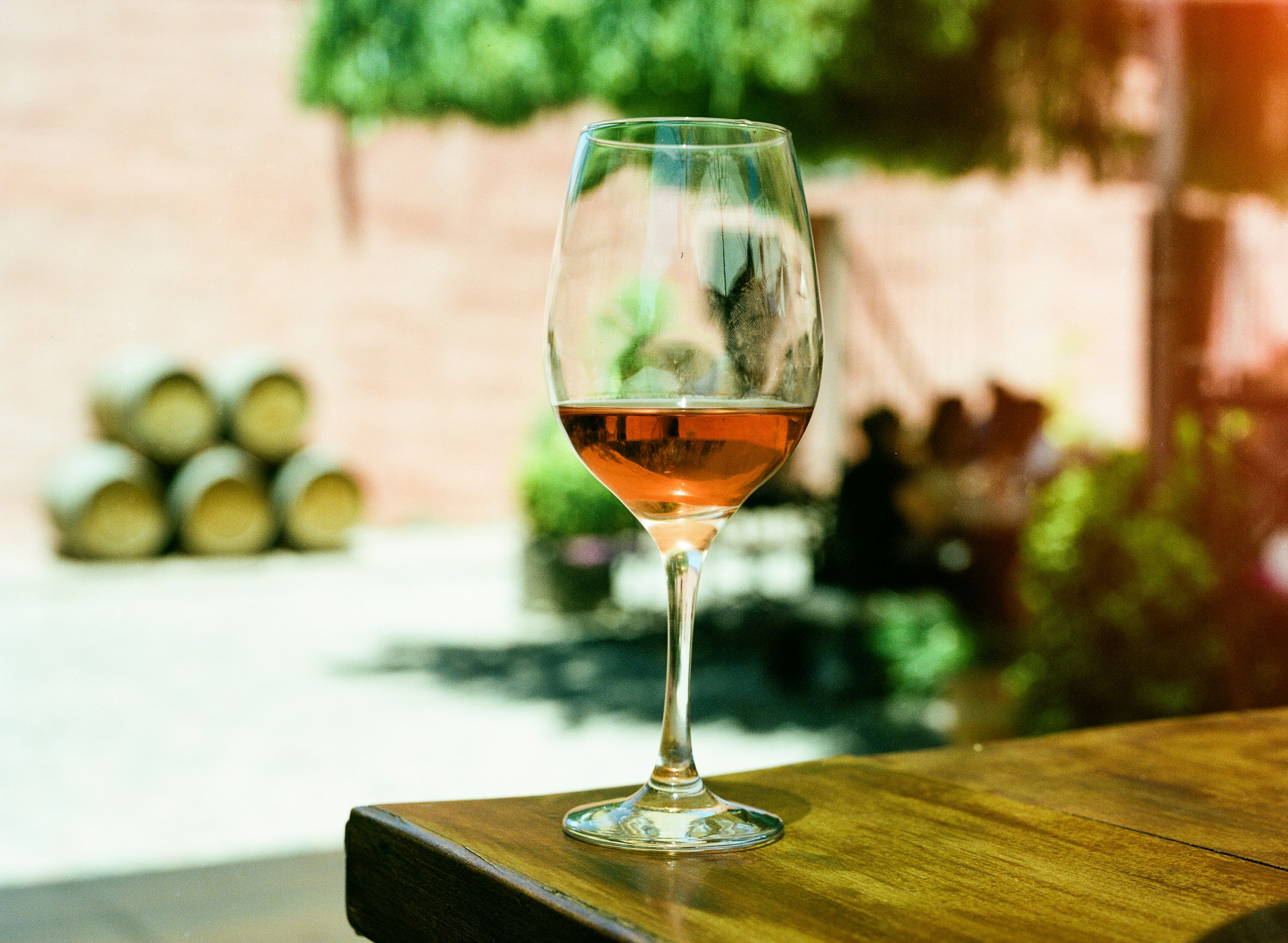
The rosé shelf is a gradient. Bottles run from nearly colorless through onion skin to something close to cranberry, and the instinct is to read that spread as a quality scale with the palest at the top. It is a reasonable instinct, and it is wrong. The color in the glass records a decision made in the cellar about what the producer set out to make, and frequently about what they set out to make instead.
Two Ways to Make Pink
Direct press is the straightforward one. Red grapes go into the press, whole or stripped from the stems, and the juice comes away after minimal contact with the skins that hold nearly all of a grape’s pigment. The wine is pink because the juice brushed past the skins on its way out. Provence, which built the template the rest of the world now imitates, works in two modes: the Conseil Interprofessionnel des Vins de Provence sets out direct press and a controlled skin maceration as its two main techniques, putting the maceration window at two to 20 hours at 61°F to 68°F (16°C to 20°C) before pressing.
Saignée works from the opposite end. A tank of red wine begins fermenting on its skins, and within the first hours the winemaker draws off a portion of the juice. Bleeding, literally. Commonly cited fractions run from 10 to 20 percent of the juice, the range the Australian Wine Research Institute reports. The Conseil Interprofessionnel des Vins de Provence puts it lower, at about 5 to 15 percent. The references genuinely disagree, and the spread is worth carrying. What remains behind now holds a higher skin-to-juice ratio, which concentrates its phenols. Whether that reliably produces a better red is less settled than the practice implies: the experimental literature on saignée is mixed, with some trials showing gains and others none. The juice drawn off is pink, and it becomes rosé.
Like this? The TERROIR Letter arrives every Thursday.
Two methods, two intentions. In the first, rosé is the product. In the second, rosé is what happens on the way to concentrating a red.
The Argument Is About Money, Not Flavor
The criticism of saignée is old and intuitive: a wine made as a consequence cannot match a wine made on purpose. It is repeated often and examined rarely. A more useful account arrived in 2023, when Costello, Deschênes, Kolstad, Plantinga, and Thomas published “The Economics of Saignée in Winemaking” in the Journal of Wine Economics. Their argument is that a technique long treated as a flavor question is structurally an economic one. Saignée, they write, “is fundamentally about economic tradeoffs between the quantity of primary wine that is ultimately produced, the quality (and thus, price) of that wine, and the amount of rosé wine that is bled off in the process.”
The model returns a result worth sitting with. Within their framework, except in corner cases, the profit-maximizing bleed is smaller than the quality-maximizing one. A producer chasing the best possible red would draw off more than one chasing the best possible return, because every liter bled is a liter of red that will not be sold as red. In their simulation the quality-maximizing fraction sits near 25 percent while the profitable fraction lands lower, and it moves with one variable above all: what the rosé itself can command. Where rosé is worth nothing, optimal bleeding falls to roughly 15 percent. Where rosé climbs past the ceiling price the model assigns the red, the optimum tips to the corner case: bleeding the entire tank.
That last case is worth naming. A winery bleeding everything is not concentrating a red at all; it is specializing in rosé, which is exactly how the authors read Provence’s rosé-first estates. The model’s most extreme setting turns out to describe a business, not a trick. These are model outputs, not field measurements, which is the honest way to hold them.
What the Color Actually Tells You
Color encodes skin contact, and skin contact encodes method. Neither encodes sweetness. Residual sugar is set by when fermentation is halted, a lever with no relationship to how long juice sat against a skin. A deep pink wine can finish bone dry and a nearly white one can carry noticeable sugar. Nothing about the hue will warn you.
Quality is a harder claim to attach to color, because color is doing something more specific than ranking. It reports extraction, and extraction predicts phenolics, weight, and texture with reasonable reliability. Longer contact means more color, more phenolic material, and often a trace of tannin the shorter route never picks up. What it does not reliably predict is fruit character, which owes more to variety, ripeness at harvest, and fermentation handling than to hours spent against a skin. So the gradient does encode something real about body. It does not encode better, any more than a scale running from Chablis to Meursault could.
The pale-equals-serious association is not a finding. It is a code, and an older one than the current Provence boom suggests: Elizabeth Gabay MW records that Émile Peynaud ran a color study in 1983 and found drinkers forgave a weaker rosé so long as it was pale. What changed since is reach. The Conseil Interprofessionnel des Vins de Provence says producers worldwide now feel pressured toward a paler style, and points to an AGREX-FranceAgriMer study in which, between 2013 and 2018, the darkest rosés fell from 51 percent of the market to 31 while the middle doubled from 16 to 32. Gilles Masson of the Centre de Recherche et d’Expérimentation sur le Vin Rosé puts the correction in one line: color in rosé indicates aroma and flavor style, not quality. A hue became a positioning decision, which is the same trick as any other quality proxy that substitutes an easily measured signal for a difficult judgment.
Reading the Shelf
The practical version is short. A pale wine has probably been pressed early or macerated briefly and will drink light, citric, and mineral. A darker one has probably had real skin time, whether by extended maceration or by bleeding, and will bring more weight and more phenolic grip. Whether it also tastes riper is a separate question the color cannot answer. Neither is a verdict, and the label will rarely tell you which you are holding.
Producers make the binary look tidier than it is. In SevenFifty Daily‘s 2018 survey of the methods, Stolpman Vineyards in California is filed under direct press but was bottling a “70-30 combination of direct-press vin gris and carbonic maceration,” which is a different animal. Raimat in Spain abandoned the choice altogether: its Clamor Rosado “is produced with 50 percent saignée and 50 percent direct press juice.” The clean cases were there too, Macari Vineyards in New York working from “whole-cluster pressed fruit” with a “short time in the press,” and Lapostolle in Chile where “whole clusters are gently pressed.”
Which returns the question to where it started, at the shelf, in front of a gradient that looks like a ranking and is not. The color is a record of what the producer was trying to do. Reading it as a score answers a question nobody in the cellar was asking.
The TERROIR Letter
The story behind every bottle.
One feature. One dispatch. One bottle worth opening. Every Thursday — free.