

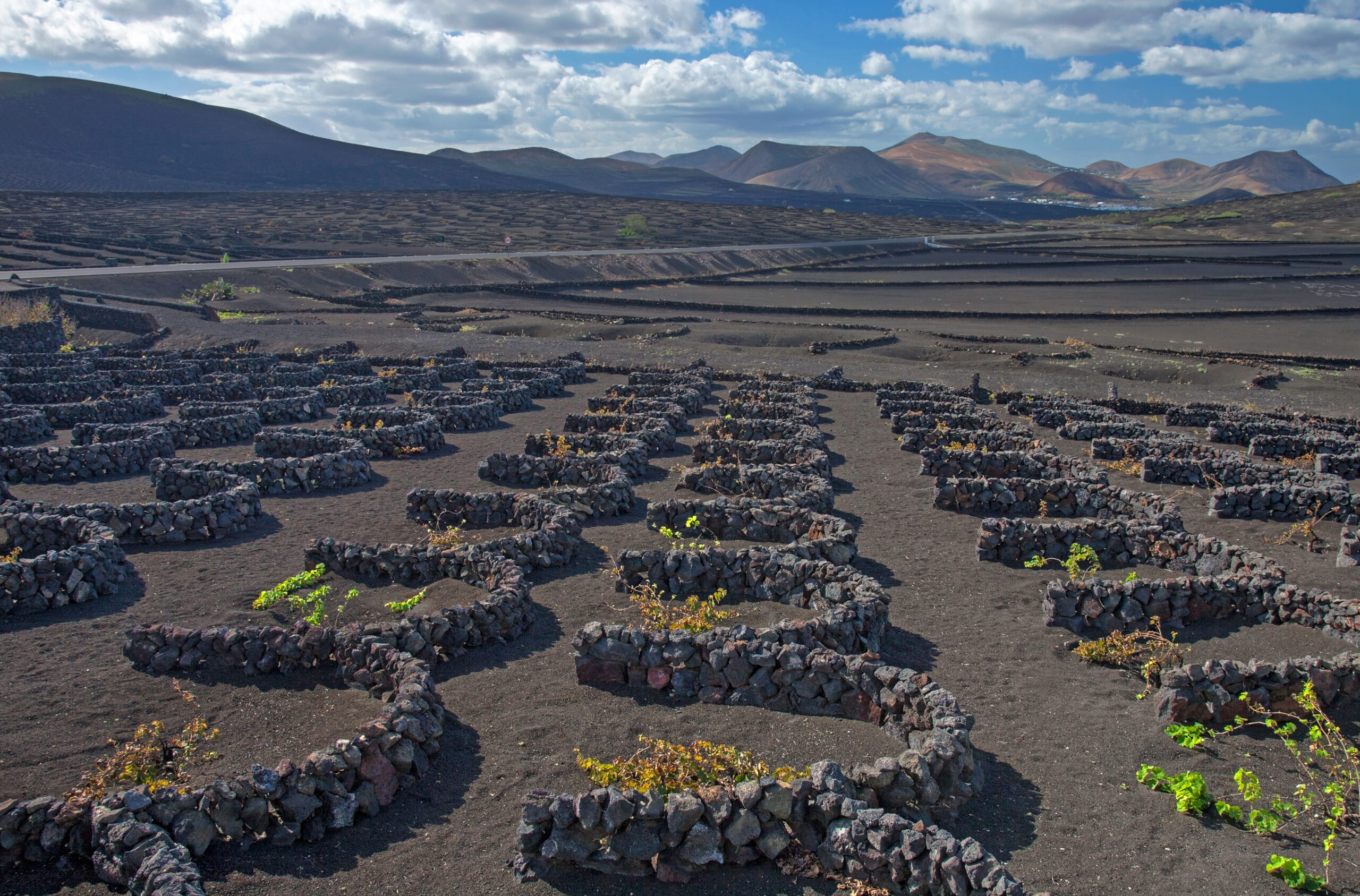
On Lanzarote, the depth of a hole now has a price schedule. Last October the island’s governing council approved a subsidy program for the growers of La Geria, the protected volcanic zone where each vine lives in its own hand-dug pit, and the aid is calculated on the depth of those pits. The deepest, beyond one and a half meters, earn the highest payment. Pits of intermediate depth, between one meter and one and a half, receive medium support. The shallowest, from thirty centimeters to a meter, get the smallest amount. The program is non-competitive: every grower who qualifies is paid, within the budget of $900,000 (€800,000) that the Canary Islands government and the island council are splitting. It may be the only agricultural subsidy in Europe priced by the shovel.
The Hole That Grows the Vine
The pits exist because the island exploded. The eruptions of 1730 to 1736 buried Lanzarote’s best farmland under black lapilli, and the growers’ answer was to dig down through the ash to the organic soil beneath, planting one vine per excavation. The hole shields the vine from the Atlantic wind; the lapilli traps what little moisture the air provides and releases it slowly. A crescent of lava rock stacked at each rim finishes one of the most photographed agricultural landscapes in the world.
It is also one of the least efficient. “The hoyos require constant maintenance, and all the work must be carried out manually,” says Juan Glaria, winemaker at Bodegas Rubicon. “You need to climb in and out of the pits constantly and, with planting densities so low, even working a single hectare takes a very long time.” The island’s appellation counts 1,889 hectares of registered productive vineyard across 1,821 growers, and the trend line bends the wrong way: the appellation’s own vine-maintenance series, a narrower measure than the register, records a fall from 1,839 hectares in 2002 to 1,481 in 2025, a decline of 19.5 percent. Nothing about the wine caused that. The labor did.
Like this? The TERROIR Letter arrives every Thursday.
The Second Force
Set La Geria beside Europe’s other heroic training systems and a pattern emerges that has little to do with romance or quality. Outside Naples, the alberata aversana, in which vines are married to poplars and climb past 10 meters, harvested by one person on a long, narrow ladder lowering a pointed wicker basket, has nearly vanished, surviving as a Slow Food Presidio for a single grape, Asprinio. In the Veneto, the bellussera, a high radial pergola from the age when vineyards also fed silkworms from the mulberry trees that supported the vines, now covers a shrinking share of the Piave appellation by the trade press’s account, and is still falling. In Rías Baixas, by contrast, the traditional granite-post pergola remains commercially alive, and Mauro Sirvent, head of agricultural production at Familia Torres, explains why without sentiment: “the Rías Baixas DO does not allow mechanized harvesting in any of its vineyards, so in terms of picking, all training systems require the same level of manual work anyway.”
That is the pattern. A landscape-defining training system survives only where a second force either makes mechanization pointless or pays for its absence: an appellation rule that bans the machine, a tourism economy that sells the view, a public subsidy, a heritage listing. The bellussera did not decline because its wine got worse; its director credits the system with weathering erratic climate better than modern trellises. It declined because the silk economy and the subsistence farming that justified its architecture disappeared. When the second force goes, the trellis goes, regardless of what is in the glass.
Pricing the View
Lanzarote is now assembling second forces deliberately, and stacking them. The subsidy is one. Tourism is another, and the growers are unsentimental about it: “Thousands of tourists visit us to see it and experience it for themselves,” says Alberto González Plasencia, owner of Bodegas Timanfaya. “If it were to disappear, those tourists would stop coming, and our wines would lose value.” A third arrived in 2025, when La Geria’s pit-and-ash cultivation became part of Lanzarote’s designation by the FAO as a Globally Important Agricultural Heritage System, a recognition of the island’s traditional volcanic-ash and sand farming as a whole.
The council president, Oswaldo Betancort, called the subsidy “historic and necessary so that our farmers can continue cultivating in the way that previous generations did,” and put the stakes in numbers: “La Geria is the viticultural heart of our island, with nearly 300,000 holes in production that concentrate more than 75% of Lanzarote’s vineyard surface area.” Read the depth schedule against that sentence and the logic of the program becomes clear. The deepest pits are the oldest, the most laborious, the most photogenic, and the most likely to be abandoned first. The subsidy does not pay for grapes. It pays, hole by hole, for the shape of the island.
What the Trellis Holds
Which returns to the craft question underneath all of this: what is actually being preserved when a trellis is preserved? Not the wine alone; the bellussera’s wine was never the problem, and Asprinio survives its dying architecture. What each of these systems encodes is a vanished set of reasons, wind and ash on Lanzarote, silkworms in the Veneto, and the labor arrangements that once made the reasons workable. A vineyard’s shape, it turns out, is an economic document. Where the original economics died, the shape persists only if something else agrees to underwrite it, a rulebook, a tour bus, a treasury.
There is something honest in Lanzarote’s version. No appeal to romance, no pretense that the pits pay for themselves. The island measured what it values, published a price band for it, and opened the applications. The grower climbs down into the hole either way. The difference is that now, for the first time since the ash fell, someone above ground is paying by the meter.
The TERROIR Letter
The story behind every bottle.
One feature. One dispatch. One bottle worth opening. Every Thursday — free.