

Neal Martin’s January report on the 2024 Burgundies contains a small experiment worth more than most tasting notes. One cuvée, split two ways: part of it raised in a Clayver, a ceramic vessel a few domaines are trialing, and part in a barrel that had held one previous vintage. The comparison, he wrote, reinforced a view he already held: that alternative vessels like ceramic, used on their own, render Pinot Noir “sterile and almost anaemic.” Winemakers trialing ceramic, he adds, share it.
Start there, because the story in Burgundy’s cellars is not the abandonment of oak. It is something slower and less photogenic: a long, uneven walk back from the idea that a serious red needs to spend its first year in wood that has never held wine. The 2024 vintage did not start that walk. It made it visible, and for once it made it cheap.
What 2024 Made Visible
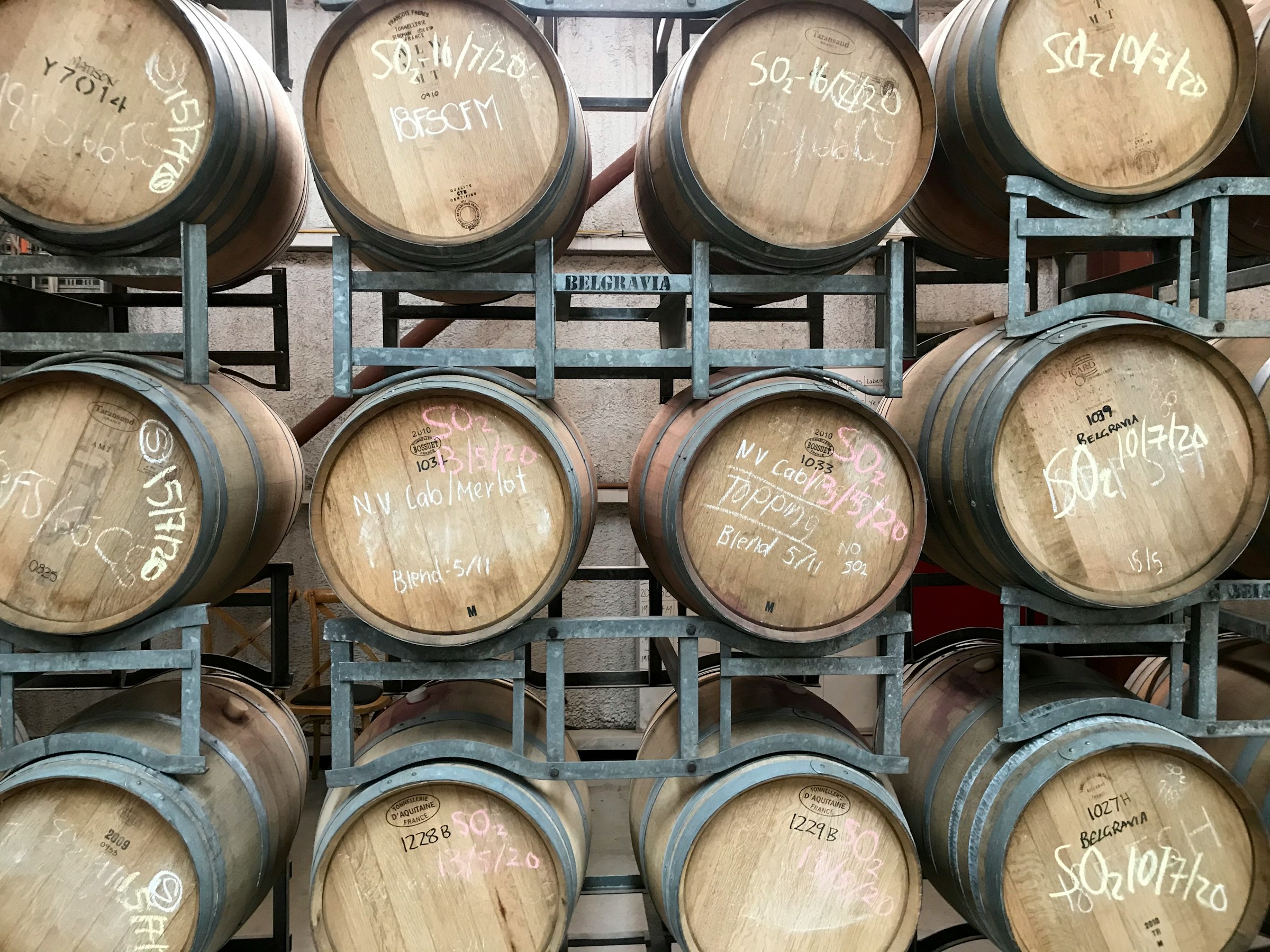
Martin’s summary of the vintage’s élevage is plain: “most winemakers dialled down the percentage of new oak.” What made the cut easy was inventory, not philosophy. As several winemakers told him, the decision “was made easy by the fact that many domaines had plenty of used barrels available after the 2023 vintage.” Two generous harvests had left the cellars full of barrels; a small, delicate 2024 arrived to find them waiting. The UK merchant Uncorked described “a widespread fear that a small proportion of new oak would make an excessive mark” on cuvées that in some cases ran to a few barrels.
Like this? The TERROIR Letter arrives every Thursday.
Not everyone had the choice. La Revue du Vin de France noted that while some estates announced a lower share of new barrels, “others had to honor past reservations with coopers and couldn’t adjust as they would have liked.” A barrel ordered in a generous year arrives regardless of what the next harvest brings.
Then there is Sarah Marsh MW, writing in The World of Fine Wine, who notes that you might have expected exactly the trend Martin describes, “particularly given the small crop following two large vintages for which producers would have bought more barrels,” and found the reverse. “On the contrary, certainly on the Côte de Nuits, many producers maintained their usual proportion of new oak or used more.” Small cuvées of one to three barrels, she found, “can be carrying anything between 50% and 100%,” which in her view “overwhelms this delicately structured vintage.” And a rule of thumb: “It’s always better to use more new oak on a cold vintage than a hot one, but 2024 was not a cold vintage.” Two critics, one winter, opposite headlines, and neither wrong. The Côte d’Or did not agree with itself, which is the truer picture of the retreat.
The Price of a Barrel
The economics are no longer a footnote. According to figures from the French coopers’ federation, reported by Réussir Vigne, the average price of a barrique rose from €811 to €949 between the 2022-23 and 2024-25 seasons. Réussir reports a 50 percent rise in the price of stave oak over two years, and the federation’s president, Magdeleine Allaume, pointed to volumes offered by the national forestry office down 30 percent and exports, particularly to China, up. At the level of a single domaine the gap is starker. Gilbert Felettig, as relayed by Uncorked, put a new barrel at €1,000 or more against roughly €250 for one that has done a vintage or two.
For a domaine bottling several small cuvées, the used barrel stops being a preference and becomes arithmetic. The coopers are feeling the wider squeeze too: Réussir’s headline on the data was that barrel sales were losing momentum, with volumes down 15 percent in 2024-25 as the wine trade’s troubles bit.
Where the Orthodoxy Came From
The idea that new oak was the default, outside a handful of top estates, was never very old. Henri Jayer, whose long shadow over Burgundy TERROIR has traced before, aged his wines in new barrels; when he adopted the practice is disputed among those who knew him. The 1980s and ’90s are better documented. Bill Nanson, speaking to GuildSomm, described Guy Accad in the 1980s and 1990s as a consultant who “liked to extract more, use more fresh new oak.” In Nanson’s telling, “the kids of the people who made wine in the ’90s were pulling back from new oak,” followed by a generation that “likes a bit more barrel, but they don’t want you to taste the barrel.” Jean-Marie Fourrier, in a 2019 merchant profile, was reported as seeing far too much new oak in 1990s Burgundy, and was then using 20 percent across his cuvées. Marsh traces the same arc in the whites, where the old answer to a rainy year was “chaptalizing, stirring the lees, and enriching flavor and texture with glossy new oak,” until “a sea-change since the Naughties, to more cleanly represent the vintage.”
More barrel but not the taste of it describes much of the present. Thibault Liger-Belair used at least 60 percent new oak “to give the mid-palate more roundness in 2024,” he told Marsh, but chooses his own trees and a “very light toast or blonde” so the wood does not announce itself. Pierre Trapet, in Martin’s account, went against the majority and used 100 percent new oak. Felettig himself, per Uncorked, kept to his usual 100 percent on all his premiers crus. Others changed the vessel rather than the percentage: Laurent Fournier and Benjamin Leroux raised their 2024s in larger barrels; Clayvers are on trial at Domaine d’Eugénie, J-L Trapet, and Leroux; and Arnoux-Lachaux has, in Martin’s phrase, carried out a “wholesale expulsion of traditional oak barrels” in favor of ceramic.
Reading the Tech Sheet
For a buyer, the tempting shortcut is the producer’s technical sheet, and Faiveley’s are a model of disclosure. The 2024 Chambolle-Musigny Les Fuées: “16 months in French oak barrels, 40-50% new oak, 50-60% second fill barrels.” Look up the 2023 sheet for the same wine and its aging line reads the same, word for word. Either Faiveley held its line on that cuvée in 2024, or the sheet is a template. The house’s own Vosne-Romanée sheet concedes the point, noting that the proportion of new oak “is susceptible to variations according to the vintage” and averages a third. A tech sheet tells you house policy. It does not measure the vintage in your glass.
Nor is it yet known how a red Burgundy raised mostly in second-fill wood behaves at five or ten years next to its higher-new-oak predecessors. The 2024 reds cannot answer; Martin calls them “not candidates for long-term cellaring,” and Marsh finds “limited aging potential.” That leaves the question open, and it is worth leaving open.
Return to Martin’s two samples. The vessel that won was not the ceramic now on trial as new oak’s successor. It was the one-year barrel, the kind of ordinary object that two big harvests left standing in cellars across the Côte. Burgundy’s retreat from new oak, when it finally became visible, ran not toward a new material but toward the wood it already owned.
The TERROIR Letter
The story behind every bottle.
One feature. One dispatch. One bottle worth opening. Every Thursday — free.