

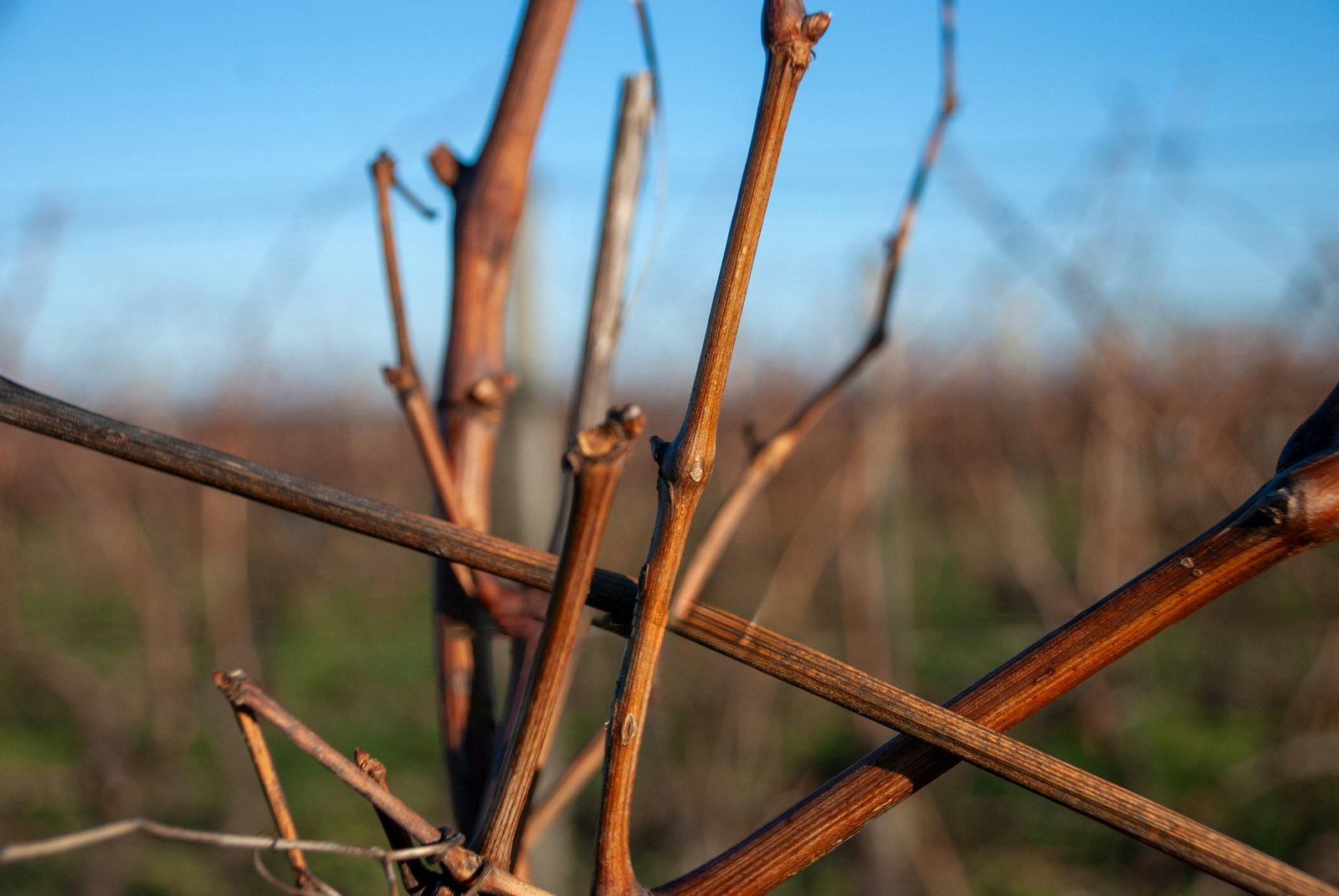
Every replanting begins with a decision that almost never makes it into a tasting note. A grower pulling out a vineyard has two places to get the new vines. One is the oldest, healthiest rows on the property, from which cuttings can be taken and propagated: massal selection, in the trade’s French-derived term. The other is a nursery catalogue, which lists certified clones by number, each descended from a single vine chosen decades ago and guaranteed free of the viruses that can hollow out a vineyard. The romantic account of this choice has long been settled. Cuttings are soulful, clones are industrial, and the second is slowly flattening the first.
The two institutions with real standing in the argument have each complicated it, three years apart, and in opposite directions.
The Charge
The first is a review article published in July 2026 in the journal OENO One under the title “Reviving grapevine massal selection in the context of climate change.” Its seven authors include Cornelis van Leeuwen of Bordeaux Sciences Agro, two scientists from Argentina’s national agricultural institute INTA, and four from the Catena Institute of Wine, the research arm of Bodega Catena Zapata in Mendoza. The Catena Institute and INTA funded the paper, which the reader should weigh: Catena’s own vineyards are the kind of massal holding the paper argues for.
Like this? The TERROIR Letter arrives every Thursday.
The review opens by giving the clonal system its due. In the 20th century, it states, “clonal and sanitary selection emerged as a decisive advance, delivering uniformity, health status, in particular with regard to virus diseases.” Then it turns. “Nevertheless, the widespread adoption of a narrow set of certified clones has led to significant genetic erosion, reducing the capacity of vineyards to buffer environmental fluctuations, adapt to climate change and resist to existing or emerging diseases and pests.”
The numbers it cites are stark, if secondhand. Drawing on a 2011 study, it reports that in Germany and France massal populations were so thoroughly replaced that “over 95 % of planting material became clonal.” It describes premium regions where “thousands of hectares are now planted with only a handful of clones of the same variety.” In genomic terms, the authors write, the clonal era “was a severe and largely irreversible bottleneck.” What was lost was “the irregular, the low-yielding, the agronomically inconvenient,” vines that may also have carried “tolerance to a pest that has not yet arrived.”
The Answer
The second institution is the one that actually runs French clonal selection. The Institut Français de la Vigne et du Vin, successor to the body that began the program in earnest in 1962, holds the national collection at the Domaine de l’Espiguette in the Gard and proposes which clones are approved for sale. In a 2023 explainer it had already answered the diversity charge directly. “Contrary to received and frequently propagated ideas,” the IFV wrote, “this method of selection offers important possibilities for improving and diversifying vine plant material, while preserving the characteristics and identity of the grape varieties.”
Its evidence is the register. France has approved 47 clones of Pinot Noir, 31 of Chardonnay, and 23 of Grenache. The clonal offering for those varieties, the institute argues, “is much more diversified than certain massal selections, for which prospecting is sometimes limited to only a few plots.”
The IFV also reminds its readers why the program exists. In 1944, the viticulturist Jean Branas set up France’s first selection service “to halt the catastrophic spread of fanleaf disease following the post-phylloxera vineyard reconstruction.” Fanleaf virus, carried by nematodes in the soil, had moved through replanted vineyards along with the cuttings growers took from one another. Certified clones offered what a cutting from a neighbor could not: a guarantee that the new vineyard would not inherit the old one’s disease. The institute still attributes yield declines in Burgundy and Champagne largely to fanleaf.
Then comes the sharper line. “It is all the more regrettable, therefore,” the IFV writes, “that some massal selection procedures are prized simply for the fact that they do not include the word ‘clone’.”
Where the Two Sides Already Agree
Read closely, the charge and the answer are not quite about the same thing. The OENO One review argues for resilience: a vineyard of many genotypes will weather a hot year or a new pest better than a vineyard of one. It concedes that “direct empirical comparisons between monoclonal and massal vineyards for vulnerability to specific stressors remain scarce.” The IFV argues for health and quality: a trial in 2005 and 2006, comparing single clones against blends of four to 15 clones, found that “in the vast majority of cases, the clone reputed to be the best is more appreciated than the blend.” One side is measuring risk over decades. The other is measuring the glass.
On the practical question, both institutions have already moved toward the middle. The IFV concedes that “in the case of certain rigorous massal selection initiatives using sanitary testing and observation of strains over several years,” the two approaches “can be considered similar.” The review proposes exactly that, under the name “Precision Massal Selection”: map a massal population’s genetics and viruses, remove only the badly infected vines, and certify the population as a whole. It points to Portugal, where selection bodies release groups of “7 to 20 genotypes” together. “What is lacking,” the authors write, “is the regulatory framework to make it operational.”
French nurseries are not waiting for the framework. The nursery Mercier has conducted its own massal selections since 2006, propagating only vines that test free of fanleaf and leafroll. Its deputy director, Laurent Hilaire, told the trade site Vitisphere in 2023 that the program “is an investment and adds an average 20% to the cost of the plants.” At the nursery Guillaume, massal Pinot Noir and Chardonnay now account for “a third of the nursery’s sales,” at a premium of 10 to 15 percent over clones of the same variety.
A Catalogue Is Not a Vineyard
One of the most vocal growers on this question is Laura Catena, whose family’s institute funded the review. “Most of the world went to mega clones after phylloxera,” she told Vitisphere in 2023, “but Argentina didn’t because we’re like an island.” No plant material entered the country for about a century, she said, until the 1990s. “Argentina has kept very diverse genetic material,” she added, “and I think that with climate change, we’re going to need all those genes.”
That is the argument the OENO One review makes at length. It is also, stripped of its framing, an argument the IFV accepts: the advice French breeders give growers, it notes, “systematically stresses the importance of planting several clones of the same grape variety on a plot.” The 47 Pinot Noir clones are there to be planted together. The question the review raises is whether they are. A catalogue that offers diversity and a vineyard that plants it are not the same thing, and no register counts the difference.
Back at the vineyard edge, the grower still has two places to look. The old rows carry whatever the property has always carried, disease included. The catalogue carries a guarantee, and a narrower inheritance. The honest version of the choice between massal selection and the clone catalog is no longer soul against industry. It is which risk the grower prefers to live with for the next forty years, and in a warming climate the answer the 20th century could afford may not be the one the 21st can.
The TERROIR Letter
The story behind every bottle.
One feature. One dispatch. One bottle worth opening. Every Thursday — free.