

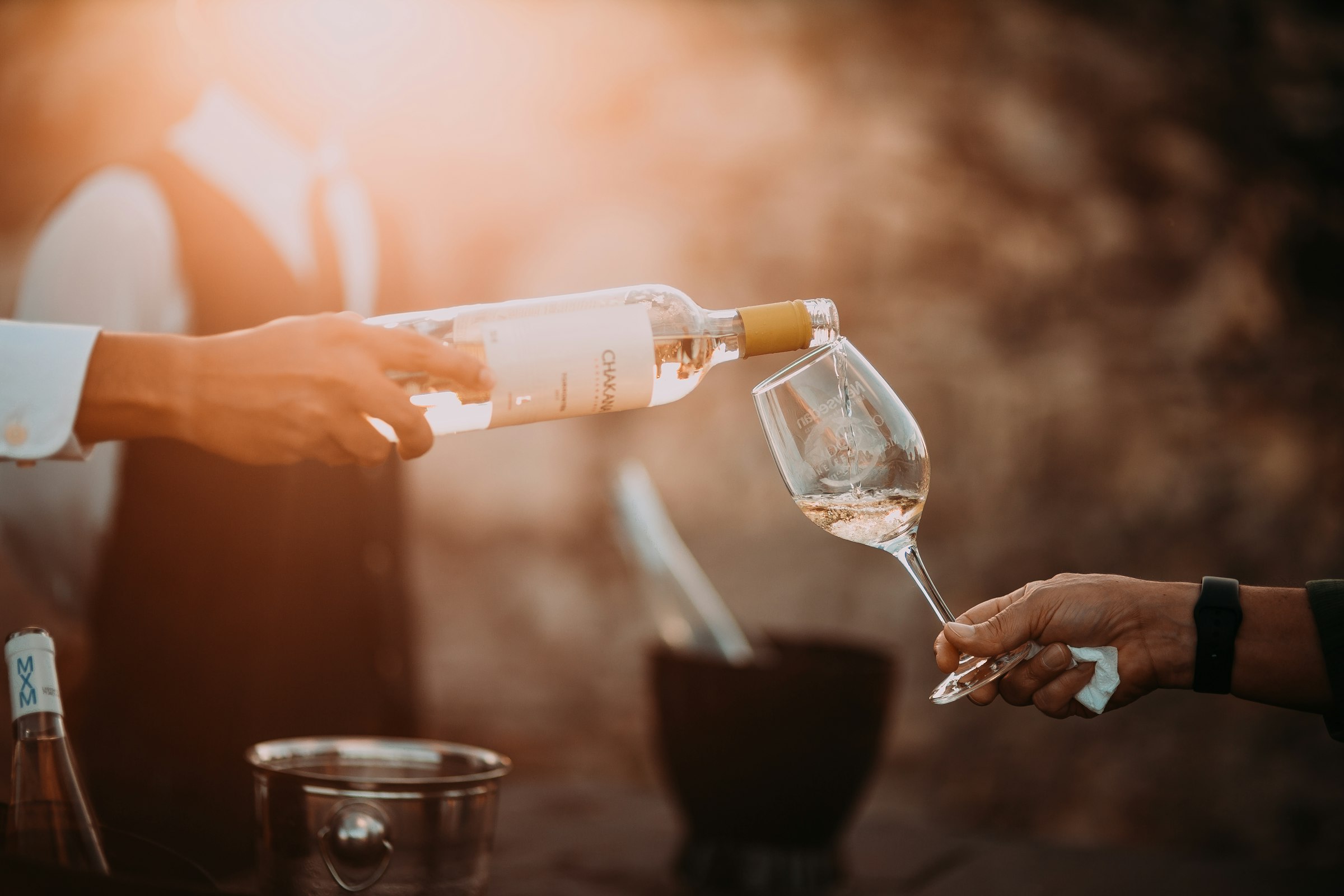
The crown cap is the tell. Lift a bottle of pétillant naturel out of an ice bucket and what stares back is the same closure used on a bottle of lager: a corrugated metal cap, pressed cold, no cage, no foil, no wire muselet doing its slow argument with the cork. Pop it and the bottle may answer with a polite hiss or a fountain of foam halfway up the table; the wine inside may arrive clear or hazed with lees, dry or faintly off-dry, six atmospheres of pressure or barely two. Champagne built its reputation on the opposite of all of this: slow second-fermentation refinement, riddling, disgorgement, precise dosage adjustment, the same bottle of Brut tasting the same in Tokyo as in Reims. That reliability is the thing pét-nat declines to provide, and the refusal is the point.
The question is not whether pét-nat is a cheaper, looser version of Champagne. It is whether méthode ancestrale and méthode champenoise are the same kind of wine at all.
The older method
Méthode ancestrale is, as the name advertises, the ancestral method. The earliest documented sparkling wines in Europe came out of Limoux, in the Languedoc foothills near Carcassonne, where Benedictine monks at the Abbey of Saint-Hilaire are credited with the technique in the 1530s. Their wine, what is now called Blanquette de Limoux méthode ancestrale, predates the codification of méthode champenoise by roughly a century and a half. Dom Pérignon, the Hautvillers cellarer whose name has become shorthand for Champagne’s invention, did not begin work in the Marne until the 1660s, and the controlled second-fermentation method that bears the region’s name was not refined into its modern form until the eighteenth and nineteenth centuries. Champagne, in other words, is the younger sibling.
Like this? The TERROIR Letter arrives every Thursday.
The chronology matters because it explains the technical distance between the two methods. Méthode ancestrale is a single fermentation interrupted. The vigneron chills the partially fermented wine, slowing the yeast before it has converted all the sugar, then bottles it. Fermentation resumes inside the bottle as the wine warms, the carbon dioxide stays trapped, and the wine finishes its sugar conversion in the same vessel the drinker eventually opens. There is no addition of liqueur de tirage, the sugar-and-yeast inoculation that triggers Champagne’s secondary fermentation. There is no riddling, no slow turning of bottles upside down to settle the lees into the neck. There is no disgorgement, no flash-freezing of the neck to eject a plug of dead yeast. And there is no dosage, no final adjustment of sweetness, no chance for the cellar to tune the wine into a house style on the way out.
What goes into the bottle is, broadly, what comes out. The lees stay. The pressure varies. The wine itself is a snapshot of a single fermentation arrested mid-stride.
What the second fermentation buys
It is worth being honest about what Champagne’s two-fermentation process delivers and what méthode ancestrale gives up. The slow, cool second fermentation in bottle, followed by months or years on the lees, develops a particular set of textures: fine persistent bead, an autolytic brioche character, a creamy mid-palate that softens the wine’s high acidity. Riddling and disgorgement produce a clear pour. Dosage lets the cellar compensate for vintage acidity, balancing bone-dry base wines into something the market can drink. The result is a beverage of remarkable consistency. A grower Champagne and a Grande Marque Brut are radically different wines, but each behaves predictably within its own house from one bottling to the next.
Méthode ancestrale buys none of that. It also costs none of that. The single fermentation produces a coarser bead and a more variable mouthfeel; residual lees produce haze and, sometimes, a yeasty funk that reads as flaw to a palate trained on Champagne and as character to one trained on natural wine. The pressure is lower and less stable. The bottle that arrives slightly fizzy and the bottle that erupts in a six-inch column when opened are nominally the same wine. The trade is straightforward: drinkers give up consistency and get, in return, a wine that tastes more directly of its fruit and its yeast and the season it was made in.
These are different propositions. The mistake is reading one as the lesser version of the other.
Why the natural-wine movement raised this flag
The contemporary pét-nat boom dates to roughly the late 1990s and early 2000s, when a small group of Loire vignerons (Christian Chaussard in Vouvray is often named as the figure who coined the modern abbreviation) began making single-fermentation sparkling wines as a side project to their still production. The timing matters. The natural-wine movement was consolidating around the same set of commitments: minimal intervention, native yeast, low or no sulfur, transparent farming, an editorial preference for the variable over the polished. Méthode ancestrale fit those commitments almost perfectly. The method requires no commercial yeast additions; the in-bottle finish makes sulfur additions difficult and largely unnecessary; the lack of dosage means no industrial sugar at the end. A pét-nat that goes to bottle is a wine that has decided, by its production logic, not to be corrected.
That is the editorial reason the bottle became the natural-wine movement’s flag. Champagne, even the small-grower Champagne that natural-wine drinkers often admire, is by definition the product of intervention: of triage, of timing, of decisions made in the cellar long after the grapes left the vine. Pét-nat is the wine that publishes the unfinished draft. The wine that lets the fermentation finish in front of the drinker, audibly. For a movement that defines itself against the corrective hand of conventional cellar work, the bottle is the cleanest available argument.
It is also why the wine reads as polarizing. A drinker who values the bottle’s transparency reads its haze and pressure variation as honesty. A drinker who values the cellar’s craft reads the same haze as failure. Both are responding to the same property of the method, and both are, by their own lights, correct.
The map widens
For most of the modern revival, the conversation was a Loire conversation. Vouvray, Montlouis, Touraine, Saumur: Chenin Blanc on tuffeau limestone, sometimes Cabernet Franc or Grolleau on the schist further south. Those producers shaped the canonical pét-nats of the early 2000s and remain the reference point.
The map is now broader. Limoux still makes Blanquette de Limoux méthode ancestrale under appellation rules that protect the older method as a named style. Bugey-Cerdon, in the eastern Jura foothills, produces a faintly sweet rosé pét-nat from Gamay and Poulsard. In Italy, a wave of younger producers in Emilia, long the home of Lambrusco, has embraced the explicit pét-nat label on wines that were already built on a closely related ancestral logic. Producers on Long Island, in the Finger Lakes, and across a scatter of California natural-wine cellars are now making méthode ancestrale bottlings from Riesling, Chenin, Pinot Noir, and other grapes, often in editions of a few hundred cases that sell directly to wine bars before they reach a shelf.
The pattern is consistent. Méthode ancestrale tends to take hold in cooler-climate areas where acidity is the natural baseline, in producer cultures that value individual bottlings over house-style consistency, and in markets willing to absorb variability as a feature.
A different argument about sparkling wine
The instinctive comparison to Champagne is the wrong frame, and pét-nat does not benefit from being asked to win it. Champagne’s logic is corrective and aggregative: the cellar takes a high-acid, lean base wine and, through a long chain of interventions, builds something more refined than the starting material. Méthode ancestrale’s logic is subtractive: the cellar does less, and the wine that emerges is closer to the grape it came from than a Brut Champagne ever could be.
Asking whether one is a downgraded version of the other is the same category error as asking whether a slate-aged Mosel Riesling is a downgrade from a barrel-aged white Burgundy. They are wines built on opposite premises about what intervention is for. The fact that both happen to fizz is a coincidence of carbon dioxide, not a shared editorial project.
The pét-nat question, then, has an answer. No, it is not lower-stakes Champagne. It is an older method, a different premise, and a wine arguing on its own merits, which, properly understood, are not the merits Champagne is arguing for at all.
The TERROIR Letter
The story behind every bottle.
One feature. One dispatch. One bottle worth opening. Every Thursday — free.