

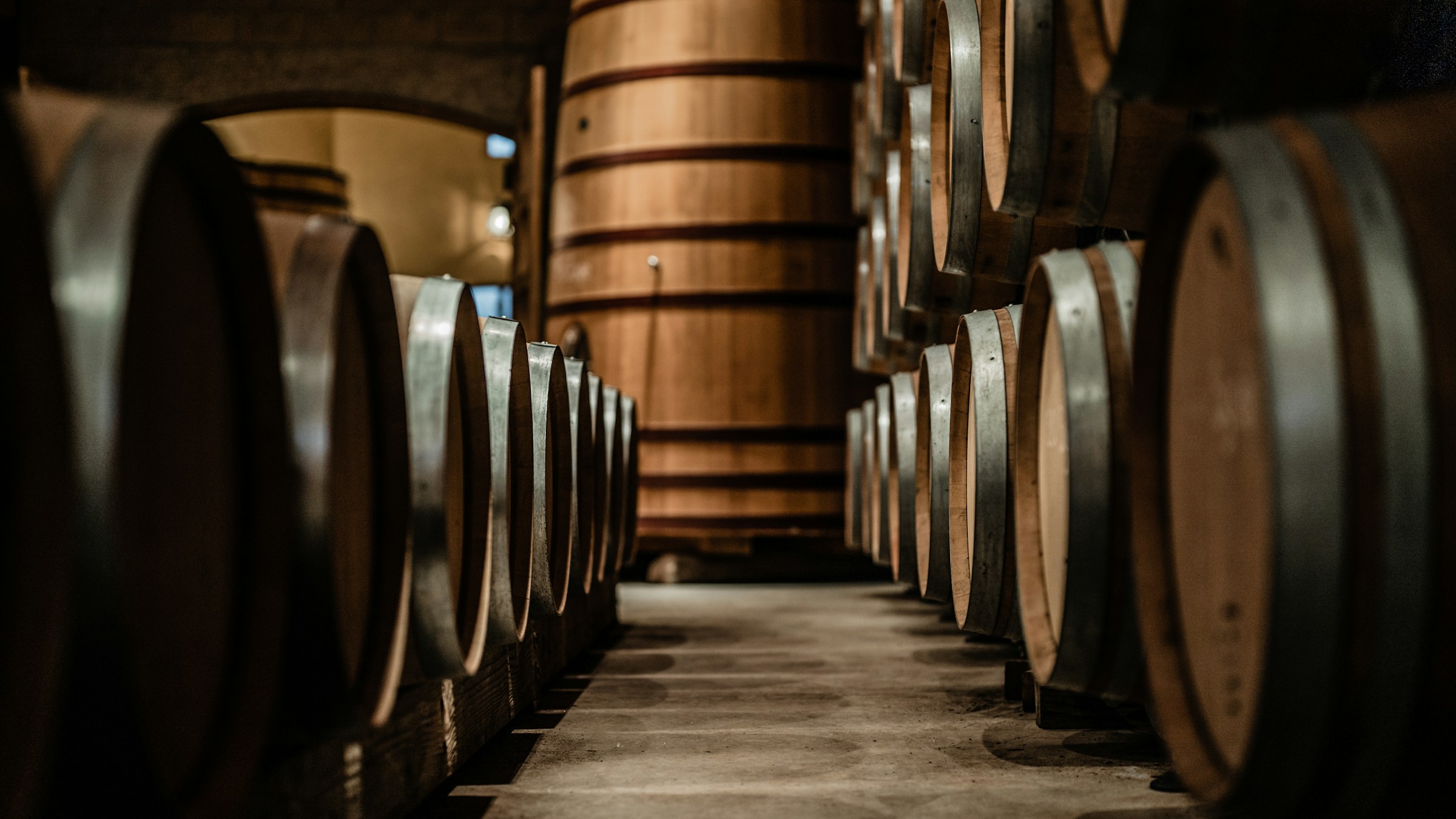
Somewhere around 2011, a generation of American Chardonnay drinkers stopped ordering Chardonnay. The phenomenon had a name, ABC (Anything But Chardonnay), and it had a flavor: butter. Specifically, the cushion of warm-popcorn richness that had become the house style of California Chardonnay across the previous decade. The wines were not flawed; they had simply converged on a single profile so completely that drinkers began ordering around them. What very few of those drinkers knew, and what the producers knew exactly, is that the butter was not coming from oak. It was coming from a bacterium.
That bacterium is Oenococcus oeni, and the process is malolactic fermentation, often shortened to ML or malo. It is one of the most consequential, and most quietly managed, decisions in white winemaking. Almost every red wine has been through it. Most Rieslings and Sauvignon Blancs have not. Chardonnay is the battleground where the choice is most visible.
Two fermentations, one wine
The first fermentation, the one most drinkers picture, is yeast-driven. Saccharomyces cerevisiae converts grape sugar into ethanol and carbon dioxide over a matter of days or weeks. Malolactic fermentation is something else entirely. It is not fermentation in the textbook sense at all, because no sugar is involved and very little energy is released. It is a bacterial conversion of one acid into another. Oenococcus oeni takes malic acid, the sharp green-apple acid native to the grape, and decarboxylates it into lactic acid, the softer acid associated with yogurt and cheese. A molecule of CO2 is released per molecule of malic acid converted, which is why a barrel in malo will quietly hiss if you listen close.
Like this? The TERROIR Letter arrives every Thursday.
The acid math is the headline change. Malic has two acidic protons; lactic has one. The wine loses titratable acidity, the pH rises, the mouthfeel softens. A Chardonnay that tasted like cut Granny Smith in November can taste like baked apple by April.
The side reaction is where Chardonnay’s reputation got made and unmade. O. oeni also metabolizes a trace amount of citric acid, and one of the intermediates is diacetyl: 2,3-butanedione, the compound the food industry uses to flavor microwave popcorn. In wine, diacetyl is the smell of butter.
Why butter reads on Chardonnay and almost nowhere else
The reason buttery is a Chardonnay descriptor, and almost never a Cabernet descriptor, is not that red wines lack diacetyl. They are full of it. The molecule simply disappears underneath everything else. Published thresholds put diacetyl perception in Chardonnay at roughly 0.2 milligrams per liter; in Cabernet Sauvignon the threshold sits closer to 2.8 milligrams per liter, more than an order of magnitude higher. Tannin, anthocyanin pigments, and the broader phenolic load of a red wine mask the buttery note almost completely. A Chardonnay, stripped of those compounds, lets diacetyl walk to the front of the glass. The same bacterial process is happening in both wines. Only one of them tells the drinker about it.
The California arc
Through the 1990s and 2000s, full malolactic conversion paired with new-oak barrel aging became the default California Chardonnay playbook. Diacetyl from the bacterium, vanillin and lactones from the oak, and a softened acid spine produced a wine that read as luxurious in a single sip and sold accordingly. By the late 2000s the style had saturated the category to the point of self-parody.
The pushback was not subtle. Sommelier lists tilted toward Chablis and Mâconnais. Domestic producers began advertising “unoaked” and “no malo” Chardonnays as a point of identity. By the mid-2010s a partial-malo style had emerged as a compromise: a portion of the wine, often 30 to 60 percent, taken through ML, the rest blocked and held in stainless steel. It is the dominant premium California style as of this writing, and it exists because diacetyl is now something producers measure, not something they accept.
How producers actually control it
Controlling malolactic fermentation is mostly about controlling Oenococcus oeni itself. Four levers do most of the work.
Temperature. The bacterium prefers cellars in the high 60s Fahrenheit. Below 60, conversion stalls. Producers who want no ML keep the wine cold through spring; producers who want a clean conversion warm the cellar.
Inoculation timing. A producer can pitch a cultured O. oeni strain co-inoculated with the yeast or sequentially after alcoholic fermentation finishes. Co-inoculation tends to produce less diacetyl: the yeast is still active and reduces diacetyl back to its odorless precursors. Sequential inoculation, with the yeast gone, leaves diacetyl in place.
Sulfur dioxide timing. SO2 inhibits O. oeni. To block malo entirely, a producer adds SO2 early and aggressively, sterile-filters, and holds cold. To split a partial blend, they pull a percentage off and dose it to lock the bacterium out, then let the rest finish.
Stirring the lees. Bâtonnage keeps the wine in contact with spent yeast cells, which scavenge diacetyl. A heavily stirred Chardonnay through ML can end up less buttery than a still one. The widely held assumption that bâtonnage adds richness is half the story; it also subtracts butter.
Why most reds go through it, and most aromatic whites do not
Red wines almost always complete malolactic fermentation, and most of the time it is not actively managed. Reds are typically pressed and barreled at higher pH than whites, which is hospitable to O. oeni; they sit in cellars through a warming spring, which the bacterium reads as a green light; and because the diacetyl reads silently against the phenolic backdrop, the producer has little incentive to fight a process that softens harsh malic edges at no flavor cost.
Aromatic whites run the opposite playbook. Riesling depends on a sharp acid frame to carry its volatile aromatics; converting malic to lactic flattens the structure the variety is grown for. Sauvignon Blanc carries thiols, methoxypyrazines, and a citrus-leaning profile that ML mutes more than it complements. In both cases the producer cools the wine, adds SO2, and holds the bacterium out.
What to taste for
A wine through full malolactic conversion reads rounder on entry, lower in apparent acidity, and longer in the mid-palate than a counterpart blocked at the same point. Diacetyl, when present at a perceptible level, sits in the nose as a smell most drinkers recognize before they can name it: warm butter on toast, the inside of a movie-theater popcorn bag, a fresh croissant. In a Burgundy from a cool vintage it can register as caramel rather than butter, the same molecule reading differently against a different acid backdrop.
The skill is in noticing whether the butter is the wine’s center or its margin. A full-malo, full-new-oak Chardonnay puts diacetyl at the front of the glass. A partial-malo wine uses it as background. A blocked-malo Chardonnay (the Chablis model, the white Burgundy of a steely vintage) has none of it, and the absence is the point.
Once a drinker can hear the bacterium in the glass, the category stops being one thing. It becomes a set of decisions, made in a cool cellar in March, by a winemaker watching a pH meter and listening for a barrel that has started to hiss.
The TERROIR Letter
The story behind every bottle.
One feature. One dispatch. One bottle worth opening. Every Thursday — free.