

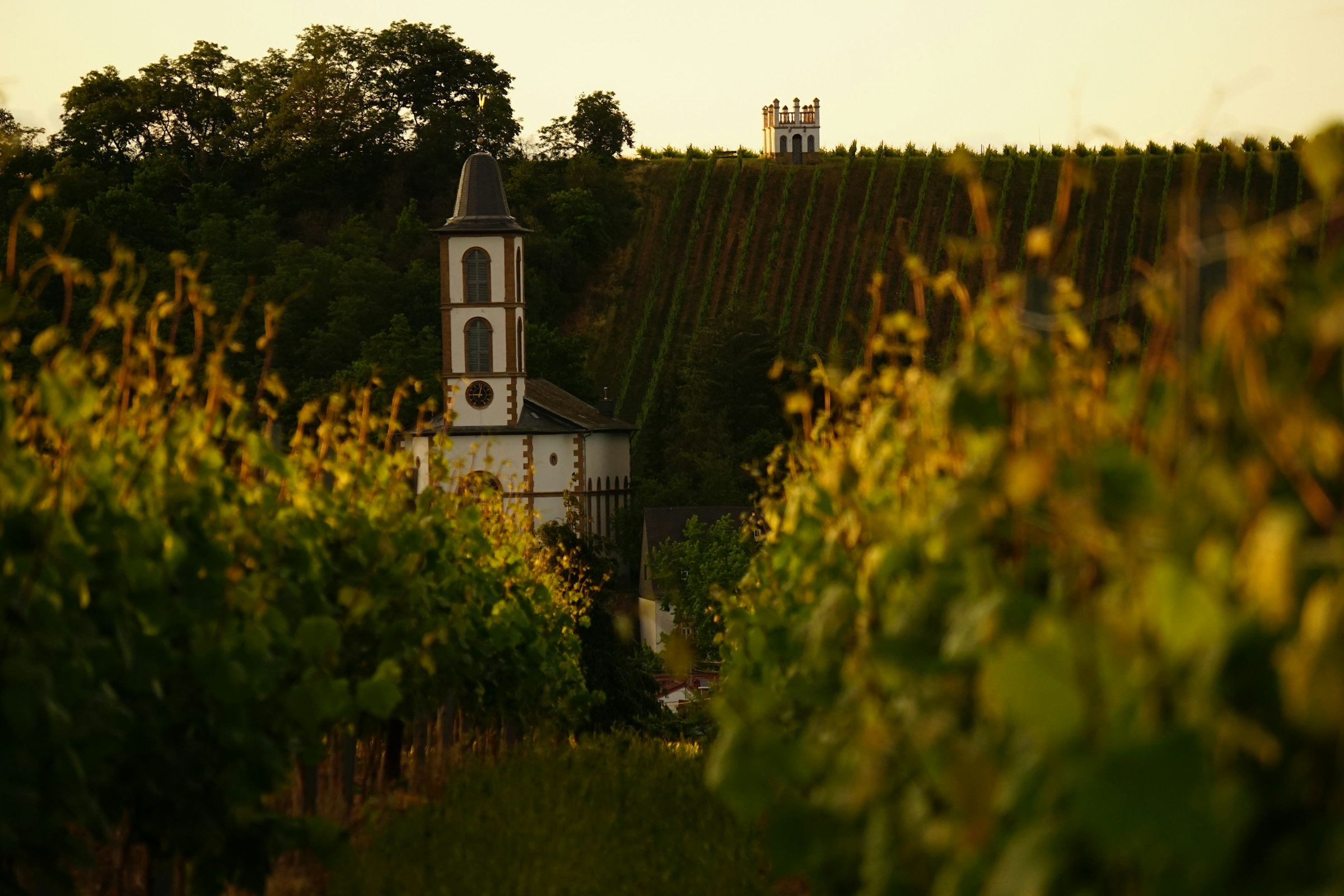
A geologist with a four-pound rock hammer stands on a south-facing terrace above the Mosel and brings the head down on a clean outcrop. The slab splits along its bedding plane and shows, on the fresh face, the deep blue-grey that gives the dominant rock of the Mittelmosel its trade name. Twenty kilometres downriver, the same gesture on a different outcrop above the village of Ürzig opens a face that is rust-coloured, iron-streaked, several shades warmer in the late-September light. Same age. Same parent material. Same compressed seabed, four hundred million years gone. Two different colours, and two different wines.
The Mosel is the closest thing the wine world has to a single-variable experiment in soil colour. The grape is held constant: Riesling, the same clones moving across the same valley. The aspect is held within a narrow band: south-facing slopes, the same continental-cool climate, the river acting as thermal buffer. What changes between one Einzellage and the next is the colour of the rock under the vine. The trade has spent two centuries arguing about whether that change can be tasted in the glass, and the answer is more interesting than the dismissive version (marketing) or the credulous version (proof).
The geology, briefly
The soil of the Middle Mosel is predominantly Devonian slate, the metamorphosed product of a shallow seabed that lay across what is now the Rhineland in the early Palaeozoic. Three variants are visible across the appellation. Blue slate (Blauschiefer) is the dominant rock, the deep grey-blue substrate of Bernkastel, Wehlen, Graach, and Zeltingen. Red slate (Rotschiefer) is iron-oxide-enriched, concentrated in the lower Cochem district and in a band of the Mittelmosel anchored by Ürzig. Grey slate (Grauschiefer) and quartzite appear in lower proportions.
Like this? The TERROIR Letter arrives every Thursday.
The Cochem district, in the lower Mosel near the confluence with the Rhine, sits on a mixed substrate of blue Devonian slate, red slate, and quartzite, and houses some of the steepest vineyards in the region. Slope angle, aspect, and substrate are not fully separable variables in the Mosel: a red-slate site is usually a particular site, with its own gradient and microclimate, and the wine off it is the product of all three. The colour is the cleanest variable to name. It is rarely the only one moving.
What the trade reports tasting
The cleanest case is the village of Ürzig, where the Ürziger Würzgarten is the iconic red-slate site of the region, and the village of Wehlen, a few kilometres upriver, where the Wehlener Sonnenuhr is one of the most celebrated blue-slate vineyards in Germany. A producer working both plots will pour the two side by side; the contrast is the standard demonstration.
The blue-slate Riesling typically reads cooler. Citrus and white-flower aromatics. A vertical line of acidity. Wet-stone minerality on the finish, the quality the trade has been calling Schiefermineralität for as long as German wine has been written about. The red-slate Riesling reads warmer. Yellow stone fruit. A rounder mid-palate, sometimes a faint spice note, more density of texture. Same vintage. Same producer. Same cellar regime. The variable that moved between the two glasses was the colour of the rock.
The trade consensus on why is hedged. Iron oxide in red slate is a darker absorbing surface, which alters heat retention at the soil-air boundary in marginal vintages. Iron-rich soils also affect water retention and root behaviour. None of those mechanisms operates in isolation: red-slate sites usually sit on slightly different exposures and elevations than the blue-slate benchmarks, and vine age, clonal selection, and producer stylistic preference move in parallel with the substrate. The honest version is that the contrast is real and reproducible at the level of a careful taster working with a single producer’s plots, and that the soil colour is one input among several that the contrast indexes.
The Bernkasteler Doctor question
Doctorberg, the vineyard that gives Bernkastel its single most recognisable wine, sits in the central Mittelmosel on blue Devonian slate. Bernkasteler Doctor anchors the standard Mittelmosel mineral profile in the global Riesling imagination. The apocryphal late-medieval origin has an archbishop cured of a terminal illness by a glass of the wine, the vineyard renamed in honour of the cure. The producers working the site today (Dr. H. Thanisch, Wegeler, Markus Molitor) sell their Doctor bottlings at the upper end of the Mosel price ladder, and the wine reads as the cleanest expression of what blue Mittelmosel slate is supposed to do in the glass: floral, mineral, vertical, long.
The point of naming the Doctor is not to crown it. The point is that the slate-colour argument runs on benchmark sites, not on bulk averages. A bottle of generic Mosel Riesling at the Gutswein tier is not where the argument lives. It lives at the Einzellage level, in the bottles labelled Wehlener Sonnenuhr, Ürziger Würzgarten, Bernkasteler Doctor, Erdener Treppchen.
The label puzzle
The American Riesling drinker who tries to follow the slate-colour argument hits the German label system on the way in. The Mosel runs two classifications in parallel. The older one, codified in the 1971 wine law, is the Prädikat scale: Kabinett, Spätlese, Auslese, Beerenauslese, Trockenbeerenauslese, Eiswein. It measures must-weight at harvest and historically reads as a sweetness ladder, though dry styles at the Kabinett and Spätlese levels are now widespread. Overlaid on it is the VDP classification, run by the Verband Deutscher Prädikatsweingüter, the association of roughly two hundred top German producers. The VDP system borrows its shape from Burgundy: Gutswein, Ortswein, Erste Lage, Grosse Lage (the grand-cru-equivalent tier; the dry wines from these sites are labelled Grosses Gewächs, or GG).
The two systems do not always line up cleanly, and the bottle on the shelf may carry one classification, the other, or both. The relationship to slate colour is implicit rather than printed. The colour lives in the village name and the vineyard name, not in any badge. Ürzig is red; Wehlen and Bernkastel are blue; Erden has both within a few hundred metres.
What the 2025 vintage will show
The 2025 Mosel harvest is finishing as this goes to print, and the 2024s are on the shelf. The 2024 vintage, cooler through the late season, came in with a higher proportion of Kabinett-level musts that historically flatter the blue-slate profile: vertical, citrus, mineral. The 2023s and 2022s, both warmer, gave the red-slate sites a stronger argument with riper stone fruit and rounder texture.
If the slate-colour argument is going to be made empirically in the next twelve months, the 2024 Wehlener Sonnenuhr Kabinett next to the 2024 Ürziger Würzgarten Kabinett, from the same producer, at the same level on the Prädikat ladder, is the comparison that does it. The blue-slate Riesling will read cooler and the red-slate Riesling will read warmer. That is the consistent observation across two centuries of trade reporting. Whether the colour of the rock causes the difference, or merely indexes correlated variables that do, is a question the chemistry has not fully resolved.
The geologist with the rock hammer would say the colour is the simplest thing to read off the outcrop. The wine in the glass, two centuries of producers working the same plots, suggests the colour reads through. Above the river, the south-facing terraces hold both surfaces a few kilometres apart. The Mosel keeps the experiment running.
If you buy through a link in this article, TERROIR may earn a commission. Disclosures
The TERROIR Letter
The story behind every bottle.
One feature. One dispatch. One bottle worth opening. Every Thursday — free.