

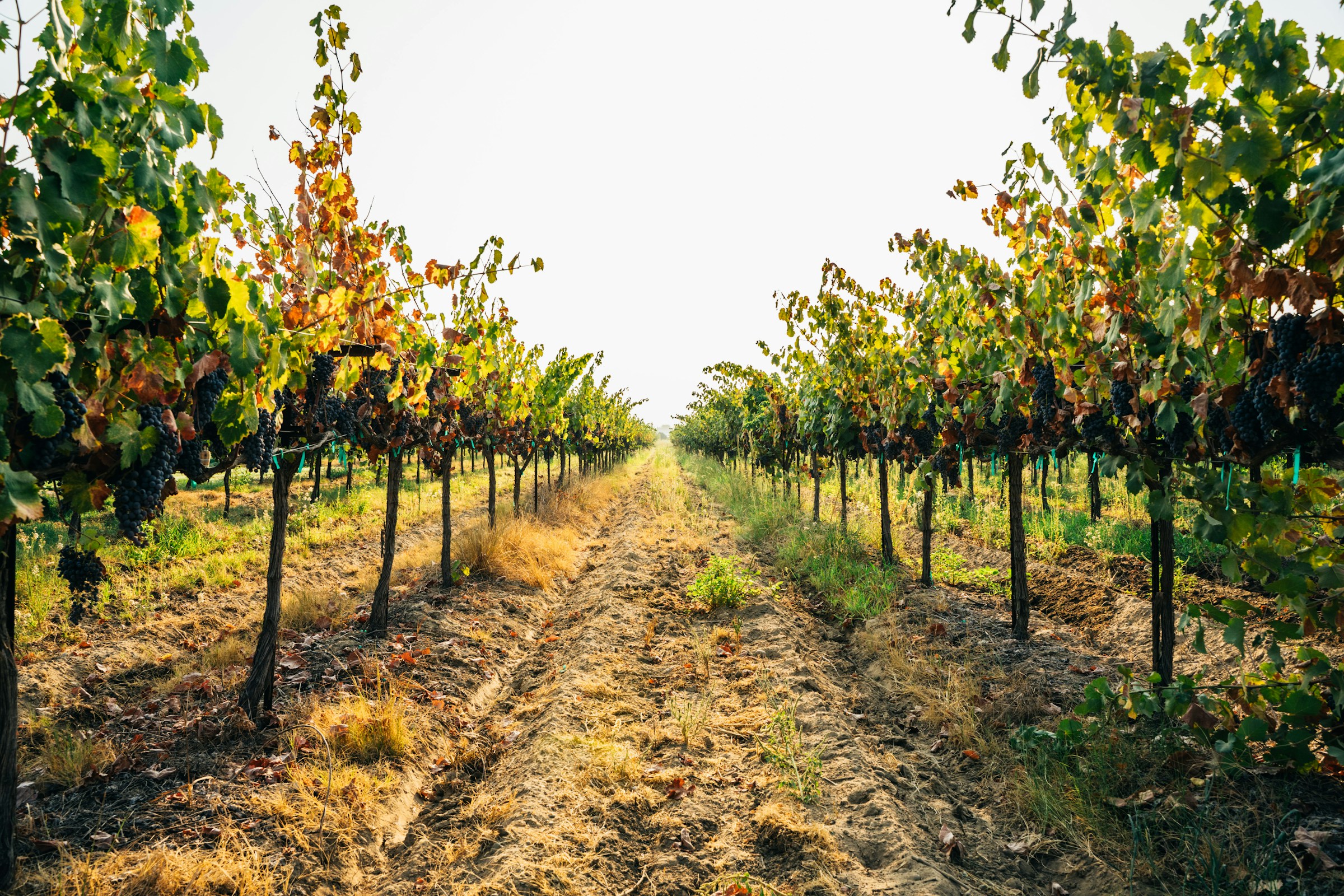
Before the sun has cleared the trellis line, a viticulturist in Fresno walks the headland to the irrigation controller mounted on a steel post at the corner of the block. The screen shows a tile of soil-moisture readings from sensors buried at thirty and sixty centimetres beneath the vine row, and the day’s evapotranspiration estimate from the nearest CIMIS station. The drip schedule for the block is set to replace, this week, half of what the canopy will lose. The line is in the ground, the water is metered, the timer is armed. The decision the controller encodes is not how much water the vines need. It is how much water the vines should be denied, and exactly when.
Watering a vineyard is the most counter-intuitive quality decision in commercial viticulture. Less water means smaller berries; smaller berries mean a higher skin-to-pulp ratio; a higher skin-to-pulp ratio is where color, tannin, and aromatic compounds concentrate in red wine. The trade calls the practice regulated deficit irrigation, or RDI. Wine-Grape-Growing defines it directly: ‘Regulated deficit irrigation (RDI) is a term used for the practice of regulating or restricting the application of irrigation water until a level of vine water stress is attained in order to improve fruit quality, reduce water consumption, and control canopy growth.’ The American Journal of Enology and Viticulture frames the same mechanic from the supply side: ‘Under RDI, less water is applied than a vineyard loses to evapotranspiration during a portion of the growing season.’
The discipline is decades old. What is new is that it now sits at the intersection of climate adaptation, water economics, and the kind of fruit-quality argument that used to belong to dry-farmed European hillsides. In California, in Spain, in Mendoza, in southern Australia, the producers winning are not the ones with the most water. They are the ones with the timing discipline to withhold it on schedule.
Like this? The TERROIR Letter arrives every Thursday.
Three windows where the deficit lands differently
RDI is not a single recipe. The viticulture trade recognises three distinct timing windows, and each window does a different job in the glass.
The first is pre-véraison. Wine-Grape-Growing describes the start point as a deficit that ‘starts when there are no remaining signs of flowering and during the early stages of fruit set.’ This is the window for berry-size control. Cell division in the berry is largely complete within a few weeks of fruit set, and a measured deficit during that window caps the eventual berry volume by limiting cell expansion. Restore irrigation later and the berries do not catch up. The size is set.
The second window is véraison to harvest. Here the effect is on flavour and color rather than size. Per Wine-Grape-Growing, ‘water deficits during this period have been shown to increase wine color, aroma, and flavor.’ The vine, under controlled stress, partitions resources away from vegetative growth and toward the berry’s secondary metabolism: anthocyanins, tannins, the precursor compounds that downstream become varietal aroma. This is the window that earns the practice its reputation among quality-driven producers.
The third is full-season deficit, applied across the growing year rather than confined to a phenological window. The trade-off here is broader and more measurable. Wine-Grape-Growing summarises the effects: ‘water deficits will reduce vegetative growth and yield, maintain or increase the concentration of soluble solids, reduce titratable acidity, and marginally increase pH.’ Smaller canopy, smaller crop, more concentrated juice, lower acid. For some sites and varieties that profile is exactly what a producer is hunting; for others it crosses the line into over-ripeness. The window choice is a regional and stylistic decision before it is an agronomic one.
What smaller berries actually do
The quality lever in every one of those windows is berry size. The mechanism is simple enough to state in one sentence. Per Wine-Grape-Growing: ‘Depending on the water deficit selected, berry size can be significantly reduced and subsequently yield when compared to well irrigated vines.’ A smaller berry has the same skin but less pulp, and the compounds that drive color, tannin structure, and varietal aroma in red wine are concentrated in or near the skin. The ratio shifts in the picker’s bin; it shifts again in the fermenter, where extraction is a function of skin contact and surface area; and it shows up in the finished wine as depth.
That is the theoretical case. It is also the case producers have leaned on for decades to justify the practice. The empirical literature, when it gets specific, complicates the picture.
What the AJEV trial actually shows
The American Journal of Enology and Viticulture trial that anchors the modern conversation on RDI was set up to test four treatments side by side: ET25, ET50, ET70, and ET100. Each treatment received irrigation equal to a different percentage of the vineyard’s measured evapotranspiration, from twenty-five percent of full replacement at the dry end to full replacement at the wet end. The expectation going in was that the deficit treatments would deliver better water-use efficiency: less water in, similar fruit out, a clean climate-adaptation win.
The trial’s headline finding cut the other way. ‘Overall, deficit irrigation did not enhance water-use efficiency,’ the authors reported. The reason, stated plainly in the paper: ‘lower seasonal irrigation water supply was associated with lower yield.’ Less water did not buy more efficiency. It bought less crop. The water-economics case for RDI, on a pure litres-per-tonne basis, did not hold up under controlled measurement.
The same trial flagged a second effect with consequences for ripening that no producer should ignore. ‘Restricting water supply was consistently associated with warmer clusters during the day but not at night.’ At the extreme end of the trial, ‘the sun-exposed side of clusters in ET25 was up to 5°C warmer during midday than in ET100.’ A five-degree midday differential on a sun-exposed cluster is the difference between phenolic ripening and sunburn, between flavour development and stuck-pyrazine character, between a ripening window the picker can manage and one that closes overnight. In an era of warming midsummers across California, Spain, and southern Australia, that finding is the one to dwell on.
The implication is not that RDI is bad practice. It is that the practice does not save water in the way producers and policy briefs sometimes claim, and that withholding water raises canopy and cluster temperatures in ways that compound, rather than mitigate, the climate pressure the practice is supposed to address. RDI is a quality lever, not a water-saving programme. Treating it as both is where the discipline gets in trouble.
By midmorning the controller in Fresno has switched the block over for its scheduled forty minutes. Half of the canopy’s daily water loss is going back into the soil; the other half is the deficit. The decision the screen encodes is the one every quality-driven producer working a hot, dry growing region is now making, in some form, every week of the season: how much water to give back, in which window, at which cluster temperature, against which yield curve. The thirsty vine is not a slogan. It is a calendar.
The TERROIR Letter
The story behind every bottle.
One feature. One dispatch. One bottle worth opening. Every Thursday — free.