

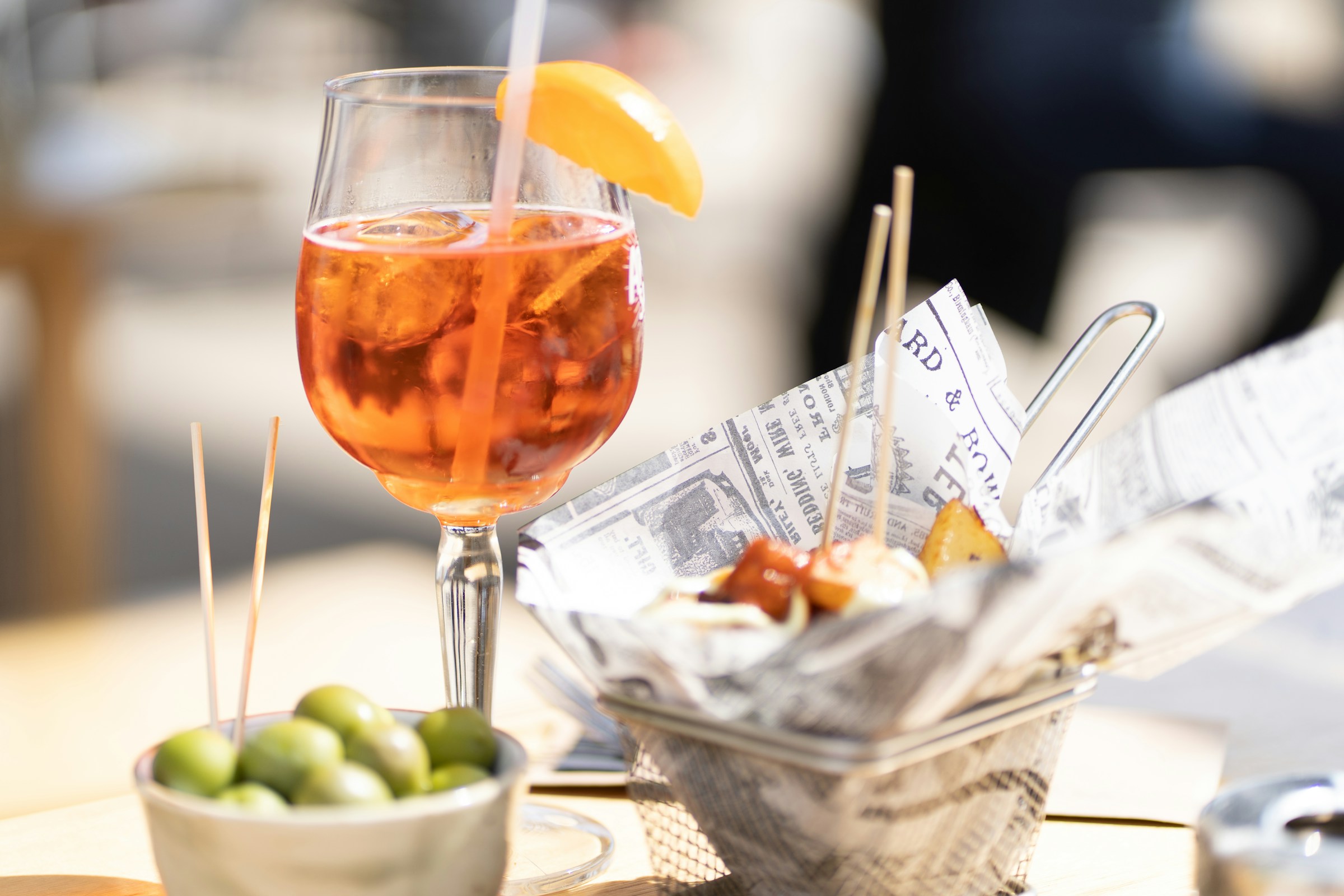
In Turin at six in the evening, the light goes amber before the drinks do. The cafés under the porticoes fill in a slow tide, and what lands on the marble tabletops is bitter, low, and built to be sipped rather than swallowed: a small glass of vermouth over ice, a splash of soda, a twist of orange. The ritual has a name the rest of the world has lately adopted as though it were an invention. The aperitivo is not an invention. It is one of the oldest commercial ideas in Italian wine, older than the cocktail it is now mistaken for, and for most of its life it was wine, or something very close to it.
The first commercial vermouth was poured in Turin in 1786, from the shop of a distiller named Antonio Benedetto Carpano. His base was Moscato, a sweet white wine, lifted with botanicals and fortified so it would keep. The recipe found favor at the court of the House of Savoy, and, more consequentially, it was cheap enough to travel down through the city rather than staying at its top. What Carpano had made was not a spirit. It was aromatized wine, sold by the glass at a fixed hour, and the word for the drink eventually became the word for the hour itself.
Milan supplied the second act. Gaspare Campari devised his bitter red infusion in 1860 and built the brand in Milan in the years after; Aperol followed from Padua in 1919, lower in proof and gentler on the palate. The drink most people now picture when they hear the word, the Aperol Spritz, is younger still, codified in its three-two-one form only in the past two decades. Its spine, though, is a wine: Prosecco, poured over the bitter and topped with soda. Strip the branding away and the modern aperitivo rests on the foundation Carpano laid, a glass of wine adjusted for the moment before dinner.
Like this? The TERROIR Letter arrives every Thursday.
That moment has become one of the most valuable on the European calendar. In 2023, NielsenIQ found the aperitivo to be the fourth most important on-premise drinking occasion in France, chosen by roughly one in four drinkers, and second in Italy, behind only the high-tempo night out. Half of Italy’s on-premise alcohol consumers visit a bar or restaurant for an aperitivo every quarter, and more than a third say they go more often than they did a year earlier. The occasion is not drifting. It is compounding.
Most wine lists have not noticed. The opener, the pour a guest reaches for before the menu has been read, is on many lists an afterthought: a generic sparkling wine by the glass, or no dedicated thought at all, the table left to default to a branded spritz the restaurant earns little on. That is a strange place to be casual, because the aperitivo is among the highest-frequency, lowest-commitment orders a guest will make all evening. It is the first yes, the pour that sets the register for everything that follows. A program that treats it as an afterthought is surrendering the one decision almost every table will make.
Part of the opportunity comes from where younger drinkers are heading. The moderation trend is measurable, not anecdotal: Circana’s 2025 research found a large and growing share of American drinkers actively trying to drink less, with the no-alcohol category drawing tens of millions of new buyers in recent years, and the shift steepest among those in their twenties. The aperitivo, framed correctly, suits that mood better than almost anything else on the list.
Framed correctly is the operative phrase, because the honest version of the story is not that aperitivo wines are weak. Many are not. Vermouth runs 15 to 18 percent alcohol; fino and manzanilla sherry sit around 15 to 17; dry Marsala and Lillet fall in the same band. These are fortified wines, typically stronger than the Barolo that might follow at dinner, not weaker. The virtue is not the proof. It is the pour. An aperitivo is a small, deliberate measure taken slowly, an ounce or two of something layered rather than a full glass of something simple. Where genuinely lower strength is the goal, the answer is sparkling: a Franciacorta or a Cava at roughly 12 percent, dry enough to wake the palate without filling the stomach. Either way, the wine list answers the moderation question more honestly than a ready-made pour does.
And the ready-made pour is the tension worth naming. Campari now sells a ready-to-serve Aperol Spritz, premixed and bottled at 9 percent, the ritual compressed into a single SKU. It is convenient, and it is the logical endpoint of two decades spent turning a wine occasion into a branded one. The drink that began as Carpano’s glass of aromatized Moscato, sold by the pour to anyone marking the turn from work to evening, is now also a premixed bottle with a barcode. There is nothing wrong with convenience. There is something lost when the most vinous hour of the day quietly stops being about wine.
The recovery is not complicated, and it asks for no nostalgia. It asks a wine list to treat its first line the way it treats its last: as a decision. A well-chosen vermouth on ice, a chilled fino, a glass of bone-dry Franciacorta, each says something about the table before the food arrives, and each returns the aperitivo to the thing it has always been. Back in Turin, under the porticoes, no one calls it a trend. They call it the hour before dinner, and they have always poured wine into it.
The TERROIR Letter
The story behind every bottle.
One feature. One dispatch. One bottle worth opening. Every Thursday — free.