

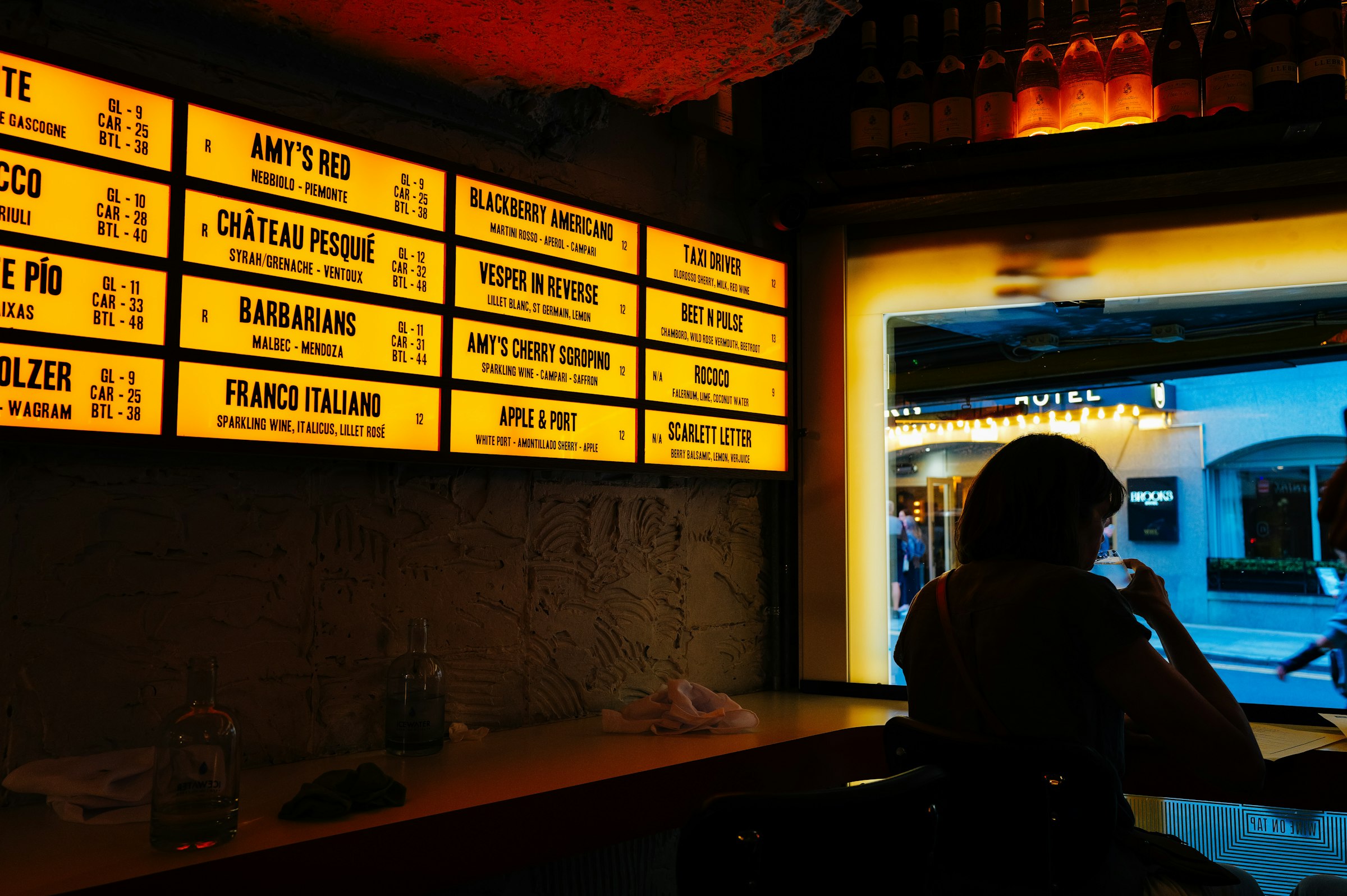
At eleven in the morning, before the kitchen has fired its first burner, a sommelier sits at the bar with a printout of the wholesale invoices and a calculator. The list is being rebuilt for the new quarter. Each bottle on the page has three numbers next to it: the wholesale cost, the retail equivalent at a good wine shop, and the menu price. The sommelier’s job for the next two hours is to set the third number for ninety-odd bottles, and the multiplier is not constant. The fifty-dollar wholesale Burgundy will land on the list at one hundred and seventy. The two-hundred-dollar wholesale Barolo will land at three hundred and sixty. The eighteen-dollar wholesale Beaujolais will land at sixty-five, which is a higher multiplier than either, and is also, by the sommelier’s reckoning, the best buy on the page.
The mathematics of a restaurant wine list are not arbitrary, and they are not uniform. Diners frequently treat the menu price as a single decision: a flat multiple, marked up because restaurants can. The trade-press consensus across two decades places restaurant markup at roughly two and a half to three times retail, or four to five times wholesale. That figure is correct as a coarse industry average, and conceals everything interesting about how a list gets built.
The math, by price tier
The multiplier moves on a sliding scale, and it moves inversely to the price of the bottle. Entry-level wines, the bottles priced between roughly twenty-five and forty-five dollars on the menu, are typically marked up at three and a half to four times their wholesale cost. These are the bottles that move in volume on Tuesday and Wednesday nights, and the high multiple is doing the heaviest work in the programme’s margin. The middle band, from roughly sixty to one hundred and twenty, runs closer to two and a half to three times wholesale. The prestige tier, the bottles above one hundred and fifty, often settles at one and a half to two times wholesale, because a list that priced a thousand-dollar Domaine Leflaive at three thousand would never sell it, and a programme that fails to move its top bottles ties up capital it cannot afford to lose.
Like this? The TERROIR Letter arrives every Thursday.
By-the-glass pricing operates on a different logic. The convention across the independent-restaurant tier is that the first pour from a bottle recovers the full wholesale cost; every subsequent pour is contribution margin. A bottle costing the restaurant eighteen dollars wholesale will be poured four times and priced at eighteen dollars per glass. The BTG list is not a sample of the bottle list at proportionate prices; it is a separate pricing exercise built around variance protection and pour-cost stability.
The second-cheapest myth
The advice that diners ought to avoid the second-cheapest bottle on the list, because it is allegedly the highest-margin pick the sommelier has deliberately positioned to catch the bargain-conscious, is one of the most durable pieces of wine misinformation in circulation. It is also wrong.
The second-cheapest bottle is, in most well-built programmes, a serious bottle. The cheapest bottle on a list is almost always a defensive listing: a recognisable name at a low price point, kept in stock to give cost-sensitive diners a reachable option and to relieve the sommelier from having to recommend something the diner does not want recommended. The second-cheapest position is where the wine director can actually argue for an interesting bottle from a region the list otherwise underrepresents, knowing the price point will keep it accessible. On most carefully built lists, the second-cheapest red and the second-cheapest white are the two slots a sommelier would happily order for themselves.
The myth persists because it sounds like inside knowledge and confirms the suspicion that the restaurant is engineered against the diner. The reverse is closer to the truth. The bottle a programme is most likely to be marking up aggressively is the recognisable mid-tier brand, the bottle a diner orders by reflex because the label is familiar. That bottle carries the highest absolute margin per bottle on the page. The second-cheapest Loire Chenin is the bottle the sommelier wishes more tables would order.
What is actually under-priced
Three regions appear on almost every carefully built American wine list at prices that have not moved in proportion to their quality. Beaujolais Cru, the ten named villages of granite-soiled gamay in the southern reach of Burgundy, sits on most lists at a wholesale-to-retail ratio that would embarrass any of its neighbours to the north. A Morgon or a Fleurie from a serious producer wholesales for fifteen to twenty-two dollars, retails in a wine shop for thirty to forty, and lands on a restaurant list at sixty to seventy-five. The category has been gaining critical respect for fifteen years and the list price has barely tracked it.
Loire Cabernet Franc occupies the same territory. Bourgueil, Chinon, and Saumur-Champigny from producers like Charles Joguet, Bernard Baudry, and Clos Rougeard wholesale at twenty to thirty dollars and reach restaurant lists at sixty to ninety. The reds drink at a level that comparable Right Bank Bordeaux at three times the menu price increasingly struggles to match. Mâcon-Villages and the named Mâconnais communes do the same work in the white-Burgundy aisle: Chardonnay from the same parent appellation as Côte d’Or villages, Burgundian winemaking, half the price.
These are not fashion picks. They are the regions where the gap between bottle quality and list price is widest, and that gap has been widening rather than closing across the post-pandemic American list-building cycle. The sommelier reading a list for personal interest is scanning these three sections first, because the sommelier knows the wholesale cost on the bottle and knows the markup discipline that built the page.
The list is a document
A restaurant wine list is not a trap and it is not a menu in the same sense the food menu is. It is a document built by a person whose budget for the year, whose cellar reputation, and whose argument about how to drink with food are all encoded in roughly two hundred lines of typeset paper. The pricing curve, the regional balance, the producer choices in the middle band, the by-the-glass programme, the second-cheapest position: each of these is a decision the wine director defends to the general manager every quarter.
The diner who reads the list as a forensic document, not a price screen, is reading it the way the sommelier intends. The eighty-dollar Cabernet Franc is not a hedge against the hundred-and-fifty-dollar Bordeaux; it is the bottle the wine director put on the list to argue that the hundred-and-fifty-dollar Bordeaux is no longer the better drink.
At eleven in the morning, when the sommelier is setting the third number on each line of the page, the bottle the sommelier most wants the table to order that evening is rarely the one with the most prestigious label. It is almost always the one whose multiplier is highest, whose wholesale cost is lowest, and whose place on the list reflects a regional bet the rest of the room has not yet caught up to. The price the diner sees at the table is the end of a calculation. The diner who can read the calculation is reading the list the way it was written.
The TERROIR Letter
The story behind every bottle.
One feature. One dispatch. One bottle worth opening. Every Thursday — free.