

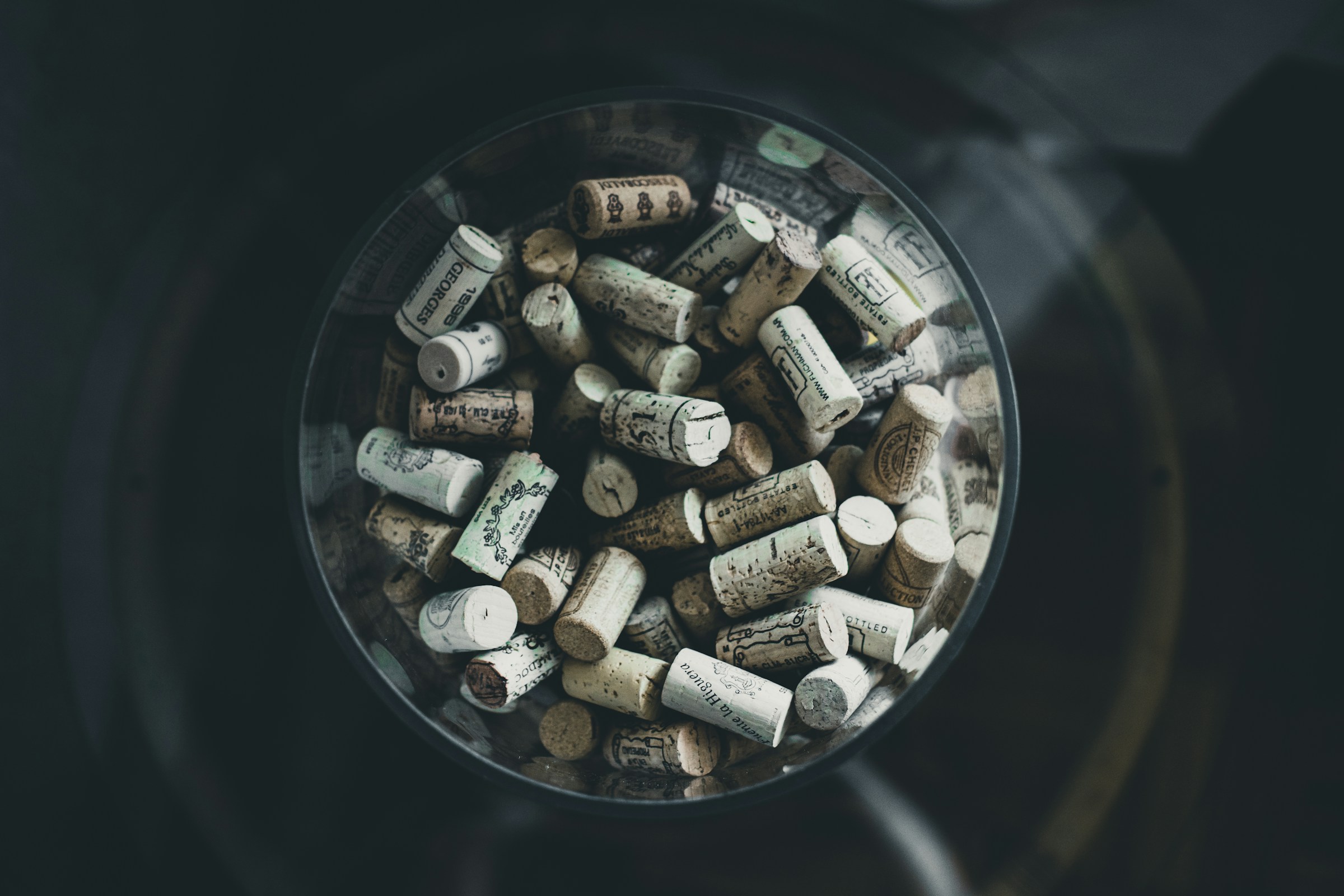
Two bottles sit on the tasting table. Same producer, same 2015 vintage, same wine in every respect except one. The bottle on the left was sealed with a natural cork in the spring of 2016. The bottle on the right was sealed with an aluminium screwcap on the same day, from the same tank. They have lain together in the same cellar at the same temperature for ten years. Tonight, both will be opened.
The cork pulls cleanly with the soft pop of a sound bottle. The screwcap turns and breaks its tamper-evident skirt with a brief crack. The two gestures are not equivalent, but the wine inside is the only thing being measured. The closure is the variable. It is the experiment most readers have not run, and it is the experiment the wine trade has been running, quietly, on hundreds of millions of bottles a year, for twenty-five years. The result is not a victor. It is a truce.
The Taint Problem That Drove the Schism
The cork-versus-screwcap argument did not begin as an aesthetic dispute. It began with a molecule. In 1982, Swiss chemists led by Hans-Reinhard Buser identified 2,4,6-trichloroanisole (TCA) as the compound responsible for the musty, wet-cardboard off-aroma drinkers call “corked.” TCA forms when chlorine-based sanitizers react with phenolic compounds in cork bark, and the cork carries it into the bottle. It accounts for eighty to eighty-five per cent of wine faults attributed to closure. Trained tasters detect TCA at one or two nanograms per litre, a few drops in an Olympic swimming pool.
Like this? The TERROIR Letter arrives every Thursday.
By the early 2000s, the scale of the problem was no longer disputable. A 2005 study at the Wine Spectator blind-tasting facility in Napa found seven per cent of 2,800 bottles tainted at recognisable levels. One bottle in fourteen meant a corked sommelier-pour at a Michelin restaurant, a returned magnum at a private collector’s table. APCOR, the Portuguese Cork Association, and its members invested in detection and process reform: gas chromatography screening, steam-and-vacuum extraction, individual-cork analysis on the premium tier. The Cork Quality Council, which audits North American cork shipments, ran more than twenty-five thousand tests in 2013 and reported an eighty-one per cent reduction in TCA incidence compared with eight years earlier. APCOR’s own figures now cite an industry taint rate between 0.7 and 1.2 per cent. The peak of seven per cent had been brought down by a factor of seven.
By the time that work was done, however, the marketplace had already chosen alternatives.
Why the Marketplace Settled in Tiers
The aluminium screwcap most readers see on a riesling or sauvignon blanc has a specific name. It is called Stelvin, developed at the end of the 1960s by a French firm, Le Bouchage Mécanique, at the request of Peter Wall, the production director of Yalumba in South Australia. The cap was trialled in 1970 and 1971 on Swiss Chasselas, a varietal particularly afflicted by TCA, and was first used commercially in 1972 by the Swiss winery Hammel. A group of Australian wineries followed in the mid-1970s. The system was then put aside for a decade, met with consumer resistance, and reintroduced in the late 1990s. Once it returned, it moved quickly. In New Zealand, screwcap adoption went from one per cent in 2001 to seventy per cent in 2004. In the Clare Valley in South Australia, a group of riesling producers led by Jeffrey Grosset bottled their 2000 vintage under screwcap in July of that year, in a coordinated move that effectively decided the region’s policy.
The reason the trade settled into tiers, rather than crowning a single winner, comes down to one phrase: oxygen transfer rate. Every closure admits some measurable amount of oxygen into the bottle. A tight screwcap with a tin-and-Saran liner admits almost none. A natural cork admits a small, variable amount. A technical cork of micro-agglomerated particles bound with a food-safe polymer can be engineered to deliver a controlled rate in between. Oxygen is not neutral for ageing wine. Too much and the wine browns and dulls; too little and reductive sulphur compounds (the struck-match or rubber notes the trade calls “reduction”) can build up and dominate the nose. A 2021 paper in the journal Foods, led by Furtado, Lopes and a Portuguese research consortium, examined the same wines under different closures and found that the trajectories diverged by varietal: aromatic whites moved differently than tannic reds, and the differences emerged on a timescale of years, not months. The practical finding: no single closure is best for every wine.
So the tiers settled along lines that mirror what the science indicated. Early-drinking aromatic whites (New Zealand sauvignon blanc, Clare and Eden Valley riesling, German riesling at the trocken level) went almost entirely to screwcap, where the absence of oxidation preserves lifted citrus and stone-fruit aromatics. Age-worthy reds with thirty- and forty-year drinking windows (Bordeaux’s classed growths, Burgundy at the village and Premier Cru tier, the top of Barolo and Barbaresco) stayed under natural cork, where slow oxygen transfer is part of the maturation chemistry the wines were built for. Champagne kept cork for the same reason. The middle of the market settled on technical closures: DIAM, a micro-agglomerated cork made with a supercritical-CO2 process that strips TCA from the granulated material; agglomerated corks for everyday bottlings; synthetics where price and consistency mattered more than tradition.
What the Closure on Tonight’s Bottle Tells You
A natural cork on a young riesling or sauvignon blanc, particularly from a New World producer, is now a deliberate choice. It signals a producer who wants the wine to age, comfortable with the small statistical risk of TCA in exchange for the maturation chemistry cork allows. A screwcap on a thirty-dollar Mosel kabinett is also a deliberate choice: the producer has decided that the wine’s drinking window does not need decades of slow oxygen, and that aromatic precision is worth more than cellar tradition. A DIAM cork on a white Burgundy in the eighty-dollar tier, quietly common across the Mâconnais, signals a producer who wants the oxygen profile of natural cork without the variability. None of these are compromises. They are decisions made about specific wines by people who have spent twenty years watching the data.
The truce, in other words, is not a draw. It is a division of labour. The closure on a bottle is no longer a statement about loyalty to tradition or appetite for novelty. It is a statement about what the wine inside was made to do.
The two bottles from the opening of this piece, the cork and the screwcap of the same 2015 vintage from the same lot, will read differently in the glass tonight. That is the experiment’s point. The wine under screwcap will be brighter on the nose, a touch more reductive on the first pour, a touch slower to open. The wine under cork will be softer at the edges, a little further along the curve of secondary aromatics, with the slight bottle-to-bottle variation natural cork still admits. Neither is wrong. They are two answers to a question the closure was always being asked, and both answers are now, finally, allowed.
The TERROIR Letter
The story behind every bottle.
One feature. One dispatch. One bottle worth opening. Every Thursday — free.