

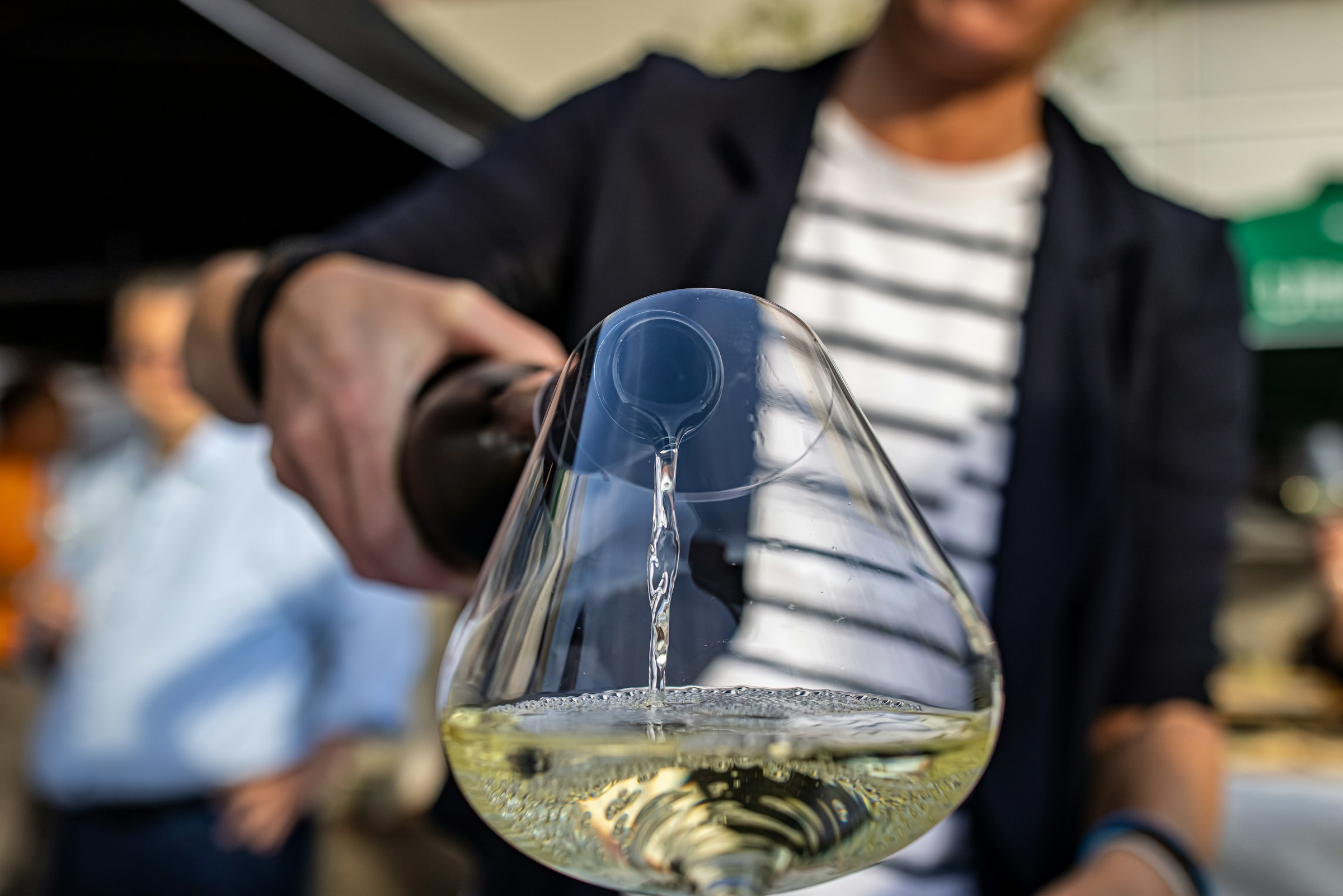
A host pours a magnum of Champagne into a wide-bellied crystal decanter and sets it on the table to “let it breathe.” Within minutes the mousse has thinned. By the time the first glasses are poured, the wine reads like a slightly oxidised Chardonnay. The dinner is salvageable. The Champagne, in any meaningful sense, is not.
The mistake is instructive because it is the mistake of someone trying to do the right thing. Decanting has become the reflexive courtesy of serious wine service: a bottle of weight is brought to the table, the cork is drawn, the wine is poured into a vessel and given air. For a small subset of wines, this is what they need. For most of what gets poured into decanters, it does nothing. For a few specific styles, it is actively destructive. The decanter is a tool, not a virtue.
Why most wines do not need decanting
A decanter is a vessel for decantation: the pouring-off of liquid from sediment. That is its original and most defensible job. A Vintage Port aged twenty years has thrown a crust; a mature Bordeaux has shed pigmented tannin into a fine film along the lower shoulder. Pouring through a decanter separates the wine from the solids. The function is mechanical; it requires no time and no aeration.
Like this? The TERROIR Letter arrives every Thursday.
The other job people assign to a decanter, letting the wine “open up,” is a different proposition. A wide-bottomed vessel exposes a much larger surface of liquid to air than an open bottle neck does. Volatile aromatic compounds lift out of solution; phenolic compounds begin a slow oxidative march that, in the right wine, softens the tannin profile and, in the wrong wine, flattens the aromatic register.
The first useful rule is that most wine does not benefit from decanting at all. A Sauvignon Blanc from the Loire, a young Beaujolais, a Pinot Noir under screwcap, a Sicilian Nero d’Avola: these are wines built to be opened, poured, and drunk. Their fruit is forward, their tannin is light, their aromatics are at peak the moment the bottle is opened. Time in a decanter erodes them. By volume, this is most of what gets poured.
Young Barolo and the case for three hours
The clearest affirmative case for long decanting is young Nebbiolo from Piedmont, specifically Barolo and Barbaresco in their first decade. The trade consensus, durable across Italian winemaking convention and Anglophone wine writing, gives the figure as three to four hours of decanting for a young Barolo before serving. A Barolo drunk within thirty minutes is a different wine from the same bottle given a full afternoon in a wide decanter.
The mechanism is tannin. Young Nebbiolo carries a tannin load high enough to lock up the wine’s aromatic core under a hard astringent grip. Time and air soften the phenolic structure: the slow oxidative process polymerises some of the harshest tannins out of the active palate experience, and the volatile aromatics that define mature Nebbiolo (rose, tar, dried cherry, licorice) begin to lift forward. The phenolic content in wine is the chemistry doing the work, and the dose matters: thirty minutes does almost nothing, an hour begins to soften the entry, three hours is when the wine starts to taste like something it cannot taste like on the night of release.
The same logic applies, in compressed form, to young Bordeaux from a structured vintage and young Mourvèdre from Bandol. One caveat: generic Barolo at the entry tier, made from younger vines on less favoured exposures, often does not have the structural depth that justifies the wait. The three-to-four-hour rule applies to the wines built to be cellared for fifteen years; for the rest, an hour is closer to right.
Mature Bordeaux and the thirty-minute rule
For mature wines, the calculus flips. Bordeaux from a long-cellared decade, mature Rioja Gran Reserva, properly aged Brunello: the tannin has already done its softening work in the bottle. What the wine needs is not three hours of phenolic conversion but thirty minutes of gas exchange to lift the secondary and tertiary aromatics: cigar box, leather, dried flowers, forest floor.
The Italian winemaking convention gives thirty to sixty minutes for a mature Bordeaux, and the same range applies broadly. The risk on the back end is real. A wine that has spent twenty-five years in glass under cork has been held at a tiny rate of oxygen ingress for the whole period; pouring it into a wide decanter for three hours puts it on a curve a hundred times steeper, and the wine can collapse inside an hour. The service-floor practice that works is short and deliberate: pour through the neck of the decanter (with a candle behind the bottle, if it has thrown a crust), and serve within thirty minutes. The decanter is doing the job of the bottle neck, just faster.
Old Burgundy, Champagne, and the wines that lose by being decanted
The two wines most often poured into decanters by reflex, and most damaged by it, are old Burgundy and Champagne.
Mature Pinot Noir from the Côte d’Or is the most fragile wine in serious commercial circulation. A twenty-year-old Volnay or Vosne-Romanée has spent its life on the cool, slow oxidative curve that mature Burgundy depends on, and the aromatic register at peak (rose petal, truffle, wet-stone minerality) is the product of a long, controlled chemistry. Decanting that wine for an hour can take it past peak before the first glass is poured. The defensible practice is to pour directly into a Burgundy glass with a wide bowl and let the glass do the aeration work over the course of the meal: the decanter in miniature, with a tenth of the surface area and a fortieth of the headspace.
Champagne is the cleaner case. The mousse (the column of fine bubbles that defines the wine in the glass) is dissolved carbon dioxide held in solution under pressure in the bottle. Pouring Champagne into a wide-bellied decanter releases it. The bubbles that were going to break on the surface of the glass for the next twenty minutes break on the surface of the decanter in the first three. What remains is a still, slightly oxidised white wine that resembles its origin only in name. The same logic, in less dramatic form, applies to aromatic whites and rosés: dry German Riesling, fresh Provençal rosé, Albariño from Rías Baixas. Their primary aromatics are the point, and the primary aromatics are exactly what time in a decanter dissipates.
Decanting is an intervention. It softens hard tannin in young structured reds given the time to spare; it lifts the tertiary aromatics of mature wines in a short exposure; it strips the primary aromatics and mousse of fragile and sparkling wines that have nothing to gain from air. The host with the young Pinot Noir, the sommelier who decants everything because the wine list charges for it, and the dinner guest who pours Champagne into a vessel because the table looks empty without one are using the same tool to do three different things to three different wines, and only one is doing the wine any favours. The decanter is not the virtue. The decision is.
The TERROIR Letter
The story behind every bottle.
One feature. One dispatch. One bottle worth opening. Every Thursday — free.