

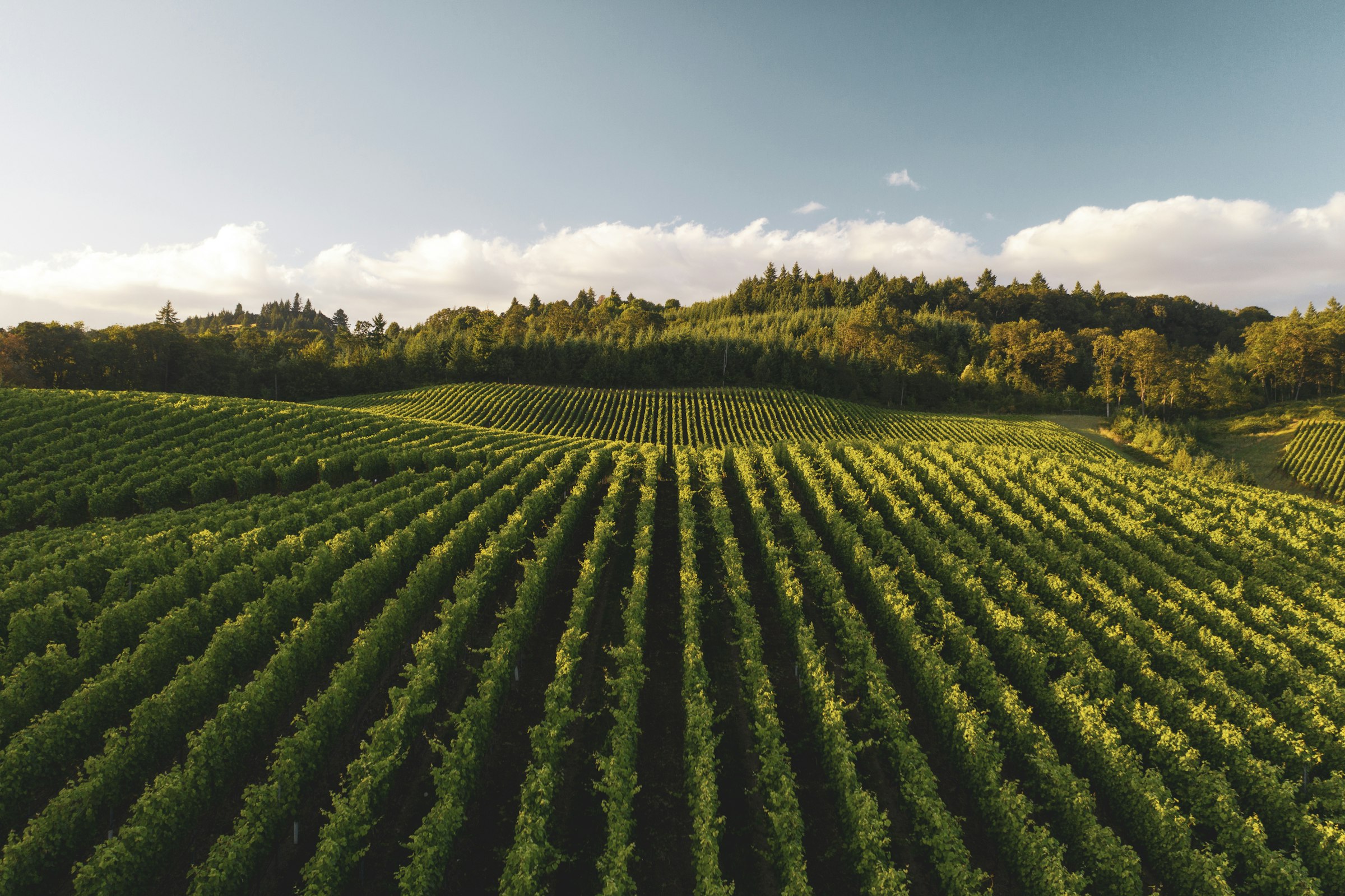
Stand on the headland of almost any working vineyard in late summer and the picture splits in two. The mid-rows are alive: clover gone slightly papery in the heat, vetch tangled into rye, the occasional mustard bolt running to seed. The under-vine strip, by contrast, is bare: a thirty-centimetre band of pale, compacted soil that runs the length of the row like the white line on a road. The vines are the same vines. The hectare is the same hectare. But the two surfaces are doing two different jobs underground, and one of them is quietly pulling carbon out of the atmosphere.
That asymmetry has become, in the past few years, the most consequential single lever a vineyard can pull on its climate ledger. Not the cellar choices, not the bottle weight, not the freight calculus. The dirt.
The number that reframes the argument
A 2024 study published in Frontiers in Sustainable Food Systems tracked soil organic carbon across vineyard plots managed with under-vine cover crops versus plots kept clean by herbicide, over a five-year horizon. The cover-cropped plots ended the period with up to 23% more soil organic carbon than the herbicide controls. Adjacent studies put the broader range at roughly 12 to 28% across comparable five- to ten-year windows, depending on baseline soils and climate, but the directional finding is now consistent across the literature.
Like this? The TERROIR Letter arrives every Thursday.
Translated into atmospheric terms, the better-managed vineyard rows are sequestering somewhere between 2.8 and 11 megagrams of CO₂ per hectare per year. The spread is wide because the inputs are: a clay-rich plot in Champagne with a diverse winter mix is not the same instrument as a sand-and-gravel plot in McLaren Vale running a single grass species. But even the floor of that range is significant. The ceiling is something else again.
Here is the figure that tends to stop people: typical cropland sequesters roughly 0.5 to 2 megagrams of CO₂ per hectare per year. The upper end of the viticulture range is therefore four to five times what conventional row-crop agriculture pulls down on a like-for-like basis. The reason is architectural. A wheat field is tilled, replanted, and disturbed annually; carbon gains in the topsoil are routinely undone by the next pass of the plough. A vineyard, by contrast, is a perennial system. The vines stay in the ground for thirty, fifty, sometimes a hundred years. Once cover crops are established and soil is left mostly undisturbed, the carbon accrues without being annually reset. Vineyards, almost by accident of their growing form, are unusually well-suited to act as biological carbon stores.
The honest trade-off nobody quite says out loud
None of this means cover crops are free. The reason herbicide-managed under-vine strips became the default across most of the New World, and across plenty of European appellations, is that cover crops compete with vines for water and for nitrogen, especially in dry-farmed regions and especially in droughty years. A vine that has to share the top thirty centimetres of soil with rye and vetch is a vine working slightly harder for its inputs. In an average vintage that competition is mild, sometimes even helpful (controlled water stress concentrates fruit). In a 2003 or a 2017 or a stretched dry stretch in the South of France, it can hurt yields meaningfully.
The labour cost is the second honest beat. Mowing the rows two or three times a growing season, terminating the cover at the right window before bloom, managing the seed mix year on year: none of it is unmanaged. A producer who switches from herbicide to cover crop is trading a chemical line item for a labour and equipment line item, and on a marginal operation that swap is not always net-positive on the balance sheet. The carbon argument is that the public-good outcome justifies the private cost, not that the private cost vanishes.
The serious version of the conversation acknowledges both. Cover crops are the highest-impact sustainability move available to a vineyard. They are also a real input, with real trade-offs in real vintages, that has to be managed by people on payroll. Both things are true at once.
What the leading programmes actually require
Three regional efforts are worth naming because each represents a different architecture for getting cover crops into the ground at scale.
Champagne’s Vitiforestry programme, run through the Comité Champagne, sits closest to a coordinated regional strategy. It pairs cover-crop adoption with the reintroduction of hedgerows and trees inside and around vineyard parcels, on the argument that the carbon ledger improves further when the cover is layered with woody perennials. Napa Valley’s relationship with the Land Trust of Napa County takes a different shape: voluntary easements and partnership grants that fund cover-crop and soil-health work on individual estates, structured as conservation agreements rather than appellation-wide rules. Italy’s Equalitas certification (the country’s main sustainability standard for wine) folds cover-crop adoption into a broader scorecard that producers complete annually. Equalitas does not mandate cover crops outright; it scores them as one weighted criterion among many, which is a softer instrument than a regulation but a more flexible one across Italy’s range of climates and soil types.
The pattern, across all three, is that nobody has yet built a binding cover-crop requirement at appellation level, and probably nobody should. The right ground cover for a south-facing schist slope in the northern Rhône is not the right ground cover for a windward parcel in Casablanca, and a one-size mandate would either be set so loose as to be meaningless or so tight as to cause harm. What the programmes share is a recognition that under-vine bare soil is no longer a neutral default. It is a choice with a cost, and increasingly a measurable one.
Five years from now
Walk the same headland in 2030 and the picture may have inverted. The mid-rows will still be alive in summer. But the under-vine strip (the white line on the road) is the surface that is most likely to have changed. A measurable share of producers across Champagne, Napa, the Veneto and Rioja have already begun seeding into it, narrowing the bare band year on year. The science is settled enough to act on. The economics are honest enough to argue about. And the soil, on a perennial crop with vines that will be in the ground long past the producers tending them, is doing the slow work of putting back what the last century of cellar carbon spent.
The TERROIR Letter
The story behind every bottle.
One feature. One dispatch. One bottle worth opening. Every Thursday — free.