

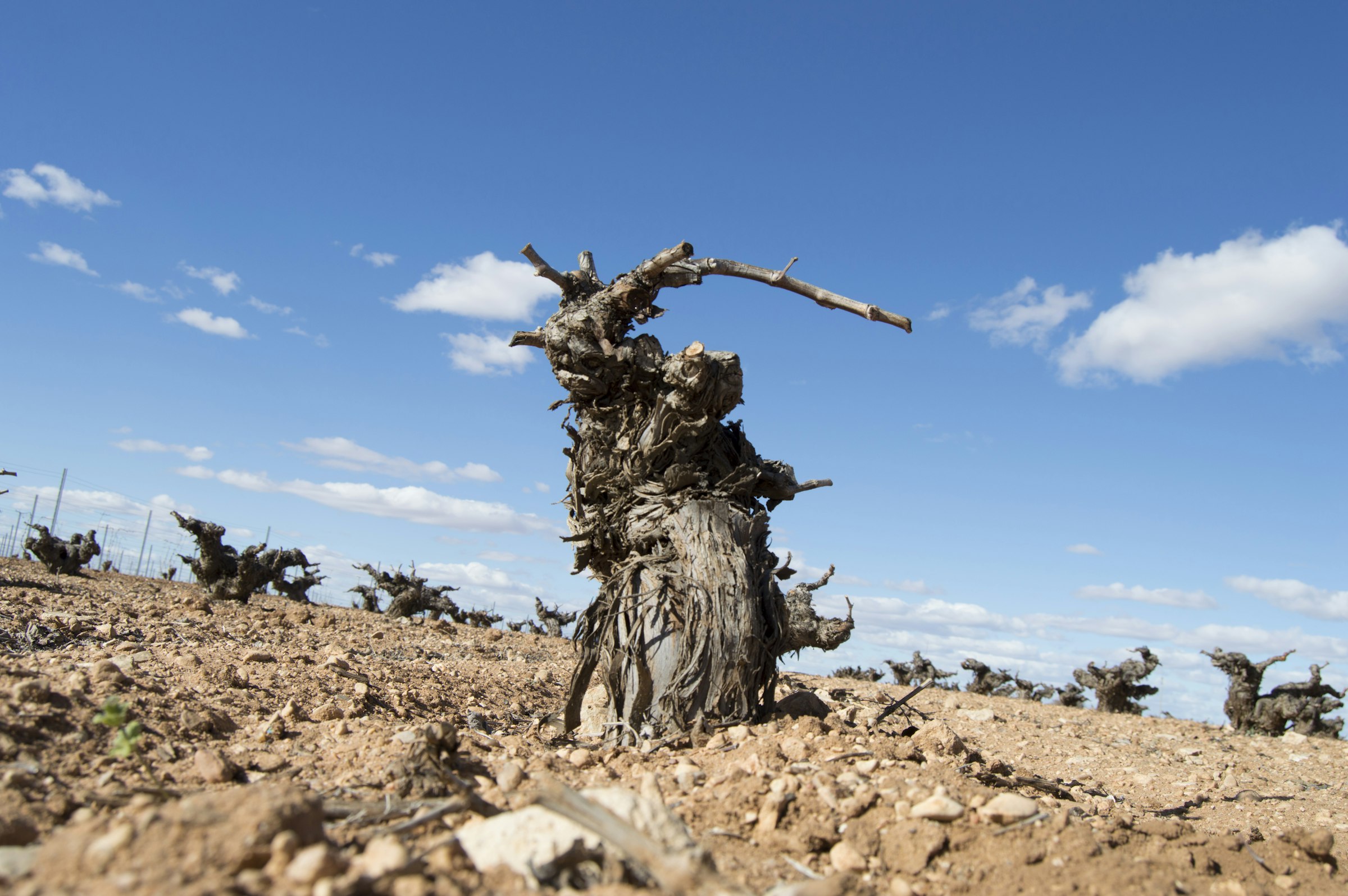
A dry-farmed vine in its third leaf is not, on the surface, a sympathetic object. The canopy is sparser than its irrigated neighbour two rows over. The fruit set is lighter. The trunk is thinner at the graft. To a vineyard manager whose bonus rides on yield per acre, the picture is a problem.
Look down, though, and the story inverts. The taproot has pushed two and a half metres into the profile. It is past the bacterial mat in the topsoil, past the clay lens at one metre, and is working the fissures in the weathered bedrock for whatever moisture banked there over winter. In year five, when the irrigated vine next to it will still be waiting for the drip line each Tuesday, the dry-farmed vine will be drinking from a column of soil its competitor has never touched. In year fifteen, when the drought stretches into its third consecutive vintage and the wells go on allocation, the dry-farmed vine will keep ripening fruit.
That underground asymmetry is the entire argument for the technique. It is also the reason most of California abandoned it.
Like this? The TERROIR Letter arrives every Thursday.
What got lost when the drip lines arrived
Dry farming was the California default through the first half of the twentieth century, not because anyone preferred it but because there was no alternative. The technology that made vineyard-scale drip irrigation cheap arrived in the 1960s out of Israeli agricultural research, reached the North Coast through the 1970s, and was effectively standard by the early 1980s. Once it became possible to water on a schedule, the agronomic logic flipped. A vineyard manager could plant tighter spacing, push earlier yields, finance the operation against predictable production, and stop worrying about whether the winter rains had arrived in time. Lenders rewarded it. Yields climbed. The dry-farmed acreage that survived did so mostly because it had been planted before anyone had the option, on old head-trained sites that pre-dated trellising itself.
The Zinfandel plantings at Ridge’s Geyserville and Lytton Springs vineyards in Sonoma County are typical of that surviving cohort: vines into their second century in places, head-trained, never irrigated, valued specifically for the depth and concentration the conditions produce. They are not relics that survived; they are the reference set against which the irrigated norm now gets measured. The newer dry-farmed acreage being planted across California today is, in effect, an attempt to rebuild that root architecture from scratch on sites that have spent forty years on the drip.
The drought-era math that brought it back
The first serious modern argument for dry farming on the North Coast came out of Napa during the 2012-2016 drought, the longest continuous water-stress event in the state’s instrumented record. At Frog’s Leap in Rutherford, founded in 1981 by John Williams and farmed dry across roughly 200 acres of estate vineyard, the comparison ran the numbers in the most uncomfortable direction. Frank Leeds, the vineyardist who has overseen the dry-farmed acreage there for decades, told Governing magazine during the drought that a conventionally irrigated Napa vineyard uses on the order of 65,000 gallons of water per acre per year. The dry-farmed equivalent uses none, save for the winter rains the soil banks before bud-break.
Multiply that across a 200-acre estate and the irrigated baseline is thirteen million gallons annually. Multiply it across the roughly 45,000 planted acres of Napa Valley and the figure becomes nearly three billion gallons a year of water that, on a fully dry-farmed footing, would not have to be drawn from wells or surface allocations at all. Nobody is proposing the whole valley converts. The point is that the conventional baseline is not free; it has simply not been priced. When a drought arrives and the cost of the next gallon goes vertical, dry farming stops being the eccentric choice and starts being the one that pencils.
The other surviving exemplar is Tablas Creek, on the limestone slopes west of Paso Robles, where the Perrin family and Robert Haas planted Rhône varieties in the early 1990s on the explicit thesis that the Mediterranean parallel was the right reference model for the site. Tablas Creek farms a substantial share of its estate dry, and has done so long enough that its public yield records read as a slow proof of concept: tonnage is lower than irrigated benchmarks, but consistent vintage to vintage, and the wines have settled into a price band that reflects the underlying economics rather than fights against them.
Why it cannot be retrofitted in a hurry
The structural barrier that keeps dry farming a minority technique is in the third paragraph of this article, and worth saying directly. A vine cannot be converted from irrigated to dry-farmed in any meaningful sense. The roots that would make the conversion possible were never grown. A drip-irrigated vine produces its feeder mat in the top thirty centimetres of soil, where the emitter releases water on a calibrated schedule. There is no metabolic reason for it to send a taproot down. When the irrigation gets shut off, the vine does not adapt; it desiccates. The dry-farmed vineyard has to be planted dry-farmed, from year one, on rootstock chosen for drought tolerance, at wider spacing than the irrigated norm, and accepted as commercially unproductive for its first three to five years.
That is a long financing window for a marginal change to standard practice. The vineyards that have done it recently (small, mostly producer-owned, mostly with cellar-side margins to subsidise the agronomic risk) are not a template the bulk of the California industry can copy. They are, instead, a working argument that the underlying technique remains viable when the conditions and the patience are present.
What has shifted in the past decade is the conditions, not the patience. California’s six-year overlapping drought cycles from 2012 through the early 2020s, combined with groundwater regulation under SGMA forcing growers to start metering what had been a free input, has begun to do to the irrigation default what the drip line did to the dry-farmed default fifty years ago. The math is moving. The acreage is moving with it, slowly, in places where the soils are deep enough and the producers patient enough to plant for the vine that will be standing twenty years from now.
Back to the third-leaf vine in the opening paragraph. The vineyard manager’s bonus this year still rides on yield per acre, and the picture is still a problem. But the taproot is at two and a half metres and falling. In year five it will be at four. In a drought year fifteen years from now, when the irrigated row beside it is on a Tuesday water allocation, that taproot will be the difference between a vintage and a write-off. The technique that California spent forty years walking away from is the one that grew the column of soil under that vine, and there is no shortcut back to it. It has to be planted in.
The TERROIR Letter
The story behind every bottle.
One feature. One dispatch. One bottle worth opening. Every Thursday — free.