

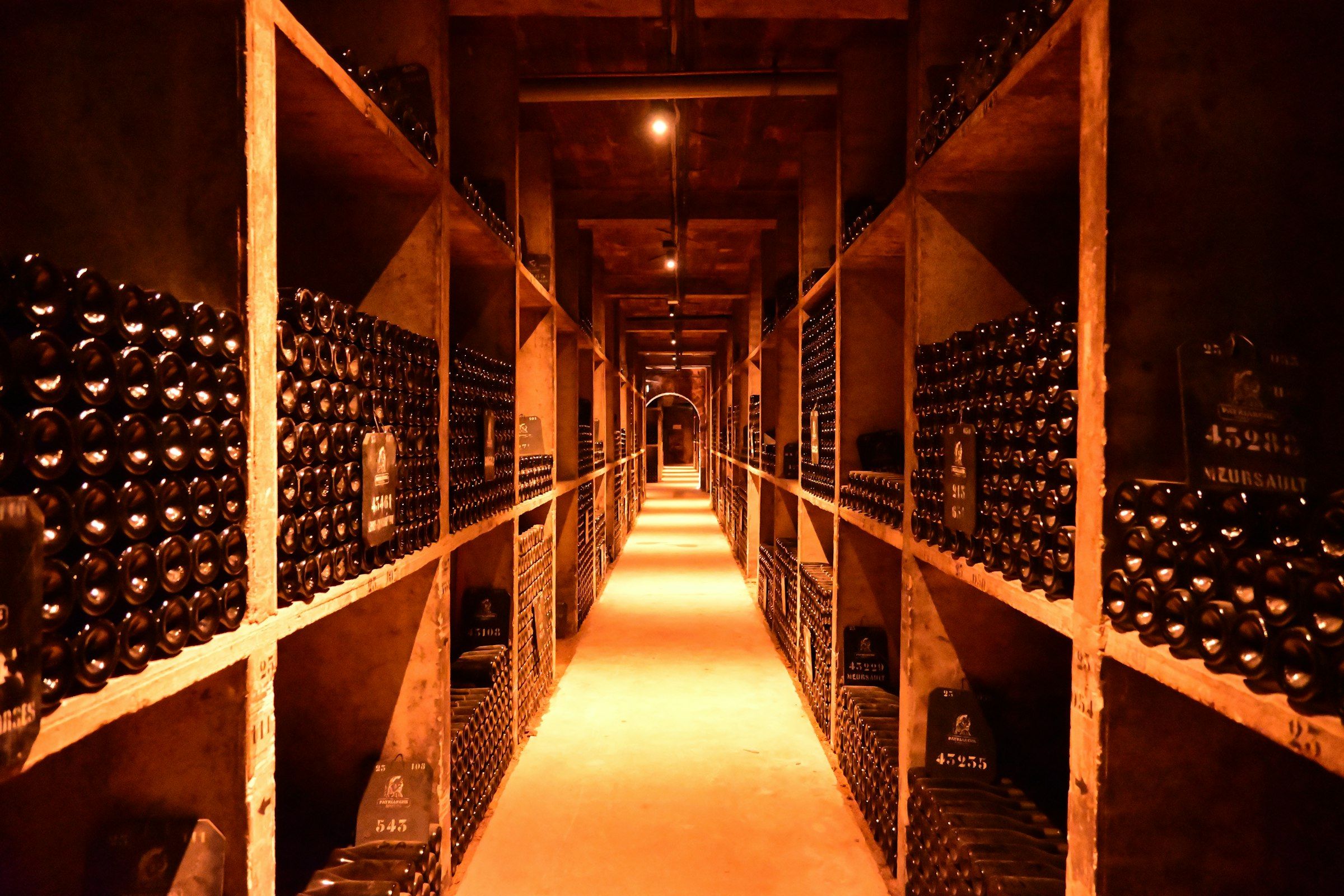
In a private cellar somewhere in Southern California, a magnum of Domaine Georges Roumier Bonnes-Mares 1923 sat on a rack for years before anyone looked closely at the label. The bottle was beautiful: the glass weighted correctly for the period, the capsule oxidised in a way that suggested it had not been disturbed. The problem was not the bottle. The problem was that Domaine Georges Roumier did not begin producing wine until 1924. Whatever was in the magnum, it was not what the label said it was, because the label described a wine that had never existed.
That single impossibility, surfaced in the early 2010s among the bottles linked to the Kurniawan inventory, did something more lasting than any individual lawsuit. It reframed the wine-investment world as a forensic exercise. The vintage on the label, for the first time, was understood as the easiest detail to fake. The harder details, the ones that could not be forged with a Photoshop file and a basement labelling rig, were the questions of wine provenance: where the bottle had been since it left the producer’s cellar, who had stored it, at what temperature, and whether any unbroken document trail could prove it.
Two scandals that forced the turn
Two cases account for almost the entire reorientation. The first was Hardy Rodenstock, a German collector who in 1985 produced four bottles of 1787 Lafite engraved with the initials “Th.J.”, which he claimed had been recovered from a walled-up Paris cellar once belonging to Thomas Jefferson. The bottles sold for record sums, one of them at Christie’s for £105,000, then the highest price ever paid for a single bottle. Jefferson’s surviving cellar records, exhaustive on the subject of his wine purchases, contained no reference to the bottles. Bill Koch, who bought several from Rodenstock, eventually commissioned independent forensic analysis. The capsules contained traces of cesium-137, an isotope released into the atmosphere by mid-twentieth-century nuclear testing and absent from any bottle sealed before 1945. The case dragged through US courts for two decades.
Like this? The TERROIR Letter arrives every Thursday.
The second was Rudy Kurniawan. Between 2004 and 2012 he sold an estimated $35 million of counterfeit Burgundy and Bordeaux through Acker Merrall & Condit, much of it from his own kitchen in Arcadia, California. When the FBI raided the house on March 8, 2012, they recovered empty bottles of Domaine de la Romanée-Conti, blank labels for vintages that did not exist (the Roumier 1923 among them), corks soaking in solutions, and printed templates for capsules. Kurniawan was convicted of mail fraud and wire fraud in December 2013 and sentenced in August 2014 to ten years in federal prison. The trial established something the trade had been reluctant to acknowledge: the most expensive bottles in the market, the great old Burgundies, were also the easiest to fake, because their provenance was almost always vague and their consumption removed them from circulation before forgeries could be cross-checked.
What the auction houses actually do now
The post-Kurniawan auction floor is a different room. Christie’s, Sotheby’s, Acker, Zachys, and Hart Davis Hart now publish provenance statements with each lot, and in the high-value categories these are no longer prose flourishes but documented chains of custody. A bottle of Romanée-Conti 1990 with a receipt from the domaine, an unbroken record of cellar storage at a single commercial facility, and a temperature log covering the intervening decades will sell at a premium of thirty to fifty per cent over an identical bottle whose history reads “from a private European collection.” The vintage is the same. The wine, in principle, is the same. The certainty about what is in the bottle is not.
The premium category is ex-domaine release, meaning a bottle sold directly by the producer from their own cellar, with no intermediate ownership. Domaine de la Romanée-Conti, Domaine Leroy, Henri Jayer’s posthumous releases through his heirs, and Domaine Leflaive all conduct periodic ex-domaine sales through the major houses. These lots clear at a multiple of secondary-market comparables. A 2005 La Tâche sold ex-domaine in 2023 reached roughly twice the hammer price of a 2005 La Tâche sold from a private cellar in the same season. The wine inside the bottle is identical. The price differential is paying for the absence of a forgery question.
Henri Jayer’s posthumous market sits inside this same dynamic. Jayer died in 2006, and his cellar releases have been administered since by his nieces. Because the Jayer name commands the highest single-producer prices in Burgundy and because his production was small and well-documented, fakes have surfaced repeatedly. The ex-domaine and heir-released bottles trade as a separate class, often labelled as such in the catalogue.
The forward question
The current frontier is whether documentation itself can be made tamper-proof. Several blockchain provenance protocols (Vinassa, WiV, EY’s Tattoo Wine project among them) attach a cryptographic record to each bottle at the producer’s cellar, updated at every transfer of custody. The protocol does not authenticate the wine. It authenticates the chain. If the chain is intact from the producer forward, and the cryptographic seal on the bottle remains unbroken, the bottle is what the chain says it is.
The limitation is structural. Blockchain provenance can only secure the chain from the moment of registration forward. The vast majority of the fine-wine market is composed of bottles that left their producer’s cellar decades before any such protocol existed. For a 1990 Romanée-Conti changing hands today, the cryptographic record begins not at the domaine but at whichever subsequent owner first chose to register the bottle, which is to say the protocol confirms that the bottle has been where the chain says it has been since 2019, and nothing about the years before. That gap is precisely the period in which the wine acquires its value and during which a counterfeit can be introduced.
Which is why, for the bottles that matter most, the question of wine provenance continues to come back to the same forensic discipline that the Roumier 1923 forced into being. Where has this bottle been. Who has held it. What does the paper say. The vintage on the label is now the least interesting fact about it.
The TERROIR Letter
The story behind every bottle.
One feature. One dispatch. One bottle worth opening. Every Thursday — free.