

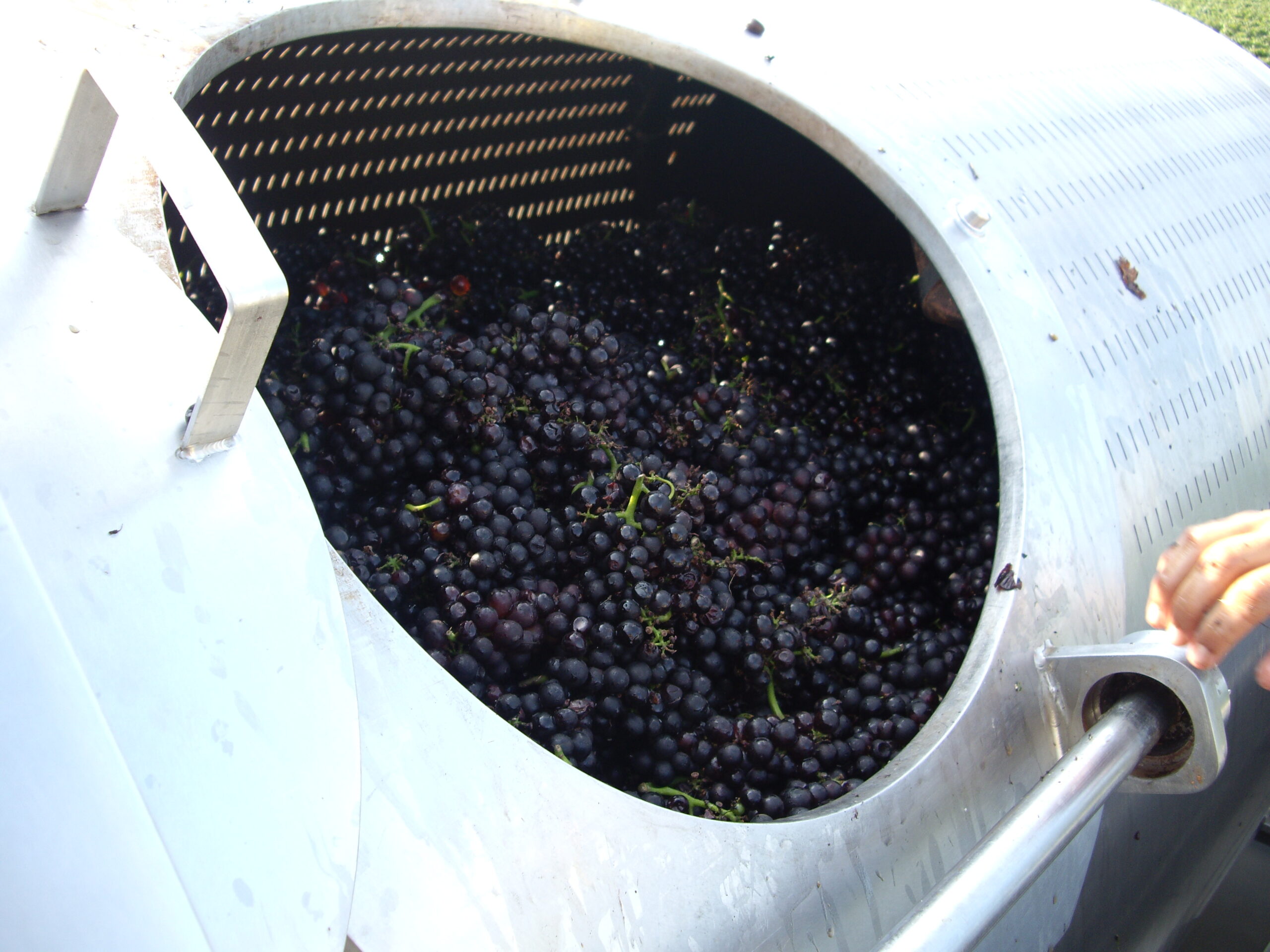
At first light on a Pinot Noir crushpad in early autumn, two pieces of equipment sit a few metres apart. On one side, the destemmer: a stainless cylinder with a rotating drum and a perforated screen, designed to shake berries off their stems and feed them into a fermenter as a loose, fruit-clean must. On the other side, an open-top wooden fermenter, empty, lined with a layer of dry-ice pellets and waiting. The cellar crew has not yet decided which one is the day’s machine.
That decision is the article. Either the clusters pass through the destemmer and arrive in the fermenter as bare berries, or they do not. There is no third option. And the wine that results from one choice will not resemble the wine that results from the other, even if everything downstream is held identical.
What the stems do, and what they cost
A Pinot Noir stem is roughly five per cent of the cluster’s weight, but its contribution to the finished wine is disproportionate. Lignified stems (brown, dry, woody to the touch) carry structural tannin that the berry itself does not produce in large quantities. Pinot’s thin skins and low seed-tannin yield make it the most tannin-poor of the major red grapes, and a fermentation with thirty, fifty, or one hundred per cent whole clusters adds backbone the grape cannot supply on its own.
Like this? The TERROIR Letter arrives every Thursday.
The aromatic contribution is more controversial. Stems carry pyrazine compounds, the same volatile family that drives Cabernet Sauvignon’s herbal register. In ripe stems at low to moderate inclusion, pyrazines read as savoury complexity: forest floor, dried herb, the faint green-tea note often described in Burgundian Pinot. In unripe stems, the same compounds read as vegetal off-notes: bell pepper, raw asparagus, a flatness that no amount of cellar work removes. Stem ripeness is therefore the load-bearing variable in the technique. A producer fermenting whole-cluster on green stems is making a worse wine than the same producer fermenting destemmed; the technique punishes haste.
There is a third effect worth naming. Whole clusters at the bottom of an open-top fermenter, weighed down by berries above them, undergo a partial carbonic fermentation inside their intact skins. Yeast cannot reach the juice through the unbroken berry, so the grape ferments anaerobically using its own enzymes, producing a different ester profile (lifted, perfumed, slightly red-fruited) before the skin eventually breaks and conventional fermentation takes over. The result is a layered aromatic structure that destemmed Pinot rarely produces.
A 70-year retreat, and a return
Before the post-war arrival of mechanical destemmers, whole-cluster was simply how red wine was made. Burgundy fermented whole bunches because there was no other practical option, and the resulting style (structural, perfumed, age-worthy) was the regional default. The destemmer arrived in cellars across France in the late 1940s and 1950s, and within a generation the technique was treated as outdated. Henri Jayer, the most influential Burgundy winemaker of the late twentieth century, was famously anti-stem; his preference for clean fruit and complete destemming shaped a whole school of producers from the 1970s through the 1990s.
The retreat was never total. Domaine de la Romanée-Conti continued fermenting one hundred per cent whole-cluster across every cuvée. Domaine Dujac under Jacques Seysses and now Jeremy Seysses held the line at eighty to one hundred per cent, depending on vintage. Domaine Leroy, under Lalou Bize-Leroy, ferments at similarly high inclusion rates. These holdouts kept the technique legible in Burgundy even when fashion was elsewhere.
The comeback gathered through the 2010s. In Oregon, Cristom in the Eola-Amity Hills built a reputation on whole-cluster Willamette Pinot, fermenting most of its single-vineyard cuvées at high inclusion. In California, Sandhi (Rajat Parr and Sashi Moorman) in the Sta. Rita Hills adopted the same logic for their Pinot programme. By the early 2020s, “what percentage whole-cluster?” had become a standard question on Pinot tasting notes, displacing earlier shorthand about oak and extraction. The trade press began tracking it. Sommeliers began asking it.
What changed was not the chemistry, which has been understood for decades. What changed was the willingness of New World producers to accept the cost: longer, cooler fermentations; the discipline of waiting for stem lignification before harvest; the risk that a green vintage produces an unsellable wine. The technique only works for growers who can defend the picking date against weather and against impatient buyers.
What the binary actually means
A wine fermented one hundred per cent whole-cluster does not taste like the same wine destemmed. The first carries lift, structure, and a savoury frame that opens slowly. The second carries fruit directness, softer texture, and an earlier-drinking profile. Neither is correct. The question is which version of Pinot Noir a given site, vintage, and producer is reaching for.
Some sites refuse high inclusion. A warm-vintage Pinot from a low-elevation New World site may not ripen stems before the fruit overripens, in which case full destemming is the only honest call. Some sites demand it: a cool, late-ripening Burgundy parcel with reliably brown stems by harvest will produce a thinner, less interesting wine if its clusters are stripped. The decision is not abstract. It is read off the cluster in the hand the morning of the pick.
Back at the crushpad, the choice has been made. The destemmer stays idle. The cellar crew tips the first bin of clusters directly into the open-top fermenter, stems and all, and the dry ice begins to sublimate around the fruit. The wine that will come out of this tank in twelve days will be recognisably Pinot Noir, and recognisably different from anything the destemmer would have produced. The two pieces of equipment, a few metres apart, do not make the same wine.
The TERROIR Letter
The story behind every bottle.
One feature. One dispatch. One bottle worth opening. Every Thursday — free.