

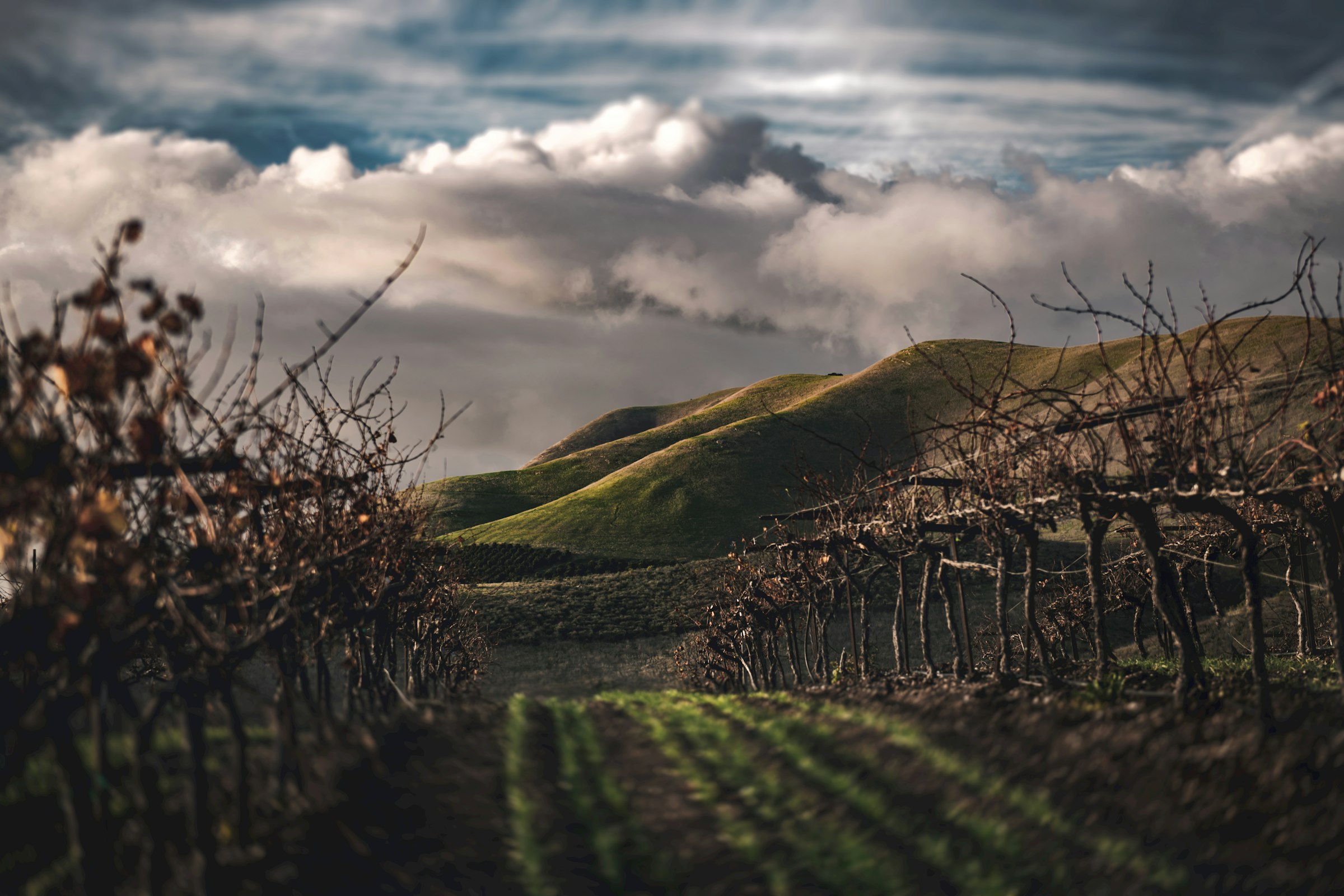
At Romanée-Conti, the most-priced vineyard on earth, the cellar team buries cow horns packed with manure across the monopole each autumn. The horns are dug up in spring, the contents stirred into water for an hour in alternating directions, and the resulting suspension sprayed at homeopathic dilution across roughly 1.8 hectares of Pinot Noir. The procedure has a number (Preparation 500), a regulator (Demeter International), and a price implication that no serious chemist has been able to explain. Aubert de Villaine has been doing it from the late 1980s. The wines, by every blind-tasting account that matters, have not gotten worse.
This is the heart of the biodynamic argument, and it is the reason “Demeter vs organic” is the wrong frame. Organic certification asks what a farm does not do. Biodynamic certification asks what a farm is. Treating the two as a ladder, where Demeter sits one rung above USDA Organic or EU Bio, misses the point. They are different paradigms wearing similar paperwork.
The floor that Demeter assumes
Organic certification, in its American and European forms, regulates inputs. No synthetic pesticides. No synthetic herbicides. No synthetic fungicides except limited copper and sulfur. A short list of permitted soil amendments. The audit, in practice, is a documentation exercise: receipts, spray logs, three years of transition before the label is granted. A vineyard that buys nothing and sprays nothing can be organic without ever using the word.
Like this? The TERROIR Letter arrives every Thursday.
Demeter certification begins where organic certification ends. The Demeter International standard requires the NOP organic floor (or its EU equivalent) as a precondition, then layers a different set of obligations on top. The nine biodynamic preparations, numbered 500 through 508, are mandatory. Preparation 500 is the horn manure already described. Preparation 501 is horn silica, ground quartz packed in cow horns and buried over summer, sprayed in the early morning. Preparations 502 through 507 are compost catalysts: yarrow blossoms fermented in a stag’s bladder, chamomile in cow intestine, stinging nettle buried directly in soil, oak bark in a skull, dandelion in mesentery, valerian extract as a liquid finisher. Preparation 508 is an equisetum tea, used as a fungicidal foliar spray. Each preparation has a prescribed application window, often tied to a lunar or planetary position.
That is the cosmological half. The agronomic half is, on its own terms, unimpeachable. Demeter farms must maintain at least ten percent of farmed area as biodiversity refuge, must integrate livestock or document a binding livestock relationship with a neighbor, must close nutrient loops on-farm rather than importing fertility, and must treat the farm as what Rudolf Steiner called a self-contained organism. A vineyard that ships in compost from a commercial yard can be organic. It cannot be Demeter.
The science problem that will not go away
Applied at the dilutions Steiner prescribed, the preparations should not work. A 1991 University of Kassel study and a longer-running DOK trial in Switzerland have tried, with mixed results, to isolate biodynamic-specific effects from the broader organic and on-farm-fertility regime. The peer-reviewed literature converges on a careful conclusion: biodynamic farms outperform conventional farms on soil biology, carbon sequestration, and biodiversity, but the marginal contribution of the preparations themselves, separated from the rest of the protocol, is hard to pin down. The horns and the stag bladders, taken at face value, are difficult to reconcile with how the rest of agricultural science describes the world.
And yet. The biodynamic roster in fine-wine reads less like a fringe than a roll call: Domaine de la Romanée-Conti, Domaine Leflaive, Maison Joseph Drouhin (in part), Domaine Leroy, Zind-Humbrecht, Nicolas Joly’s Coulée de Serrant, Pingus, Frey Vineyards in California, Quivira, Cooper Mountain. Anne-Claude Leflaive converted Domaine Leflaive over the course of the 1990s after a comparative trial against conventional plots on the same Puligny-Montrachet parcels convinced her the biodynamic wines were structurally more compelling. The wines won the trial. The chemistry of the trial remains, to this day, partly unexplained.
The honest reading is that something works, and the disagreement is over what. The skeptical case is that biodynamic farms are exceptionally well-run organic farms, that the lunar calendar enforces beneficial scheduling rigor, that the preparations are placebos for the farmer, and that the wines reflect attention and intent rather than horn silica. The biodynamic case is that the preparations themselves are doing soil-microbial work the current instrumentation cannot measure. Neither side has settled the other, and the wines continue to arrive.
What the certification actually changes in the cellar
A practical Demeter audit, for a wine producer, has three pressure points. The first is the vineyard calendar: spraying, pruning, and harvesting are scheduled against Maria Thun’s biodynamic calendar, which distinguishes root, leaf, flower, and fruit days based on lunar position relative to the zodiac. The serious producers treat this as a planning tool, not an oracle; harvest still happens when the fruit is ready.
The second is the closed-loop fertility requirement, which in practice means cover cropping, on-farm composting, and either resident livestock (Leflaive runs draft horses for ploughing) or a documented partnership. This is the requirement that separates Demeter from input-substitution organic farming, and it is also the requirement that drives a substantial portion of the vineyard cost.
The third is cellar discipline. Demeter for wine, codified in the international processing standard, restricts sulfite additions below organic levels (a maximum of 70 mg/L total for dry reds, 90 mg/L for dry whites at the time of writing), prohibits a long list of common enological additives, and limits acidification, deacidification, and reverse osmosis. A Demeter wine, in other words, is also constrained in what the cellar can do after the fruit comes in. This is where Demeter-certified producers diverge most sharply from organically-grown-fruit-but-conventionally-made bottlings.
The argument the label is making
Reading the Demeter standard against the organic standard is a useful exercise because the documents themselves are arguing. The organic standard is a list of prohibitions written by regulators. The Demeter standard is a list of obligations written by a movement. One is asking the farm to stop doing harm. The other is asking the farm to become a particular kind of thing.
Whether the cow horn does the work or the farmer does the work is, at the level of the finished wine, an academic question. The Demeter logo is not a guarantee of quality. It is a declaration that the producer has accepted a fuller set of constraints than organic certification imposes, on the conviction that those constraints make better wine. The market for fine biodynamic wine suggests, at a minimum, that the conviction is being shared.
The TERROIR Letter
The story behind every bottle.
One feature. One dispatch. One bottle worth opening. Every Thursday — free.