

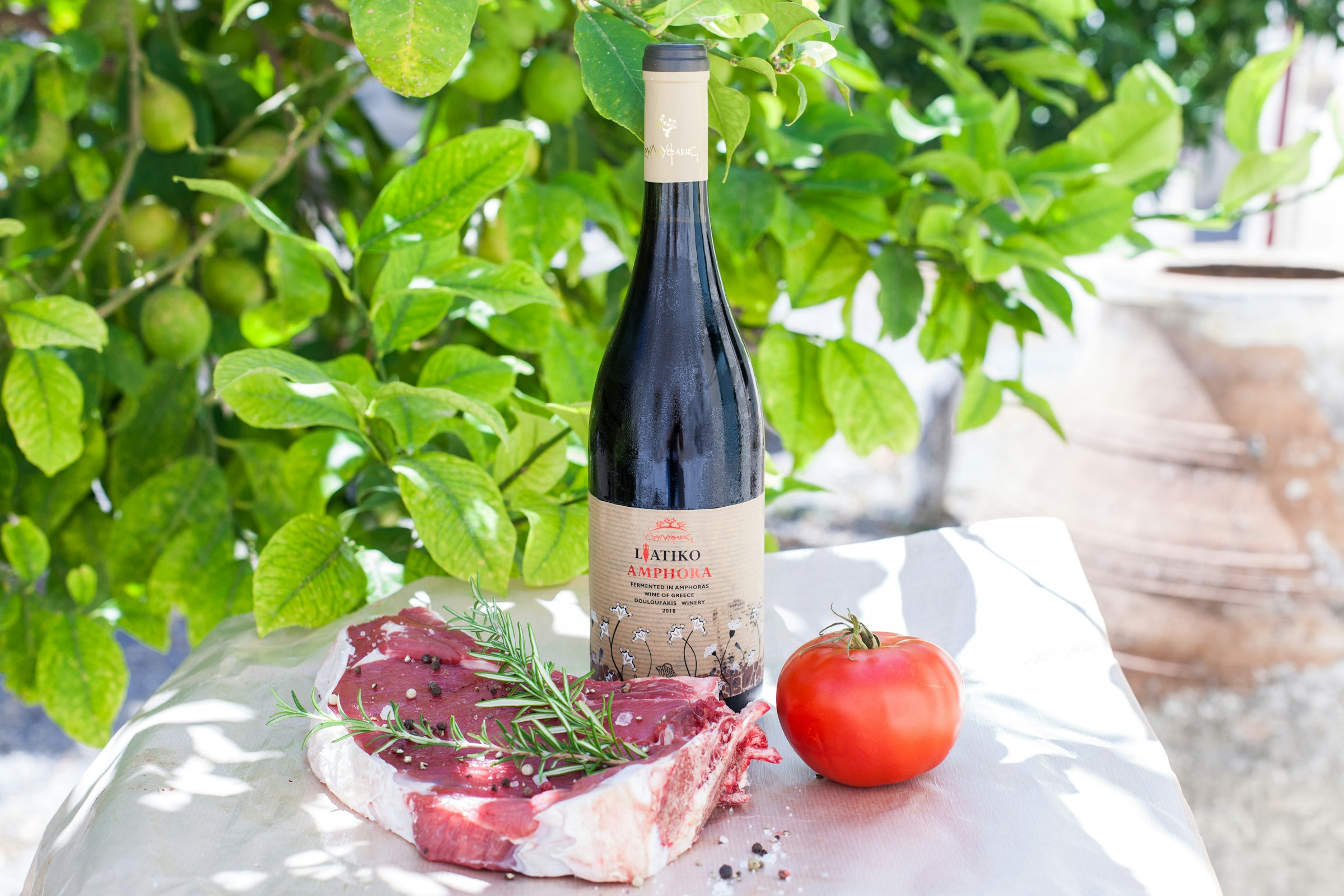
The ribeye arrives well-marbled and rested, and the diner who has read enough to know better than to default to a steakhouse Cabernet has ordered a Pinot Noir from a serious Oregon producer instead. The first bite is fine. The second bite is when something quietly goes wrong. The wine, which tasted bright and savoury on its own a minute ago, now reads thin against the fat, watery against the protein, a step behind the food at every turn. By the third bite the diner is chewing, then waiting a beat before sipping, because the wine is no longer cleaning up after the bite. It is sitting next to it.
The reason this happens, and the reason a Cabernet in the second glass would be doing the work the Pinot is not, is one of the most reliable pieces of food-and-wine chemistry there is. The steakhouse-Cabernet cliche is not tradition. It is not marketing, though marketing followed. It is biochemistry being correct on the plate.
What tannin is actually doing
Tannins are condensed polyphenols (proanthocyanidins, in the technical register) extracted from grape skins, seeds, and stems during red-wine fermentation. They have a strong affinity for proteins, and the sensation they produce on a bare palate is astringency: the drying pull a young Cabernet or a structured Nebbiolo plants on the drinker who tastes it without food. Tannin molecules bind to the proline-rich proteins in saliva, precipitate out of solution, and pull the saliva’s slipperiness off the tongue. The mouth registers the loss of lubrication as dryness.
Like this? The TERROIR Letter arrives every Thursday.
That is what tannin does when there is nothing on the palate but saliva. The binding has a hierarchy. Tannins preferentially bind to whichever protein substrate offers the highest affinity, and dietary proteins (the long muscle-fibre proteins of a cut of beef) plus the fat surrounding them give the tannin a far larger target than the small proline-rich proteins in saliva. When red wine arrives in a mouth already holding a chewed bite of ribeye, the tannin reaches the meat first, binds to its proteins and the rendered fat, and is consumed by the bite rather than by the drinker’s palate. The astringency does not register, because the polyphenols that would have produced it are no longer available.
The wine, in turn, is not just losing tannin to the meat. Alcohol is a competent fat solvent, and the wine’s ethanol dissolves a layer of rendered fat, releasing volatile flavour compounds back to the palate. The pairing is biochemically reciprocal: the meat absorbs the wine’s astringency, the wine releases the meat’s aromatics.
Why Pinot Noir disappoints with a ribeye
Pinot Noir is a thin-skinned grape. Its wines, even at the structural end of the spectrum (a serious Volnay, a Willamette Valley bottling from old vines), carry a fraction of the tannin load of a Cabernet or a Nebbiolo. The grape’s gift is aromatic complexity at low extraction. That gift becomes a liability against a fatty ribeye. The wine does not have enough tannin to absorb the fat-and-protein load on the plate, and having given up its small reserve in the first sip, has nothing left to clean up the second bite. The drinker perceives the wine as “thinning out” or “disappearing into” the meat. The chemistry is more specific: the protein-and-fat surface of a six-ounce ribeye is larger than a 150ml pour of Pinot can handle, and the imbalance reads on the palate as the wine retreating.
The same pattern shows up with Gamay, with most lighter-bodied Italian reds (Valpolicella, lighter Chianti, Frappato), and with the entry-level Spanish reds built for early drinking. None of these wines are flawed. They are matched to a different food category. Against charcuterie, against duck, against roast chicken with mushrooms, they read as their producers intended. Against a well-marbled steak they read as not enough wine.
Why Cabernet locks in
Cabernet Sauvignon sits at the high end of the tannin scale. Its skins are thick, its seeds are tannic, and a structured Cabernet (Napa, a Left Bank Bordeaux carrying enough Cabernet to drive the wine’s architecture, a Coonawarra or Margaret River bottling) arrives at the palate with a tannin reserve sized to match the protein-and-fat load of a steak rather than to be defeated by it.
What happens at the second bite is the opposite of what happens with the Pinot. The wine’s tannin reaches the meat, binds, and is consumed; the wine’s alcohol pulls a layer of fat off the bite; the wine’s mid-palate (dark fruit, cedar, graphite or tobacco depending on origin) arrives clean. The drinker registers the wine as having “cut through” the fat. What the wine has done is feed its tannin into the protein-binding hierarchy at the rate the meat can absorb it. The astringency is consumed by the meal. The flavour is released to the drinker.
The same chemistry runs for the other high-tannin reds the canon pairs with steak. Nebbiolo (Barolo, Barbaresco) does the work with a different aromatic register: roses, tar, dried cherry rather than cassis and cedar. Northern Rhone Syrah works on the same principle. Tannat from Madiran, possibly the most tannin-dense of the canonical reds, pairs with the duck-confit-and-cassoulet cuisine of its region for the same reason: regional cuisine is fat-dense, regional wine is tannin-dense to match.
The principle extended: lamb, duck, pork
The tannin-fat equation is not a single pairing. It is a curve, and the canonical pairings of the trade are readings of that curve at different points: the tannin load of the wine should match the protein-and-fat density of the dish.
Lamb sits near the top with steak. Fat is high, flavour is savoury and gamey, and Syrah is the trade default for structural reasons: Northern Rhone at the Cornas / Cote-Rotie tier has both the tannin load and the olive-and-peppercorn aromatics. A structured Spanish red (Rioja Gran Reserva, Ribera del Duero) sits in the same window.
Duck breast sits lower. The skin is fat-rich but the breast itself is leaner, and the canonical Pinot Noir pairing works for the same structural reason the Pinot-with-steak pairing fails: less fat to absorb, lower tannin reserve sufficient, aromatic complexity free to register.
Pork sits further down again. Moderate fat, broader range (lighter-bodied reds, structured rose, weightier whites with some residual sugar). A heavy Cabernet against a pork chop is the inverse of the Pinot-against-ribeye problem: too much tannin for the fat reserve to absorb, and the wine reads as overweight.
The steakhouse-Cabernet pairing is the high end of the curve, the place where the protein-and-fat density of the dish is great enough that only a high-tannin red can carry it. The cliche is correct. The diner who learns the chemistry does not stop drinking Cabernet with steak. The diner learns where on the curve the next dish sits, and orders the wine the curve asks for.
Back at the table, the ribeye is still on the plate and the Pinot is still in the glass. The server, asked, will bring a second glass: a Napa Cabernet the room pours for moments like this one. The third bite, the one the Pinot could not keep up with, is a different bite under the Cabernet. The fat is being absorbed, the protein is being met, the wine is releasing its dark-fruit-and-graphite character cleanly to the palate. The pairing is not louder than the Pinot pairing was. It is just calibrated.
The TERROIR Letter
The story behind every bottle.
One feature. One dispatch. One bottle worth opening. Every Thursday — free.