

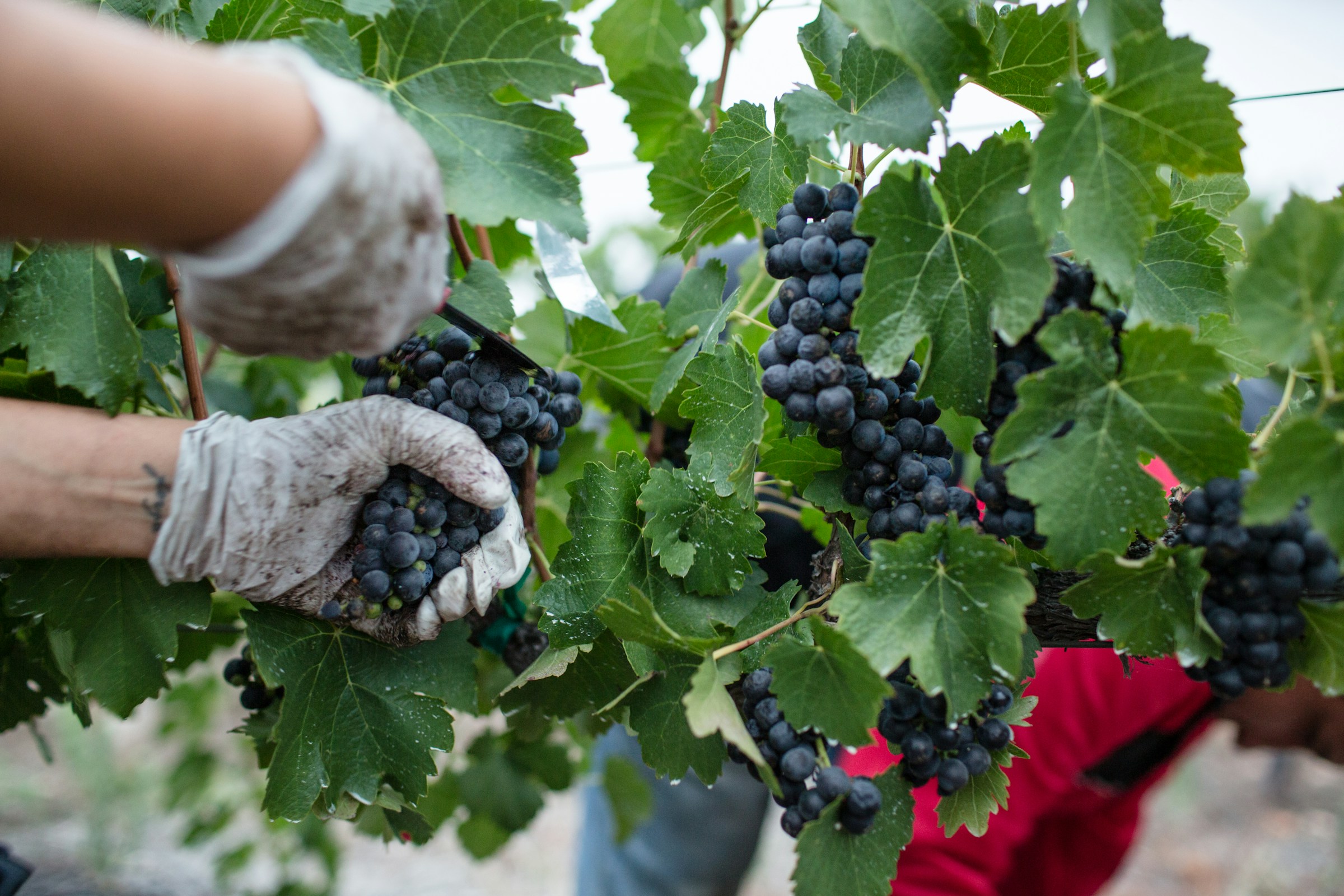
Two bottles on a wine-shop shelf in November of 2025, both white Burgundy, both Chardonnay, both bottled by Maison Louis Jadot in Beaune. The first price tag reads $80, the second reads $18. The first is a village Meursault from the Côte de Beaune, the wine that has come to define what serious white Burgundy is supposed to cost. The second is a Mâcon-Villages from a band of limestone hills sixty kilometres south, made by the same négociant from the same grape on geologically related rock. The buyer holding the second bottle is buying the part of Burgundy the price ladder has not yet found.
The Mâconnais is the southernmost of the four major Burgundy white-wine districts, and at the village-and-regional tier it now sits roughly a third the price of a comparable Côte de Beaune village wine. For the reader who has watched Bourgogne Blanc cross fifty dollars and Meursault village wines settle in the seventy-to-ninety band, the Mâcon-Villages shelf at fifteen to twenty-five dollars reads almost like a clerical error. It is not. It is the consequence of a two-century-old hierarchy, applied to a vintage (2024) bottled into a market where the wine above it has become unaffordable for the household it used to serve.
The pricing gap that opened
Côte d’Or pricing has been moving in one direction for the better part of a decade, faster since 2018. The Burgundy hierarchy concentrates demand at the top, the top has been hollowed out by collector demand and short crops (2021 frost above all), and the price compression that kept village-level Côte de Beaune within reach of a careful household has unwound. A village Meursault at $35 in 2012 reads as an $80 bottle on the same shelf today. Premier Cru Meursault has moved into the $150-and-up band. Bâtard-Montrachet at the Grand Cru tier is a four-figure wine in any vintage worth a label.
Like this? The TERROIR Letter arrives every Thursday.
The Mâconnais price line has not moved with it. Mâcon-Villages holds at a Wine-Searcher average around $18 for the Louis Jadot 2024. Saint-Véran sits in the low-to-mid twenties. Pouilly-Fuissé, the only Mâconnais appellation granted Premier Cru status (twenty-two climats elevated in September 2020), reaches into the forties and fifties at the village tier, a fraction of what the same level of ambition costs sixty kilometres north.
The gap is not because the wine is worse. It is because the wine sits below the appellation rung the trade has been pricing for. Mâcon-Villages does not carry “Côte d’Or” on the label, and the buyer paying for the brand of Côte d’Or is not, by definition, paying for what sits south of it.
The geology that did not change
The Côte d’Or is a limestone escarpment running south from Dijon to the Dheune, the east-facing slope on which the great whites of Meursault, Puligny-Montrachet, and Chassagne-Montrachet are grown. The substrate is Jurassic limestone laid down on a shallow seabed some hundred and seventy million years ago, weathered into the marl-and-limestone topsoils Chardonnay reads as the language it was built to speak.
The limestone band does not stop at the Dheune. It continues south through the Côte Chalonnaise and into the Mâconnais, surfacing in the hills above Vergisson, Solutré, Fuissé, and Chaintré (the four communes of Pouilly-Fuissé) and east toward Verzé and Viré-Clessé. The Mâconnais geology is, in the standard Burgundy reference, “similar to that of the Côte d’Or.” The alkaline clay over limestone in the southern hills is the soil type Chardonnay reads most cleanly almost anywhere.
The Mâconnais climate is fractionally warmer than the Côte de Beaune, and the wines tend to carry slightly more weight of fruit and slightly less of the cool vertical line that defines a Meursault. The substrate continues, the variety is the same, and the cellar work at the careful end of the Mâconnais is increasingly the same too. The chasm in price between the two halves of the same limestone band is a chasm in market, not in rock.
Producers and the 2024 vintage
The Louis Jadot Mâcon-Villages is the shelf-anchor reference at the négociant tier: widely distributed in the American market, consistent year to year, the 2024 trading around $18. It establishes the floor. Maison Joseph Drouhin sits at a similar tier with a Mâcon-Villages and further-up-the-ladder bottlings (Pouilly-Fuissé, Saint-Véran), the 2023 still in market alongside the early 2024s. Both houses have spent decades inside the Côte de Beaune; the same hands working the Meursault bottling work the Mâcon-Villages.
The grower-domaine layer is where the argument tightens. Domaine Henri Perrusset, on a small estate at the northern edge of the Mâconnais, farms biodynamically on limestone and marl and bottles a careful, unoaked Mâcon-Villages at the upper end of the value tier. Domaine Robert et Damien Martin, in Verzé, bottles a Mâcon-Verzé 2024 that appears on the Vivino Top-25 Mâconnais list this year and trades at a small premium to generic Mâcon-Villages. Above them, Domaine Daniel Barraud in Vergisson works the Pouilly-Fuissé tier with a precision the trade has described in serious-white-Burgundy language for two decades.
The 2024 vintage in the Mâconnais was complicated by an early-spring frost and a damp summer, but the better growers brought in clean fruit at sound acidity, and the wines are showing fresher and more vertical than the warmer 2022 and 2023 bottlings. A careful 2024 Mâcon-Villages should drink well over the next two-to-five years; a Pouilly-Fuissé from a top grower will reward five-to-ten. Neither is made to age the way a Premier Cru Meursault is, and neither is priced as if it were.
What to do with the bottle
The bottle at $18 is not a substitute for a Meursault. It is its own wine. Drink it cold but not refrigerator-cold, around ten degrees Celsius, in a stem with a wide enough bowl for the fruit to open. Pair with what a careful drinker pairs with white Burgundy at any tier: roast chicken, soft cheeses (Comté sits on the same limestone arc through southern Burgundy into the Jura), white-fleshed fish, a quiche that takes its eggs seriously. The Pouilly-Fuissé at $45 belongs at a more considered dinner; the Mâcon-Villages at $18 is the Tuesday wine, which is the wine the household used to expect village-level Côte de Beaune to be.
For the buyer following the argument seriously, the order is straightforward. Start at the négociant tier (Louis Jadot, Joseph Drouhin). Move to a grower-domaine bottling (Henri Perrusset, Robert et Damien Martin) at $20 to $28. Try a Saint-Véran in the low twenties and a Pouilly-Fuissé in the forties. Then put a village Meursault next to a Pouilly-Fuissé from a serious grower in the same vintage. The Meursault will still be the more layered wine, in most vintages, by a careful margin. That margin will not look like a sixty-dollar gap.
The argument is not that the Côte d’Or is overpriced. It is that the price ladder has stretched, and the wine immediately below its bottom rung, made from the same grape on the same limestone band by some of the same houses, is still bottled at the price the ladder used to start at. The shelf in November of 2025 carries the asymmetry openly. The two bottles in hand, $80 and $18, are the evidence.
If you buy through a link in this article, TERROIR may earn a commission. Disclosures
The TERROIR Letter
The story behind every bottle.
One feature. One dispatch. One bottle worth opening. Every Thursday — free.