

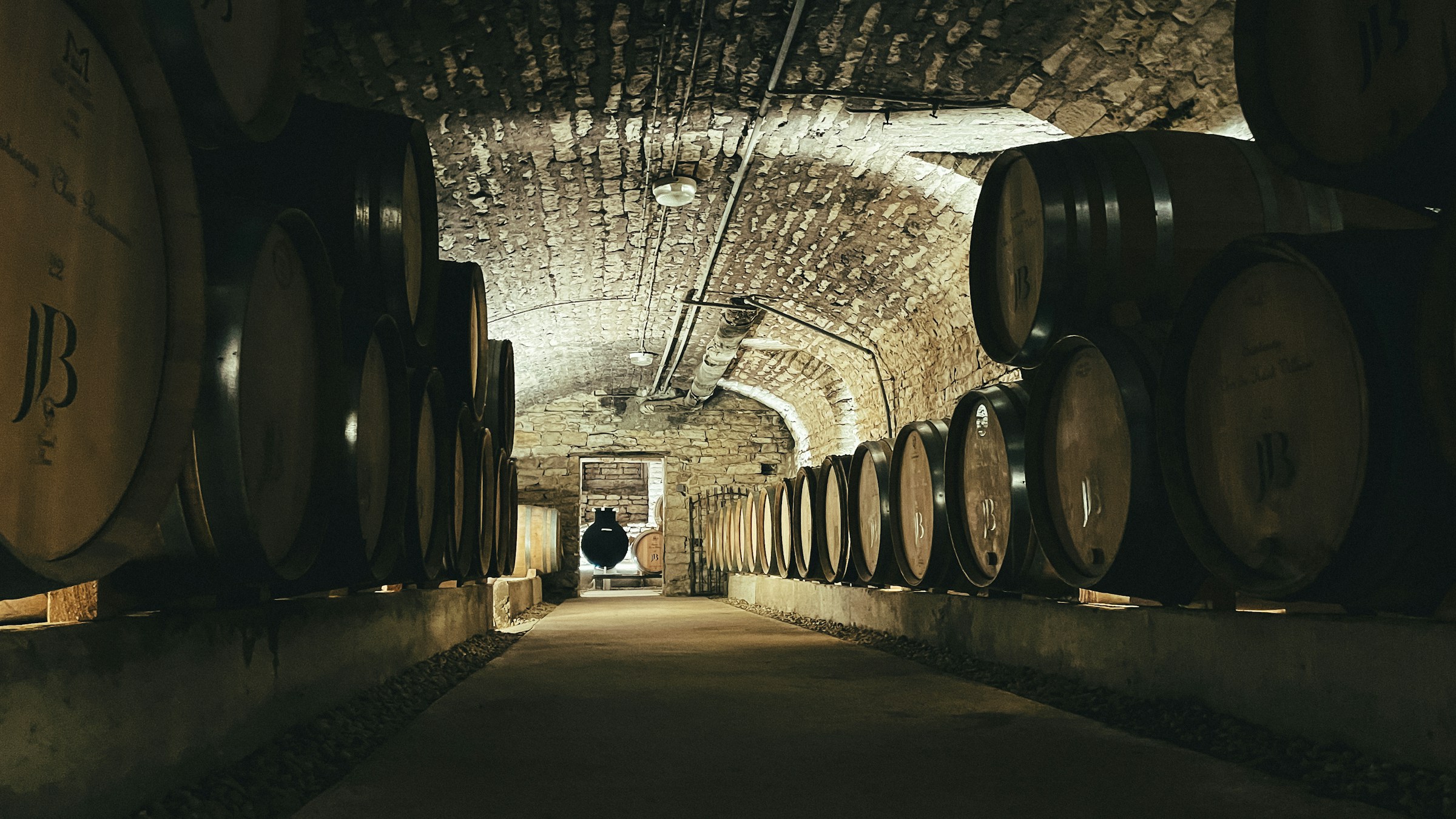
The first thing many drinkers notice in a barrel-fermented Chardonnay is a texture rather than a flavor: a roundness across the middle of the palate, a sense of weight that has nothing to do with sweetness and everything to do with mouthfeel. It reads as richness. It reads, often, as the oak. Most of the time it is neither. That creaminess is the residue of a decision someone made in a cold cellar over the winter, usually with a stick.
The technique is called bâtonnage, which Jordan Winery defines plainly as “the French term for stirring wine lees.” The mechanic is as simple as the word suggests. A winemaker drops a rod through the bunghole of a barrel and stirs, lifting the sediment of spent yeast off the bottom and back into suspension. A few seconds per barrel, repeated through the months a wine spends in wood, is enough to change how the finished wine feels in the mouth. Understanding what that stirring does, and why a generation of white-wine producers has been quietly doing less of it, is a small lesson in how texture gets built and, sometimes, how it gets taken apart.
What the Stick Actually Does
The sediment at the bottom of the barrel is not uniform. Winemakers divide it into gross lees and fine lees, and the distinction governs everything that follows. Gross lees are the coarse fraction, larger than 100 microns: grape fragments, dead yeast in clumps, the debris that settles out within a day of fermentation ending. Left undisturbed in quantity, they can turn reductive and give off the smell of hydrogen sulfide, which is why most winemakers rack them away early. Fine lees are the patient half of the story. Measured in single digits to a few tens of microns, they stay suspended longer, and as the spent yeast cells break down in a process called autolysis, they release mannoproteins and polysaccharides into the wine.
Like this? The TERROIR Letter arrives every Thursday.
Those mannoproteins are what the drinker tastes. They coat the palate, add volume through the middle, and round off the edges of acidity and astringency. Jordan describes the result as “more weight in the mid-palate, more creaminess and more complexity from being in contact with those lees.” WineMaker Magazine reaches for the same vocabulary: “extra body and mouthfeel,” a “creamier mouthfeel.” Stirring speeds the exchange along by keeping the lees in motion and in contact with the wine, rather than packed inertly at the base of the barrel.
This is the line that separates two terms drinkers often blur. A Muscadet labeled sur lie has rested on its lees without agitation, taking on a faint texture and a prickle of freshness from passive contact. A barrel-fermented Chardonnay that has been stirred has had that contact deliberately amplified. The lees are the same raw material; the stick is the difference. It is the same logic that runs through malolactic fermentation, another lever on a white wine’s texture, and the same reason producers working with concrete eggs value a vessel that keeps fine lees in gentle suspension without anyone lifting a rod at all.
The Paradox in the Barrel
Here the technique turns on itself. Yeast lees are, among other things, an oxygen sponge. As they autolyze they consume dissolved oxygen, scavenging it out of the wine and buffering it against premature aging; studies of commercial whites have measured lees absorbing anywhere from none to nearly half of the dissolved oxygen present over the first six months in barrel. In that sense a bed of fine lees is a reservoir of protection, an antioxidant the wine carries within it.
The catch is that the act of stirring introduces the very thing the lees are there to remove. Each time the bung comes out and the rod goes in, the wine meets a little air. Bâtonnage is therefore protective and risky in the same gesture: it builds the texture that mannoproteins provide while nudging the wine toward the oxidation it might otherwise have resisted. The arithmetic is not even simple to game, because the lees’ appetite for oxygen is strongly suppressed by sulfur dioxide, the winemaker’s other main antioxidant. The two do not stack. A cellar that leans hard on sulfur cannot count on the lees to do double duty, and a cellar that leans on the lees has to be careful about how much air the stirring lets in.
The Retreat from Richness
For a long stretch of the late twentieth century, richer was the goal, and bâtonnage was the means. Then some of the most closely watched cellars in white Burgundy began, quietly, to put the stick down. Domaine Coche-Dury, a name that needs little introduction among collectors of white Burgundy, is reported to have pulled back sharply on its stirring from the late 1990s, reducing it further by the early 2000s. Jean-Marc Roulot stirs only sparingly, every few weeks until malolactic conversion at most, on the grounds that bâtonnage “can create heaviness” where he wants tension and clarity. Others were blunter still: Domaine François Jobard is described as abhorring the technique outright.
Part of the retreat traces to a crisis. Beginning with the 1995 to 2002 vintages, white Burgundy suffered an epidemic of premature oxidation, bottles browning and shedding their fruit years before they should have. Bâtonnage became a prime suspect. The honest reading, though, is that no single cause was ever proven. Reduced sulfur additions, the cleaner juice of pneumatic presses, faulty corks, and low glutathione in stressed vineyards have all been named alongside stirring, and the people who studied the problem most closely tend to agree the cause is still not known for certain. What can be said is that the suspicion was enough to change behavior, and it arrived just as taste was shifting away from breadth and toward line and freshness, a direction that made heavy stirring feel dated regardless of where one stood on the cork question. Controlled trials gave the skeptics cover: in one such trial, an unstirred Chardonnay was preferred at four months and described as fresher, with more varietal definition, than its stirred counterparts.
None of this makes bâtonnage a mistake. It makes it a choice with a cost, and winemakers have grown more deliberate about when to pay it. Some now pursue the texture by other means, leaving a wine on its fine lees without agitation, or rolling the whole barrel to lift the sediment without ever opening the bung to the air. The creaminess is still there for anyone who wants it. What has changed is that its absence has become a statement too. The next time a barrel-fermented white feels broad and soft across the palate, or pointedly does not, it is worth remembering that the texture was authored. Somewhere in a winter cellar, someone decided how often to pick up the stick, and someone decided when to set it down.
The TERROIR Letter
The story behind every bottle.
One feature. One dispatch. One bottle worth opening. Every Thursday — free.