

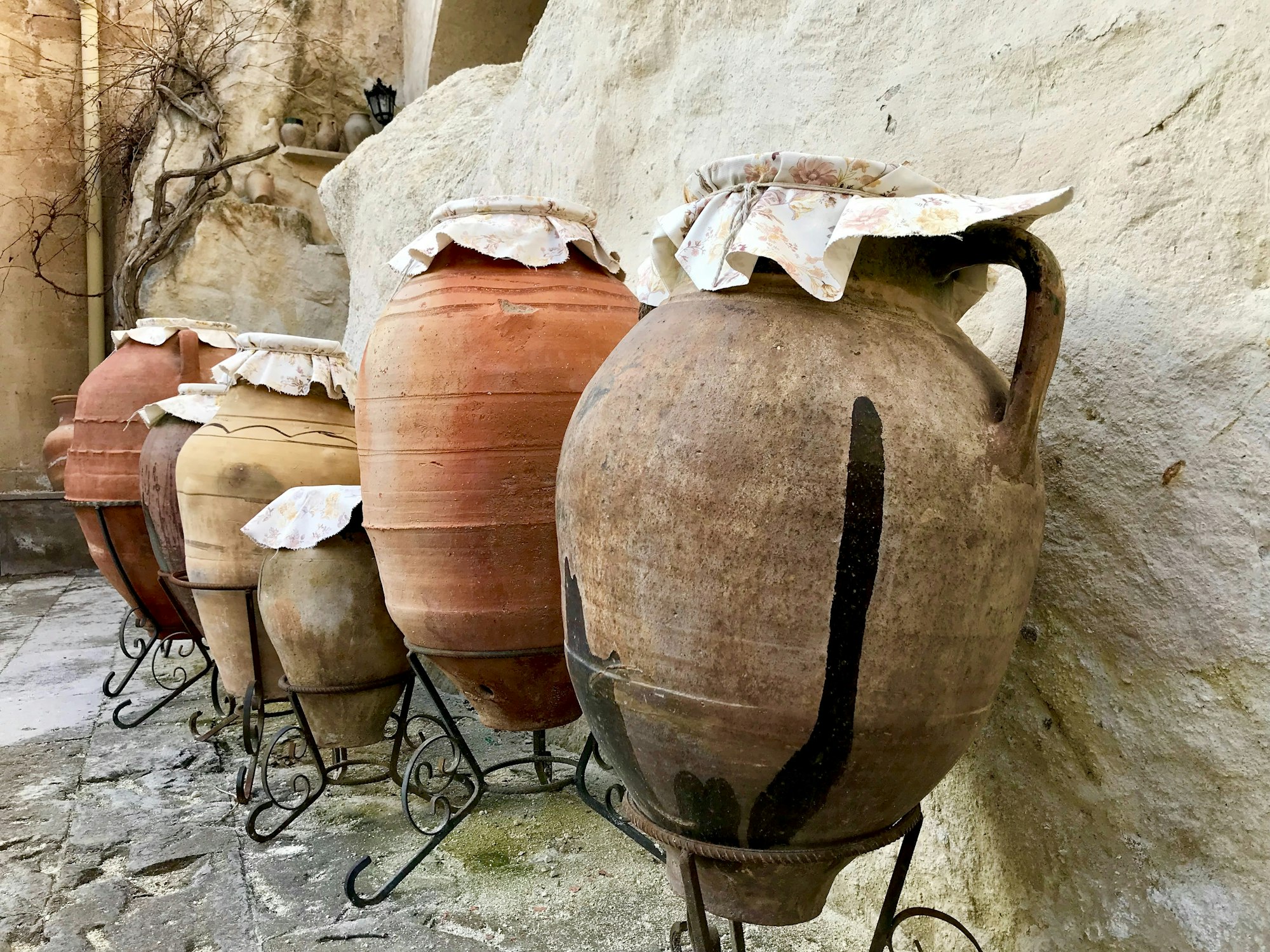
In a Kakheti cellar in spring, after the floor has been swept and the room cooled to the year’s working temperature, a winemaker lifts a stone lid from a vessel buried up to its rim in the cellar floor. The lid comes off in two hands. Underneath, a kvevri eight hundred litres deep holds wine that has been sealed there since the previous autumn, fermenting on its own skins, seeds and stems through the cold months, the clay walls pulling heat out into the surrounding earth. The wine inside is the same colour as weak tea or pale amber, and it is not red. It is white wine, made the way white wine was made before anyone wrote down how to make it.
This is the scene the trade now calls “orange wine,” a name coined in Britain in the early 2000s for a category that is simultaneously the oldest white-wine method on earth and a 1990s Friulian reinvention. The contradiction is the story.
Kakheti, the long arc, and a five-thousand-year gap
The kvevri tradition has deep archaeological roots in the South Caucasus. Excavations at sixth-millennium-BC sites in Kvemo Kartli (Dangreuli Gora, Gadachrili Gora, Imiri) have recovered tartaric-acid residues in early earthenware vessels, the chemical signature of grape fermentation. Kvevri range from twenty to ten thousand litres, eight hundred a working norm, buried in the earth or set into cellar floors. In 2013, UNESCO inscribed the Georgian traditional method of winemaking in qvevri on its Representative List of Intangible Cultural Heritage.
Like this? The TERROIR Letter arrives every Thursday.
That recognition has been read, in trade and popular writing, as evidence of an unbroken eight-thousand-year tradition. Recent archaeological scholarship contests the framing. Newer work argues for a substantial discontinuity in the kvevri record, with the modern ubiquitous use of buried clay vessels representing a twentieth-century restoration of the tradition rather than an organically preserved technological continuity from the Neolithic. The deep antiquity is real. So is a continuity gap on the order of millennia, during which the practice was reduced, regionalised, and in many places abandoned, before being deliberately reconstituted in the past century.
The honest version of the long arc is neither “eight thousand years of unbroken tradition” nor “an invented heritage.” It is older than almost anything else in working wine, and it is also a restoration. The second half of the story is set not in Kakheti but in north-eastern Italy.
Oslavia, 1996, and the Friulian reinvention
The hill of Oslavia sits on the Italian side of the border with Slovenia, in the Collio sub-zone of Friuli-Venezia Giulia. Joško Gravner had been making white wine there since the 1970s, increasingly disenchanted with the clean stainless-steel style that had come to define modern Friulian whites. In 1996, a hail event damaged the Oslavia harvest. Working with the surviving Ribolla Gialla, Gravner took the opportunity to begin extended skin-maceration trials on his whites, fermenting them in contact with their skins for weeks rather than pressing them off in hours.
What followed was a deliberate excavation. Gravner travelled to Georgia in the late 1990s to study the kvevri method directly, and in 2001 he made his first wine fermented in buried clay vessels imported from Kakheti. He was not the only producer working in this direction, but his reach was disproportionate. In the same Oslavia neighbourhood, Stanko Radikon and Dario Prinčič were already pushing extended-maceration whites. Across the border in the Brda valley, Aleks Klinec, Edi Simčič and Aleš Kristančič were doing parallel work in Slovenia. By the late 2000s, the cluster across the Italian-Slovenian border had become the working centre of the modern skin-contact white movement.
The Friulian reinvention is therefore a specific historical event, not an evolution. It begins with a hail-damaged harvest, an experimental decision, and a research trip; it crystallises around a cohort within roughly a ten-kilometre radius; and it spreads from there into the natural-wine bars of London, New York, Copenhagen and Tokyo, where the British neologism “orange wine” became the working name. The Friulian cohort did not pretend to be Georgian, but the Georgian tradition gave their experiment a structure to work inside.
What the wine actually is, and what skin contact does
The mechanical definition is narrow. Orange wine is white wine made with extended skin contact during fermentation, usually measured in weeks rather than hours. The skins of white grapes carry the same family of compounds (phenolics, tannins, anthocyanin precursors) that give red wine its colour, structure and grip. Press a white grape off its skins in two hours and those compounds stay behind. Ferment on the skins for two months and they extract into the wine. The result reads more like a structured rosé or a light-bodied red than a conventional white: amber to copper, tannic on the gum, with the texture of a wine that has chewed through something on its way out of the cellar.
Two ancillary points are worth naming because they are routinely conflated with the category. Skin-contact whites are not by definition natural wine, though much of the modern category sits inside the natural-wine movement; the chemistry of extended maceration is independent of sulphur regime, yeast source, or vineyard certification. And skin contact is not by itself a low-intervention move. Working with skins requires more cellar judgement than working without them, not less: the cap has to be managed, and the press cut at the end of fermentation is a single irreversible decision. Producers who work this way tend to keep sulphur additions low because the polyphenolic load of the wine itself buffers oxidation, not because the category demands it.
Reading orange wine on a list, in 2025
The category has moved out of its early-2000s natural-wine bar context and onto the by-the-glass programs of mainstream restaurants. On a working wine list in 2025, an orange wine entry is most often one of three things. It is a Friulian or Slovenian Ribolla Gialla from the Oslavia–Brda cohort or its second generation, drinking as the most chewable white on the list. It is a Georgian Rkatsiteli or Mtsvane from a Kakheti producer working in qvevri, often imported in small allocations, drinking older than its vintage suggests because clay-vessel ageing flattens early-life primary fruit. Or it is a domestic skin-contact white from California, Oregon, the Finger Lakes or the Loire, varietally unfamiliar and worked in a hybrid of the two older models, usually shorter on the skins and lighter in extraction than the European reference points.
None of the three are interchangeable. Orange wine is a method, not a flavour profile; the producer’s hand, the grape, and the maceration length matter more for what arrives in the glass than the category label. The label is useful trade shorthand and an unreliable predictor of any specific bottle.
Which is to say: the kvevri in the Kakheti cellar and the open-topped fermenter in the Friulian one are doing related work on either end of the same arc. The arc has a five-thousand-year gap in the middle, and a 1996 hail event at the modern end, and a stone lid in eight hundred litres of working tradition at the other. The wine in the glass is the same colour at both ends. The label “orange” is younger than either.
The TERROIR Letter
The story behind every bottle.
One feature. One dispatch. One bottle worth opening. Every Thursday — free.