

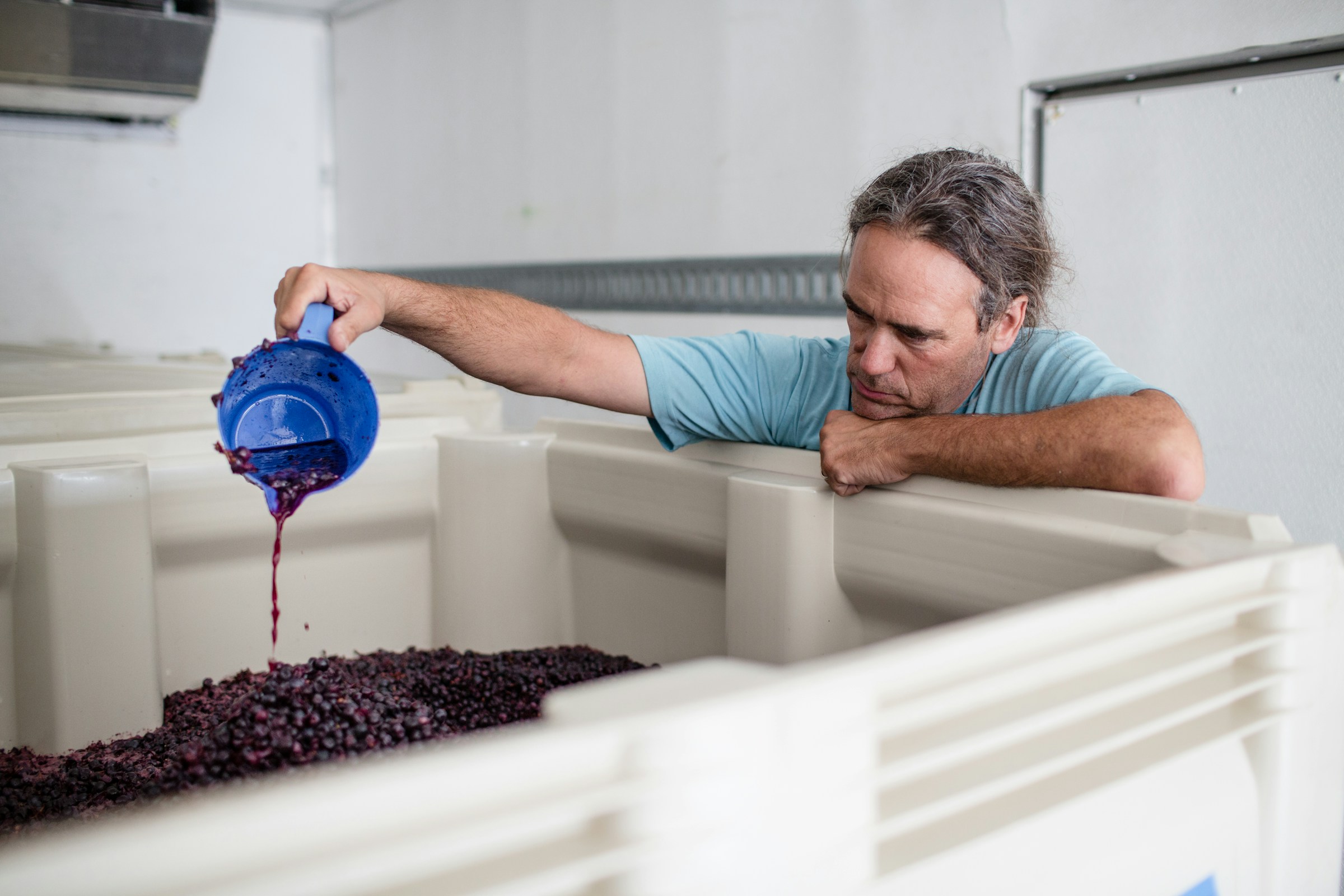
A small cellar in the middle of red-wine fermentation, two open-top fermenters side by side, both filled with the same fruit picked off the same hillside on the same October morning. One has a hand on a punching tool, driving the wooden disc down through a thick cap of skins and seeds until the cap breaks up and disappears into the juice underneath. The other has a hose looped from a valve at the base of the tank up over the rim, pumping juice out the bottom and spraying it back across the top of the cap in a slow, even shower. Same fruit, same yeast, same temperature. Two operations running in parallel on two tanks of the same wine. By next spring, after malolactic and racking, the two tanks will not taste the same.
That gap is what cap management is. Every red wine fermentation has the same physical problem: as yeast turns sugar into alcohol, they throw off carbon dioxide, and the CO2 lifts the grape skins and seeds to the surface of the tank in a dense floating cap. The juice underneath is what becomes wine. Everything that gives red wine its color, its tannin, its aromatic depth (anthocyanins, phenolic compounds, the aromatic precursors) is in the skins, not the juice. Left alone, the cap dries out and the juice ferments below it as a thin, pale liquid that nobody would recognize as red wine. The cap has to be reintegrated, repeatedly, throughout fermentation. How that happens, and how often, and with what force, is one of the most consequential decisions any red-wine producer makes.
The two operations
The Winemakers Research Exchange, an industry-funded trial network that runs side-by-side cellar experiments and publishes the results, defines the two options in plain terms. Punch-down is the “displacement of solids into the fermenting liquid by a punching tool… until the cap is physically broken up.” Pump-over is the “pumping of fermenting liquid from the bottom of the tank over the cap, sometimes with intentional aeration.”
Like this? The TERROIR Letter arrives every Thursday.
The physical difference is sharper than the definitions suggest. A punch-down is a vertical mechanical action: a wooden or stainless disc on the end of a pole, pressed down by hand or by a small hydraulic arm, breaking the cap apart and forcing the skins back into the juice. Energy lands directly on the solids. A pump-over is a circulation: juice is drawn off the bottom valve, returned over the top, and filters down through the cap to rejoin the juice underneath. Energy lands gently, in liquid form. Aeration can be added by exposing the returning juice to air on its way over, which feeds the yeast oxygen and helps fermentation finish clean.
Both operations integrate the cap. Both happen multiple times a day at peak fermentation. The wines they produce are different because what they do to the cap is different.
The extraction asymmetry
The Winemakers Research Exchange puts the contrast directly. Punch-down “is thought to increase skin extraction, promote extraction of seed tannin, and increase the tannic structure of the wine.” Pump-over “is not believed to affect tissue integrity, and is thought to be more gentle, limiting vegetal or bitter extraction.”
The asymmetry is mechanical, and then chemical. The punching disc physically tears at the cap. Skin tissue breaks; seed coats fracture; aromatic precursors and tannin compounds dissolve into the juice faster and more completely. A pump-over passes liquid through the cap without disturbing tissue structure. Extraction still happens (the cap is wet, the juice is contacting the skins, alcohol is being produced and is doing its own solvent work), but the cap stays intact, and the most aggressively extractable parts of the cap, the seed tannins and the bitter compounds in stem and skin tissue, stay locked inside until the wine itself comes to retrieve them.
The chemistry sharpens at the back end of fermentation. Per Word on the Grapevine, “punchdowns tend to extract more tannins, particularly as alcohol levels rise, given that tannins are more soluble in alcohol.” A tank in the first three days has maybe two or three percent alcohol; a tank on day eight or nine is approaching its finished alcohol of fourteen percent or higher. Tannins that would not dissolve in juice will dissolve in wine, and the punching disc at day nine is working in a solvent that wants to pull tannin out. A pump-over at the same stage moves the same alcoholic juice through the cap but does not tear it. The window of maximum mechanical extraction lines up with the window of maximum chemical solubility.
In glass, the difference reads as structure. A wine made entirely on punch-downs tends toward density: more color, firmer tannin, a longer grippier finish. A wine made entirely on pump-overs tends toward translucence: paler color, softer tannin, a finish that releases the palate rather than holding it. Neither is better. Each is a different version of the same fruit.
The hybrid protocol
The two-tank scene at the top of this article is real in some cellars but rare. Most producers do not pick one operation and stay with it. They run a protocol, and the protocol is timed to fermentation.
A common approach for Pinot Noir, the grape most sensitive to tannin extraction because of its thin skins and bitter-releasing seeds, is a three-phase hybrid circulated widely in technical practice: “mostly pumpovers until the grapes start fermenting…he then switches to punchdown until the must is dry, he then briefly returns to pumpovers.” The reasoning tracks the chemistry. In the cold-soak phase, alcohol is at zero and the goal is color and aromatic extraction without seed-tannin release: pump-overs are gentle enough to start without overworking the cap. Once fermentation begins and alcohol climbs, punch-downs build tannin frame as the solvent comes online. After the must goes dry, brief pump-overs return for one purpose: to keep the cap wet enough to avoid acetic spoilage during the final post-fermentation maceration. Three phases, three different jobs, the same tank.
Bordeaux protocols on Cabernet and Merlot, where seeds are larger and skins thicker, lean longer on pump-overs throughout, with délestage (drain the tank, let the cap compact, pump the juice back over) used when the cellar wants more structure without mechanical punching. Northern Rhône protocols on Syrah often use punch-downs in open-top wooden fermenters, sometimes with the producer’s own foot doing the work. Burgundy producers working with whole-cluster Pinot Noir frequently begin with foot-stomping, the gentlest mechanical action available, before any pump or pole touches the tank.
The protocol is the answer, not the operation. When a winemaker is asked why this year’s bottling feels softer or chewier than last year’s from the same vines, the answer is rarely the vintage in the simple sense of weather. The vintage is the input. The protocol is what the cellar did with it.
Back in the small cellar at the top of this article, one of the two tanks is now winding down. The punching tool is parked against the wall. The cap that was breaking up under the disc has collapsed into a thin skin on top of clear, dark juice. The other tank is still being pumped, the hose still looped from base to top, the cap still floating but wet. Same fruit, same yeast, same hillside. Two different wines, already, because of what happened with a stick.
The TERROIR Letter
The story behind every bottle.
One feature. One dispatch. One bottle worth opening. Every Thursday — free.