

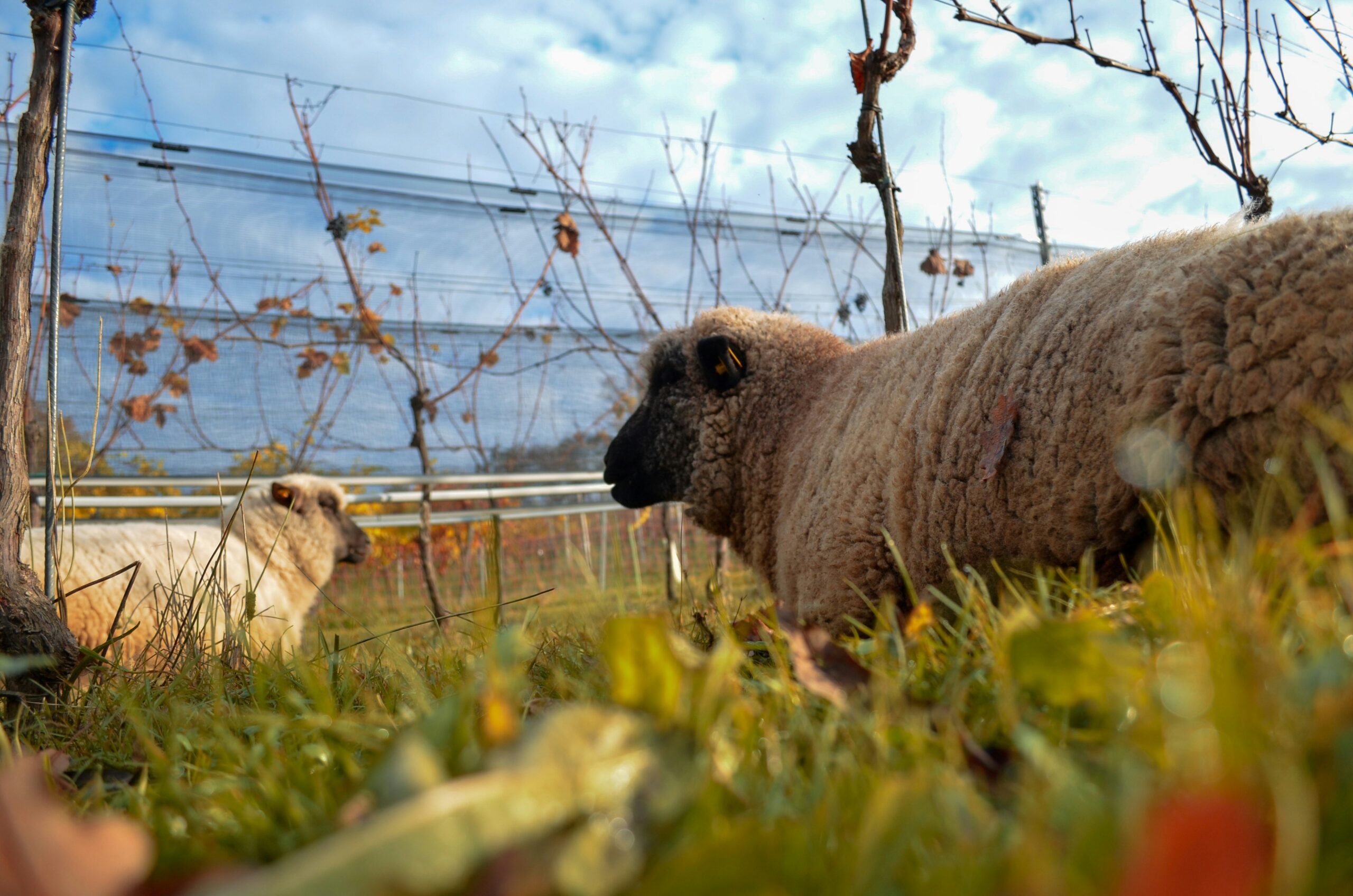
It is high summer in the Waipara Valley, the vines heavy with fruit, and the sheep are still there. That is the surprising part. For generations, vineyard sheep have been winter tenants, turned into the dormant rows to crop the cover and turned out again at bud-break, before they can strip the young leaves and the buds that become the crop. These sheep have not been turned out. They graze the rows in January because they cannot reach what matters: the fruiting wire rides about 66 inches off the ground, and a sheep, standing, comes up short. Raise the fruit, and the winter guest becomes a year-round resident. That single change is what turns a folksy tradition into something a sustainability auditor has to take seriously.
The Winter Guest Moves In
The old arrangement was seasonal by necessity. Sheep and grapevines want the same soft green growth, so the flock went in when the vine was asleep and came out when it woke. The workaround is a trellis that lifts the fruit above a grazing sheep’s reach. The design traces to an unlikely place: Jerry Watson, a grower in Cat Spring, Texas, who built a divided-canopy system in 2002 to fight bunch rot in his Blanc du Bois. That high canopy happened to solve a different problem entirely, parking the fruit at about five and a half feet, out of range.
Two estates have made the method their signature. Greystone, in New Zealand’s Waipara, grazes its certified-organic rows year-round on the high-wire system. Paicines Ranch, in California’s San Benito County, built its trellis in the winter of 2016 expressly so the flock could stay, a project led by viticulturist Kelly Mulville. There is also a second, more literal answer to the same problem: instead of raising the fruit, shrink the sheep. Babydoll Southdowns stand no more than two feet at the shoulder, short enough that they cannot easily reach the canopy of most vines. Raise the wire or lower the animal; either way the sheep stops being a winter visitor.
Like this? The TERROIR Letter arrives every Thursday.
The Tractor Goes Quiet
The case for keeping them there is, at first pass, overwhelming. An April 2026 study from the Bragato Research Institute, run at Greystone, found that year-round grazing let the vineyard drop herbicides entirely. With the sprays gone, the carbon footprint of the vineyard’s agrichemical inputs fell 57 percent against a conventionally farmed block. The tractor did less, too. Passes for mowing, leaf removal, and suckering are the diesel-heavy chores of the growing season, and the sheep quietly absorbed them: fuel use fell 40 percent in the organic model and 65 percent in the conventional one. Mulville’s California trials report the same shape of result, four to eight fewer tractor passes down each row every year. Fewer chemicals, less diesel, a flock doing the labor for the price of the grass. If the story ended here, it would be a clean one.
The Methane Asterisk
It does not end here, and the same study is honest about why. A flock that grazes 12 months instead of three is a flock that belches methane 12 months instead of three, and methane is a potent greenhouse gas. Bragato found that going year-round multiplied the grazing operation’s methane impact roughly fivefold, and that increase more than doubled the carbon footprint of the high-wire block. At the scale of the vineyard itself, the integrated system emits more, not less: around 2.5 tonnes of carbon-dioxide equivalent per hectare each year, against roughly 0.75 for a vineyard with no sheep at all. The herbicide and diesel savings are real, and they are not enough to cover the methane.
So where is the win the researchers claim? It lives in a different comparison. Set the integrated hectare against the alternative of running the two enterprises apart, a vineyard on one piece of land and a sheep farm on another, and the combined operation emits about 43 percent less than the two standalone systems added together. The gain is not a greener vineyard. It is land doing two jobs at once, producing wine and meat and wool from ground that would otherwise yield one of them. That is a real and defensible argument. It is simply not the tidy carbon-neutral story a back label prefers to tell.
What It Costs
The honesty extends to the balance sheet. A vineyard trained low, in the standard vertical trellis most of the world uses, cannot simply let the sheep in year-round; it has to rebuild the trellis to carry the fruit five or six feet up, and in doing so it usually gives up mechanical harvest, since the machines are built for the lower canopy. Then there is the wage bill. Bragato put the cost of conversion at 23 percent above the organic baseline and 49 percent above the conventional one, and found that the fuel and chemical savings did not offset the extra labor a flock demands. The thing that pays it back, if anything does, is the second income from the land, and even that rests on early yield figures the institute itself says need more years to confirm.
None of this makes the sheep a bad idea. They are a genuine improvement on the spray rig, and a closed loop has its own quiet appeal. But the reason to keep them is not that they make the wine greener. It is that they make the land work harder, honestly accounted for, with the methane left in rather than edited out. That is still a good story. It is just not the one printed on the bottle.
The TERROIR Letter
The story behind every bottle.
One feature. One dispatch. One bottle worth opening. Every Thursday — free.