

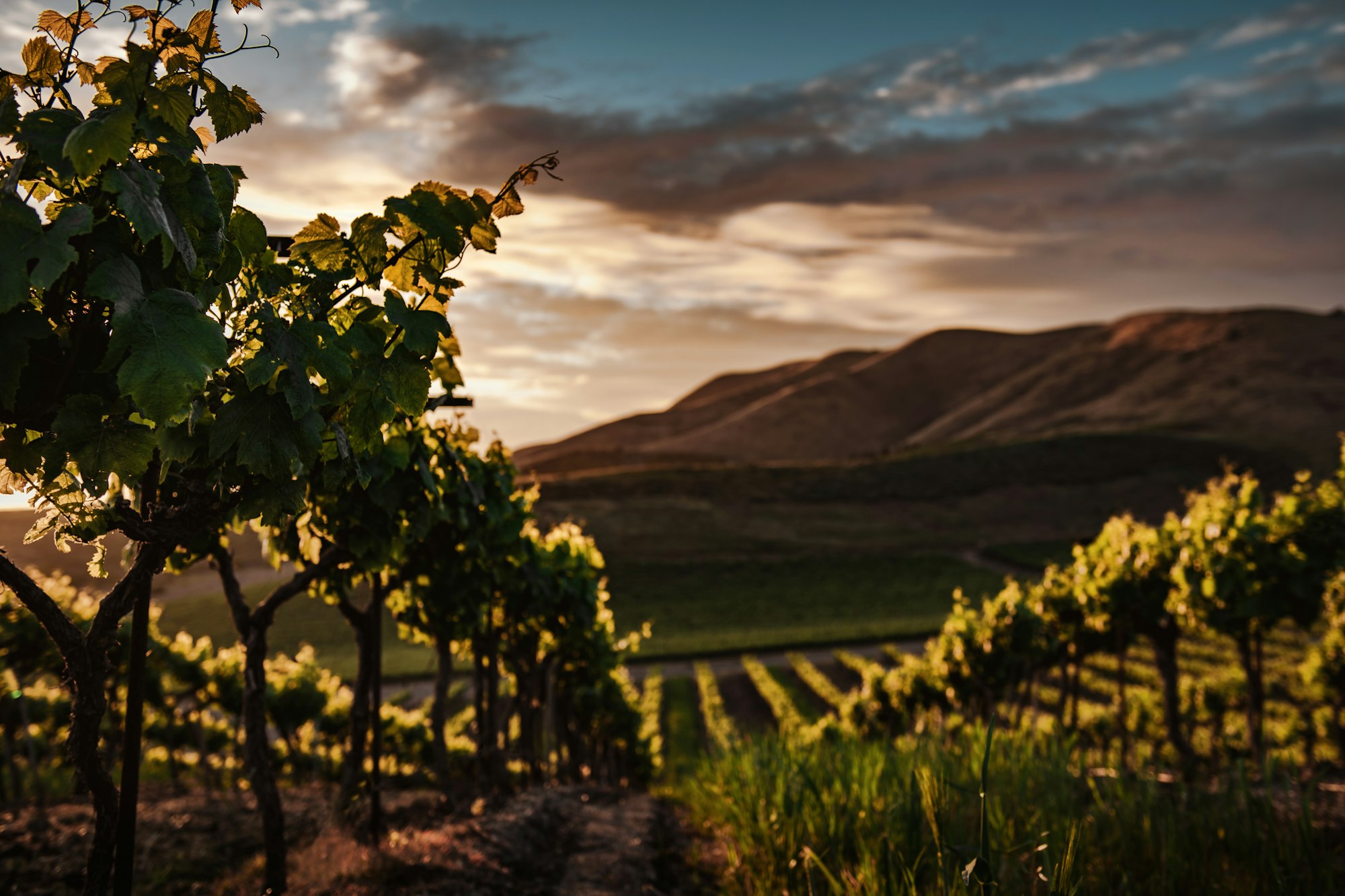
A small stream called the Fontgent runs down the hill above Ampuis, and on paper it does very little. It is not a boundary on any label. It appears in no appellation name. But the official rulebook for Côte-Rôtie cites an old wine atlas that maps the hillside as two slopes “separated by the Fontgent stream,” and growers on either side of it make noticeably different wine from the same grape. South of the stream the rock is gneiss, which weathers into pale, silica-rich sand. North of it the rock is mica-schist, which breaks down into darker soil, heavier with clay and richer in iron. The French call the two slopes the Côte Blonde and the Côte Brune, and the names describe the dirt before they describe anything in the glass.
This is the Northern Rhône‘s quiet argument, repeated three times along a short stretch of river: one grape, Syrah, grown in three appellations, producing three wines that a practiced taster can tell apart. The usual explanation reaches for climate or producer style. The documents that govern these appellations reach for geology first.
Two Rocks, One Stream
The INAO cahier des charges for Côte-Rôtie, approved by the institute’s national committee in November 2023, states that the Côte Blonde “rests on a substratum mostly made of gneiss,” producing “siliceous, light-colored soils,” while the Côte Brune sits on mica-schists that have weathered into soils “less siliceous, more clayey, richer in iron and dark in color.” It then does something unusual for a regulatory document. It ties the wine to the rock directly, describing “the duality of the Côte Brune and the Côte Blonde, linked to contrasts in the soils, the winemaking, and the structure of the wines.”
Like this? The TERROIR Letter arrives every Thursday.
The Blonde’s sandy, crumbling soils, known locally as arzel, are held on the slope by dry-stone walls; the Brune’s clay matrix is stable enough for narrower terraces. Viognier, the white grape that Côte-Rôtie permits in the vineyard up to 20 percent of the vines, is interplanted more often on the Blonde than on the Brune, and the cahier notes that a violet aroma “sometimes” appears “when the Viognier is present in the blend.” The grapes are fermented together, a practice the rulebook codifies by requiring that wines from both varieties be “vinified by blending the grapes concerned.”
Philippe Guigal, whose family bottles single-site wines from both slopes, described the effect to a Wine Spectator seminar in 2014. “It’s interesting to see how the Blonde controls the aromatics,” he said, with the Brune supplying structure. “It’s like we can mix Burgundy and Bordeaux in the same bottle.” La Mouline, on the Blonde, carries 11 percent Viognier. La Landonne, on the Brune, is all Syrah.
The appellation covers 342 hectares (845 acres) in production as of 2025, according to the regional trade body Inter Rhône, up from roughly 250 hectares when the cahier last recorded a figure in 2009.
The Hill the River Stole
Downriver, on the opposite bank, Hermitage breaks the pattern. The other appellations in this story sit on the right bank of the river, on the eastern edge of the Massif Central. Hermitage sits on the left, alone. The cahier explains why in one sentence: the hill is “a fragment of granite massif that the Rhône separated from the Ardèche mountain,” an island of the wrong geology stranded in the Drôme.
At its southern tip, the rock of Pierreaiguille stands 335 meters (1,099 feet) above sea level. The western part of the slope is granite, overlaid with mica-schist and gneiss that have decomposed into fragile sandy-clay soils. The eastern flank is different again: terraces of ancient river gravel laid down as alpine glaciers melted, with the oldest deposits highest on the hill, and loess blown in by northerly winds onto the flat shoulders near the top.
The rulebook is explicit about which grapes go where. “The Syrah is planted mostly in the western part of the granite slope,” it states, while the white grapes, chiefly Marsanne, “are concentrated on the more calcareous soils.” Syrah must make up at least 85 percent of the red-wine vines. The wines, in the cahier’s own description, “are powerful and tannic.” At 137 hectares (339 acres), Hermitage is the smallest of the three, and the figure is the same in the 2009 rulebook and the 2025 count.
Jean-Louis Chave, whose family blends across the hill’s named sites rather than bottling them separately, told the merchant Bordeaux Index in 2025: “We are so lucky to have the core of Bessards in our blend.” The word that matters is core. Bessards is the most granitic section of the hill, the spine around which the softer, gravel-grown lots are arranged.
Burnt Earth
Twelve kilometers (7.5 miles) south of Hermitage, back on the right bank, Cornas removes every other variable. One commune. One grape, by law: the appellation is made “exclusively from the Syrah grape.” And one rock, almost without exception. The cahier describes a vineyard “installed on soils derived from the weathering of primary eruptive rocks of the granite family,” specifically the porphyritic granites of Tournon. A sliver of limestone scree survives in the north, around a site called Pied-la-Vigne, but the document dismisses it as concerning “only a tiny part of the geographic area.”
Cornas is the control case. If the soil map really is the tasting note, this is where it should be easiest to read, and the wines cooperate. The cahier calls them “powerful and well-built,” noting they are “often described as virile,” with “abundant but silky tannins.” Harvest often runs about a week ahead of Hermitage. The name itself, according to the rulebook, is Celtic for burnt earth.
Matt Walls, who covers the Rhône for Decanter, wrote in 2021 that Cornas “has become the go-to appellation in the Northern Rhône for those looking for granitic, ageworthy Syrah,” and described the wines of Domaine Clape, whose Reynard vines are a century old, as never shying away “from the serrated tannins that this terroir creates.” His image: “like stroking a hedgehog.” Inter Rhône lists 162 hectares (400 acres) in production as of 2025, up about 40 percent from the roughly 115 hectares the earlier rulebook recorded in 2009.
What the Border Is Doing
Jancis Robinson summarizes the conventional hierarchy as “the deep-flavoured, long-lived reds Hermitage and the theoretically more fragrant and delicate Côte Rôtie.” The word theoretically is doing honest work. She notes that “in practice most Côte Rôtie is 100 per cent Syrah,” so the perfume the appellation is known for cannot simply be Viognier. Some of it, the rulebook’s own soil account implies, may be the gneiss.
That is the claim these three rulebooks make, each in its own language. Côte-Rôtie’s cahier ties the two faces of its wine to gneiss on one side of a stream and mica-schist on the other. Hermitage’s ties power and tannin to a granite core and glacial gravel. Cornas’s ties abundant tannin to porphyritic granite with nothing to soften it; the serration is Walls’s word, and it fits. A reader can start with the producer, the vintage, or the barrel. The appellations themselves suggest starting with the rock.
Back on the hill above Ampuis, the Fontgent still runs between the two slopes, invisible on the label and decisive in the glass. The stream does not make the wine. It only marks where the mountain changed its mind.
The TERROIR Letter
The story behind every bottle.
One feature. One dispatch. One bottle worth opening. Every Thursday — free.