

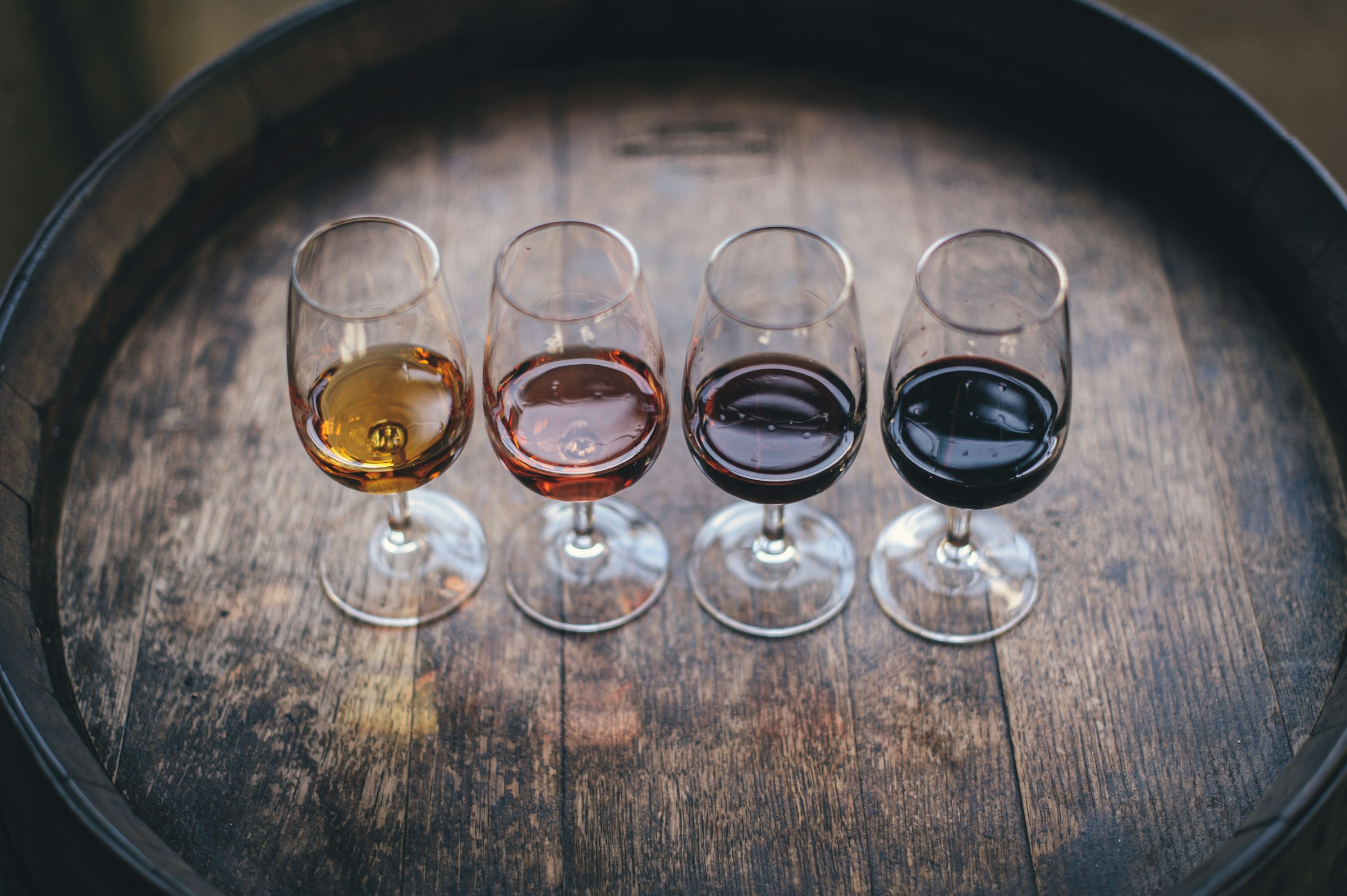
In 2023, Jon Leopold, wine director of The Alinea Group, walked The New Wine Review through the pairing at Alinea course by course. Read in order, it is less a list than a score. A rosé Champagne opens at a communal “garden” table. The second pour is not wine at all but a stirred sherry-and-vermouth cocktail in the Adonis style, “low alcohol, which also helps, because with these pairings, you’re drinking a ton of wine.” Krug 2008 arrives with caviar. A Corton-Charlemagne meets the Hot Potato course, chosen, in Leopold’s words, because “We wanted a white wine for the balance of the menu.” A Czech-style dark lager comes with a fish-and-chips course, “only 4.8 percent alcohol.” Later comes a big, jammy 1998 Turley Zinfandel, followed by a Chianti Classico and a 2006 La Chapelle Hermitage. One course, a quick hit of bubblegum, is listed simply as “Pairing: None,” a “setup for dessert.” The night ends with a 1957 Madeira alongside a dessert painted directly onto the table.
Nothing in that sequence was matched glass to plate in isolation. Each pour was placed. The rest before dessert, the beer in the middle, the white, rather than a red, chosen for the menu’s balance: these are decisions about the whole evening, made by someone thinking about the last glass while pouring the second. That is the part of the sommelier’s craft that rarely gets described, and it is the part that separates wine pairing from a run of good matches.
The Ladder, and Who Bends It
The default shape is a ladder. Gabriele Rizzardi, then wine director at Buona Terra in Singapore, described it to the Michelin Guide in 2020 as house method: “we start with light food and wine, with the food and wine getting heavier as the meal progresses.” Jancis Robinson noticed the same shape from the other side of the table in 2011, writing of Noma, The Fat Duck, and The French Laundry that a diner learns “how long you generally have to wait until you are served a red wine.” Fireworks on the plate, she observed, “seem often to call for the bright light of a white wine, or a sherry, or a sake.”
Like this? The TERROIR Letter arrives every Thursday.
The ladder is a tendency, though, not a law, and one of the few pairings documented course by course in print bends it deliberately. At Alinea the Turley, all jammy fruit, was poured two courses before the Hermitage, chosen because its course carried blueberry and an aigre-doux sauce whose “very intense flavors” needed the fruit to stand up to them. The dark lager sat mid-menu, where a ladder would be reaching for its first red. Leopold was candid about the cost of that choice: “anytime we do beer or sake, we have to nail it because people come in wanting wine. Otherwise, it’s not a trust-building experience for the guest.” A director who leaves the ladder does so knowing the guest is keeping score.
What the Glass Remembers
Some of that scorekeeping is measurable. In 2009, Mantonakis and colleagues published a study in Psychological Science in which participants tasted sequences of glasses and chose a favorite. Every glass held the same wine. The sequences still produced “a large primacy effect”; the first glass “had a large advantage.” A reader of TERROIR’s piece on the wine list will recognize that much. The twist is in the second finding: participants “who were knowledgeable about wines showed a recency effect in the longer sequences.” For an experienced palate working through a long run of glasses, the last pour gains weight. A wine director spending a 1957 Madeira on the final course is, whether by instinct or design, playing to exactly that audience.
The physiology is harder to pin down than the psychology. Lab work on sequential tasting shows that astringency accumulates: a 1986 study in the American Journal of Enology and Viticulture found perceived astringency “increased significantly” on repeated ingestion, and a 2016 paper in the Journal of Sensory Studies concluded that “None of the evaluated palate cleansers could prevent the occurrence of astringency buildup,” advising that tasters limit the number of samples in a session. Those experiments ran within a single lab sitting, not across an evening of courses. Whether the same holds over a long dinner appears untested in the literature.
Wine directors themselves tend to name a plainer mechanism: alcohol. Leopold’s low-alcohol cocktail in the second slot was a hedge against the total. At Atera in New York, Punch reported in 2015, a 24-course tasting came with about 16 beverages, and the magazine’s advice for building cocktail pairings was to “Go for central ingredients with low ABV, like sherry, beer or vermouth.” The sherry in slot two, the 4.8 percent lager, the course with no pour: these are the arc’s ballast, keeping the guest lucid enough to notice the Madeira.
Director, Not Matcher
The role this describes is closer to a director’s than a matchmaker’s. John Germain, wine director at Reserve in Scottsdale and the inaugural recipient of the Michelin Guide’s Southwest Sommelier Award, told the Guide in August 2026 that “Every new course begins with a conversation with Chef Ben Wald to understand the story he wants to tell, the emotion he hopes to evoke and the role that dish plays within the progression of the menu.” The Guide’s account of their method reads like blocking notes: should the wine mirror the dish or contrast it, refresh the palate or reveal hidden flavors? The wine is chosen after its role is written.
Restaurants have begun writing the principle down for guests. Substans, in Oslo, publishes its own guide to pairings for tasting menus that cautions against front-loading richness and adds that the light-to-heavy progression “is not mandatory, but it is usually wise.” Germain put the ambition more sharply: “The greatest luxury isn’t simply opening a rare bottle, it’s opening exactly the right bottle at exactly the right moment.”
Which returns the question to that bubblegum course at Alinea, the one marked “Pairing: None.” On a pairing sold at a fixed price, a slot left empty is the director’s most exposed decision, a silence written into the score where the guest expects a note. It rests the palate, holds the alcohol level, and lets the Madeira that follows land as a resolution rather than one more pour. The rare bottle was always going to be there. The craft was in the pause before it.
The TERROIR Letter
The story behind every bottle.
One feature. One dispatch. One bottle worth opening. Every Thursday — free.