

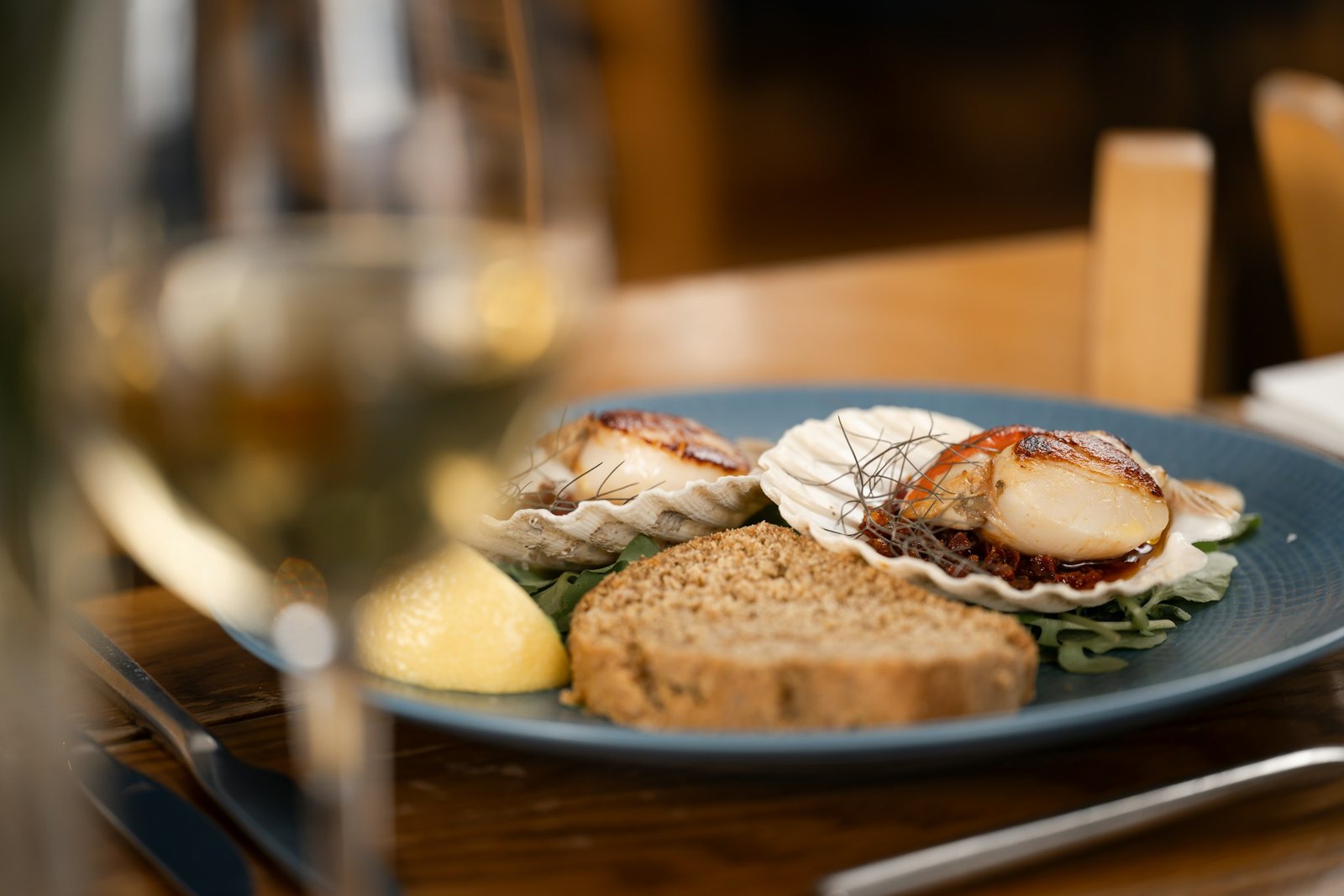
In a laboratory in Fujisawa, south of Tokyo, a sensory panel chewed dried scallop and sipped wine, red and white, dozens of bottles of each. They were not enjoying themselves, and that was the point. The researchers wanted to know why a mouthful of seafood followed by a mouthful of red so often leaves a metallic, fishy aftertaste, the one behind one of the oldest rules in pairing: red with meat, white with fish. The tasters rated the unpleasantness. The chemists measured the wine. The variable that tracked the ratings was iron.
The rule, it turns out, was never about color. Color was the proxy a dinner table could see for a metal nobody could.
The Metal Behind the Fishy Aftertaste
The study, led by Takayuki Tamura at the Mercian Corporation’s product development laboratory and published in the Journal of Agricultural and Food Chemistry in 2009, is unambiguous in its abstract. “Strong positive correlations were found between the intensity of fishy aftertaste and the concentration of both total iron and ferrous ion.” The team then tested the relationship in both directions. “The intensity of fishy aftertaste was increased by the addition of ferrous ion in model wine and suppressed by the chelation of ferrous ion in red wine.” Add iron, the fishiness rises. Pull it out, the fishiness falls.
Like this? The TERROIR Letter arrives every Thursday.
The compounds the paper names are a set of volatiles, among them hexanal, heptanal, 1-octen-3-one, and nonanal, found in dried scallop that had been soaked in red wine. Their formation “depended on the dose of ferrous ion in the model wine.” The results, the paper suggests, show that the ferrous form of iron “is a key compound of the formation of fishy aftertaste in wine and seafood pairing within the concentration range commonly found in wine.”
The American Chemical Society’s press release for the paper added the detail that gives the study its scale. The tasters, it said, sampled 38 red wines and 26 white wines with scallops, and “wines with high amounts of iron had a more intensely fishy aftertaste.” The release framed this as the first scientific explanation for the old rule, which is the Society’s claim rather than the paper’s, and it passed on something from the researchers that the rule never allowed for: some red wines already go well with seafood, and low-iron reds, they suggested, might be a good match.
Where the Iron Comes From
The Australian Wine Research Institute, in its technical note on iron-related haze, confirms the chemistry Tamura’s team was working with. “In wine, most of the iron is in the Fe++ oxidation state due to the normally low redox potential,” the institute writes. The ferrous ion the Fujisawa panel tasted is the form iron naturally takes in a bottle.
The institute is also specific about the sources, and soil is not among the ones it names. Iron enters wine, in the AWRI’s account, from “the continued use of iron grape bins and hoppers in vineyards” when those bins are “inadequately coated,” from “certain bentonites used as protein fining agents,” and “possibly some filter pads.” Much of what arrives before fermentation leaves again: iron contamination at that stage “is usually eliminated by adsorption of the metal on, and thus removal with, the yeast lees.” The institute credits “the widespread use of stainless steel in place of iron equipment and pipelines in modern wineries” with making iron problems “now rare in the Australian industry.”
The AWRI offers no typical range for iron in wine, only a threshold: “an iron concentration of about 6 mg/L is generally accepted as a level at which casse formation is a risk,” casse being the haze that excess iron produces. What a given bottle contains below that line, the label does not say.
The White Wine Was Not Safe Either
A year after Tamura, a second Japanese laboratory complicated the story from the other side. A team at the National Research Institute of Brewing in Higashi-Hiroshima paired white wine and sake with surume, dried squid, a common accompaniment to drinks in Japan. If color were the variable, white wine should have passed. It did not. “White wine and dried squid pairings had a more undesirable taste and more fishy off-odor than sake and dried squid pairings,” the 2010 abstract reports.
The team then worked through the chemical differences between the two drinks one by one. “Among the major chemical constituents that distinguish wine from sake, only wine-specific sulfite markedly increased bitterness intensity and aldehyde levels” when the fatty acid DHA, found in fish and squid, was added. The authors are careful with their verb. The results “suggest that sulfur dioxide in wine participated in degradation of unsaturated fatty acids.” Suggest, not prove. But the implication is that the old rule was steering diners away from one reaction, iron, and had nothing to say about a second, sulfite, that the white glass carries too.
It also explains a pairing the rule never covered. Sake sits easily beside dried squid not because it is pale but because, on this evidence, it lacks the wine-specific sulfite the Hiroshima laboratory singled out.
What a Diner Can Do With This
A Kirin Holdings laboratory published a coda in 2012. Pretreating wine with alcohol-treated yeast cells and phytic acid stripped out the iron, and “fishy aftertaste in wine-seafood pairings was not perceived” in the treated wine. The paper opened by noting that “cost-effective methods to remove iron from wine have not been developed” and offered its own as one; nothing in the published record shows it in commercial use.
So the reader is left with chemistry and no instrument. The sommelier Matthieu Longuère, writing for Decanter in 2016, reached the right conclusion by a different route. “Yes, red wine with fish can work, and it’s very easy to prove it,” he wrote, recommending “barbecued tuna with a light, fresh, cool-climate Pinot Noir.” His reasoning was tannin and acidity, not iron.
Two pieces of reasoning follow from the science, and they should be marked as reasoning rather than findings. First, the clash should be worst with the oiliest seafood, since in the Hiroshima study the unsaturated fats were the raw material for the off-flavors. Second, because no label states iron, the chemistry gives the diner a reason rather than an instrument: it explains why one red works and another does not, without saying which is which.
Back in Fujisawa, the panel chewed its scallop and reported what it tasted. The rule they were testing had been right for a long time, for reasons no one at the table could have named. It was never the color. It was the metal, and the sulfite, and a chemistry the white glass was only ever half-avoiding.
The TERROIR Letter
The story behind every bottle.
One feature. One dispatch. One bottle worth opening. Every Thursday — free.