

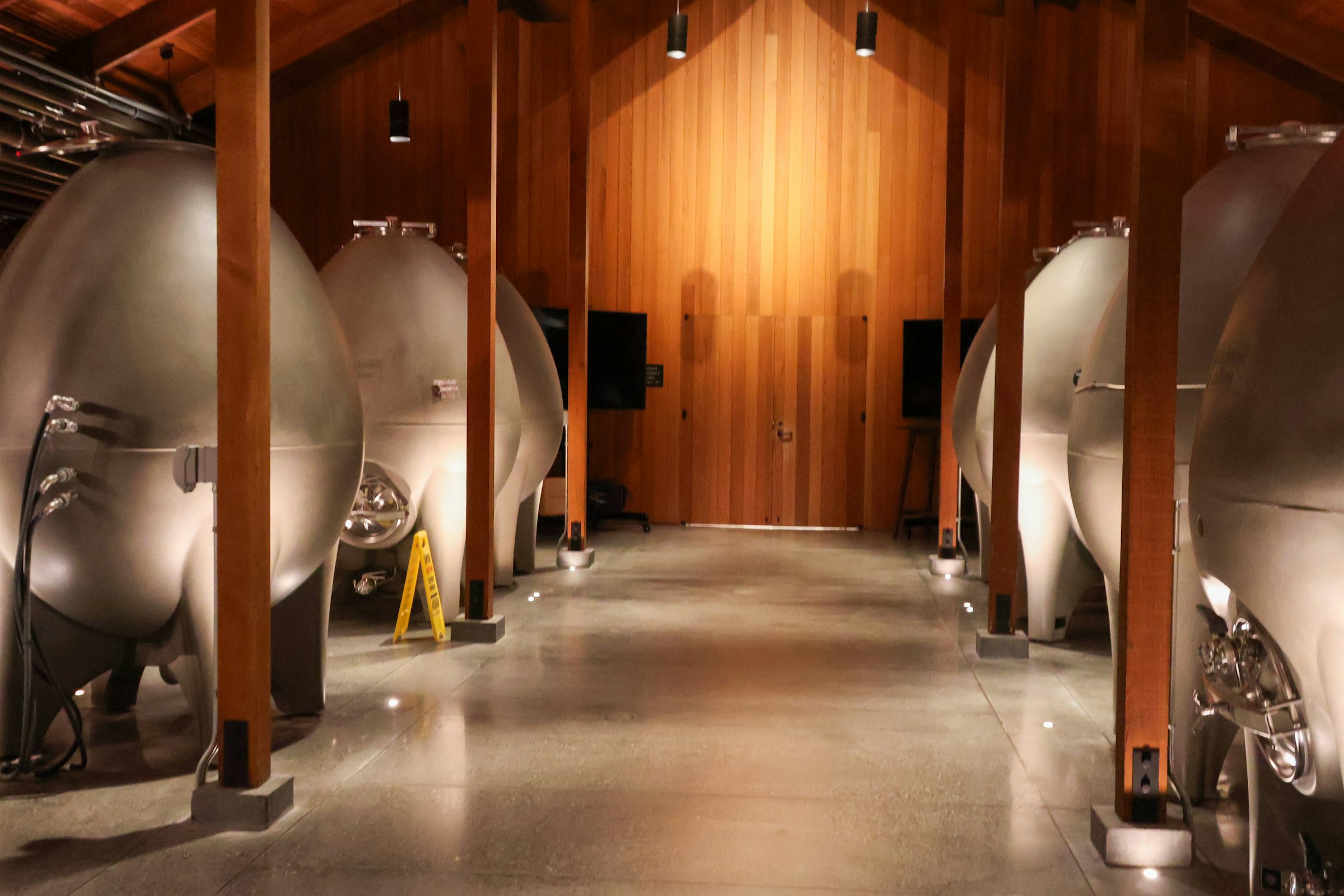
In the autumn of 2001, Michel Chapoutier walked into a concrete workshop on the eastern edge of Burgundy and asked the family who ran it whether they could build him an egg. The workshop belonged to Nomblot, a manufacturer founded in 1922 that had spent eight decades producing cement cisterns for the storage tanks under Burgundian cellars. Marc Nomblot was the second generation. The shape Chapoutier wanted was unusual: roughly two metres tall, three thousand litres, walls fifteen centimetres thick, and tapered at both ends into a shell of unreinforced cement. There was no rebar. There was no internal coating. There was a small steel door near the base and nothing else.
Twenty-five years later, that shape sits in the cellars of Pingus in Ribera del Duero, Stags’ Leap Wine Cellars in Napa, Trefethen in Yountville, Domaine de la Romanée-Conti for the white-wine cuvées, and several hundred other producers across France, Italy, Spain, California, Oregon, Australia, and Chile. The shape did not come from a wine consultant. It came from a heritage cement company in Mâcon that had quietly become the most consequential cellar-equipment supplier of its generation.
What the egg actually does
The geometry is the point. A vessel with no flat surfaces and no internal corners, fermenting at temperatures that drive convection currents, produces a self-circulating vortex inside the must. The yeast lees do not settle on a flat floor; they are continuously suspended by the rotation that the egg’s interior wall enforces on the liquid. In a barrel or a tank, the same effect requires bâtonnage: a winemaker descending into the cellar twice a week with a stainless rod to stir the lees back into suspension by hand. In the egg, the geometry does the work that the rod would otherwise do.
Like this? The TERROIR Letter arrives every Thursday.
The cement wall does a second thing. Unreinforced concrete is porous in a way that polished stainless steel and lined fibreglass are not. Oxygen migrates through the wall at roughly the same rate it does through a neutral oak barrel, which is to say slowly and continuously. The wine inside experiences micro-oxidation of the kind that builds glycerol-forward texture and rounds the linear acid spine of a young white wine. It does not, however, experience oak. There is no vanillin from American staves, no coconut-lactone from medium-toast French, no spice from new wood. Texture without flavour transfer is the trade the vessel offers.
A third thing follows from the wall thickness. A fifteen-centimetre cement shell holds thermal mass on the order of a small dolmen. Cellar temperature fluctuations that would force a stainless tank up or down by two degrees Celsius in a working afternoon shift the egg’s interior by tenths of a degree. The fermentation runs cooler and slower on its own, without glycol jackets, without thermostatic intervention.
The texture signature in the glass
A blind line-up of the same Chardonnay must, fermented in four vessels in the same cellar, gives the cleanest demonstration of how much the container matters. Stainless steel produces the most vertical wine: linear acid, primary fruit, no textural padding around the mid-palate. The wine reads as transparent. New French oak produces the opposite: a creamy, vanilla-coconut sheath that broadens the wine across the palate and partially obscures the underlying fruit. Neutral oak sits between them, contributing slow oxidative integration without the new-wood signature.
The concrete egg produces a fourth profile that does not slot neatly between the others. It has the broadness of an oak-aged white without the wood flavour, the lees-suspension texture of a long bâtonnage protocol without the hand-stirring schedule, and a salinity that several winemakers attribute to mineral migration from the cement wall itself. Whether that salinity is genuinely a cement effect or a perceptual artefact of the absence of oak sweetness is a question the trade has not settled. What is not contested is that the wine reads differently. It is recognisably its own category.
The adoption arc
The first decade after 2001 was slow. Chapoutier used the eggs initially for his Ermitage and Saint-Joseph white cuvées. A handful of biodynamic producers in the northern Rhône and Burgundy followed. Pingus brought the eggs to Spain in the mid-2000s. By the early 2010s, Napa and Sonoma producers were ordering them in pairs and quartets, and Nomblot’s workshop in Mâcon was running a multi-year backlog. Competitors emerged: Sonoma Cast Stone in California, Vicard Génération 7 in Cognac, and a handful of smaller artisanal moulders in Italy and Spain. The shape itself became uncontroversial. By 2020, a producer in any premium white-wine region who mentioned fermenting in concrete eggs no longer needed to explain what that meant.
The interesting development was not the eggs themselves but what they revealed about the vessel question more broadly. Stainless steel and oak had been treated, for most of the late twentieth century, as the two endpoints of a binary. The egg established that the binary was an accident of which vessels happened to be commercially available, not a fact about white-wine production. Amphorae returned to the conversation by the mid-2010s, first via the Georgian qvevri revival and then via terracotta vessels from Tava and Artenova in Italy. Fibreglass eggs and stoneware tanks followed. Producers began assembling cellar inventories of four, five, or six vessel types and blending across them.
The overlooked variable
The vessel has spent most of wine writing’s attention budget on oak: new versus used, French versus American, light toast versus heavy, two hundred and twenty-five litres versus five hundred. The egg argues that the comparison was always too narrow. Vessel material, wall porosity, interior geometry, and thermal mass each impart a textural signature on a young white wine. The choice is not between oak and not-oak; it is between five or six distinct material decisions, each of which produces a recognisably different wine from the same fruit. A producer who ferments a single-vineyard Chardonnay across stainless, neutral oak, new oak, concrete egg, and amphora, and then blends the components, is exercising a degree of textural control that a producer working only in barrel cannot match.
Marc Nomblot did not set out to reshape white-wine production. He set out to fulfil a 2001 order from a Rhône winemaker for a piece of cement shaped like an egg. The cement company kept its name, kept its workshop in Mâcon, and quietly became the supplier whose product is now sitting in the cellars of producers his grandfather built storage tanks for. The vessel is no longer the part of the cellar that nobody looks at.
The TERROIR Letter
The story behind every bottle.
One feature. One dispatch. One bottle worth opening. Every Thursday — free.