

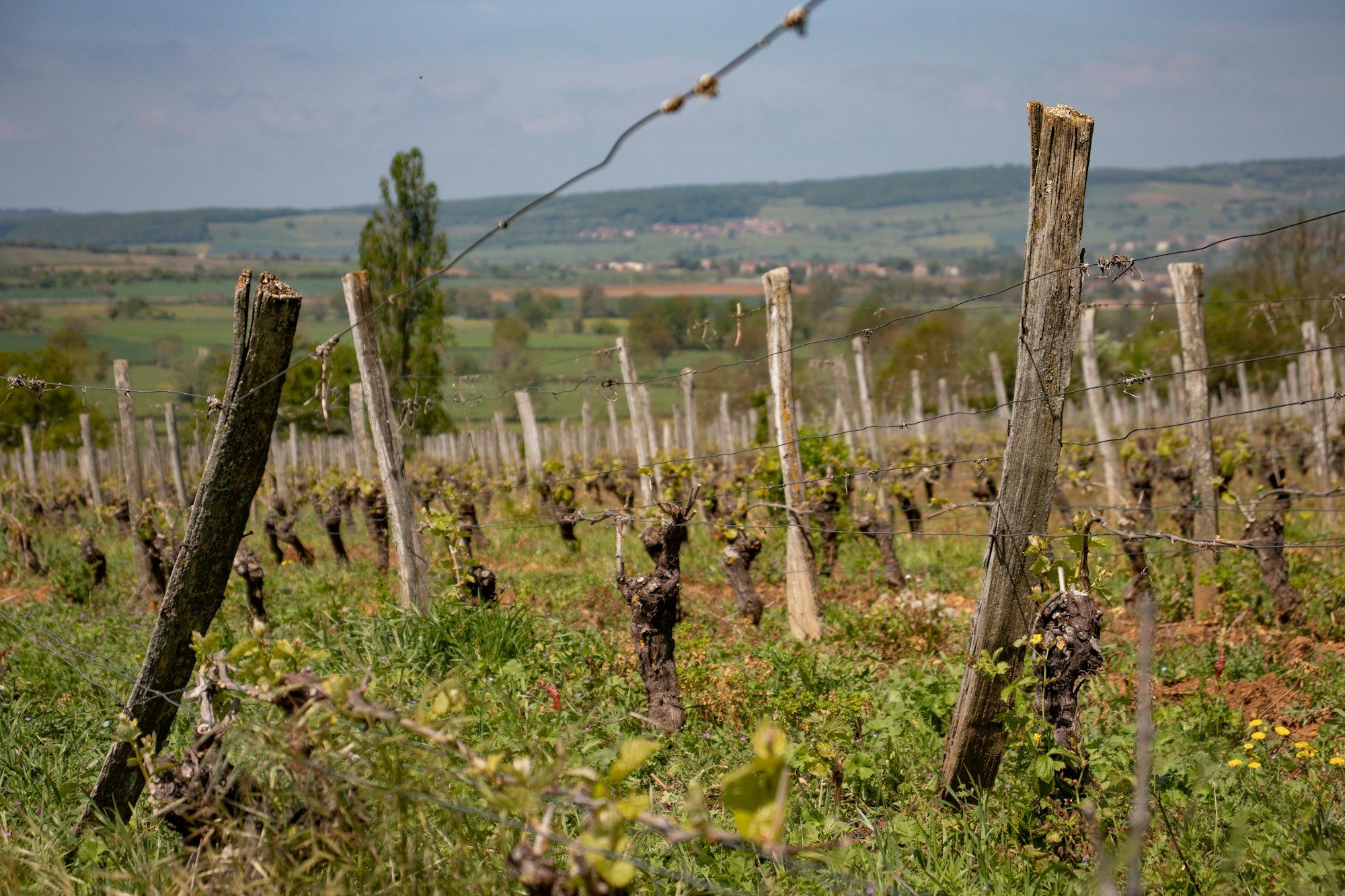
On a tasting bench in a producer’s cellar in Villié-Morgon, two rock fragments sit on a tray labelled in pencil. One is pink, coarse-grained, with a sparkle of feldspar where it has fractured fresh: granite from Fleurie. The other is dark, almost slate-blue under the cellar lights, dense in the hand: blue diorite from the Côte du Py at Morgon. Behind the tray, ten bottles stand in a row: Brouilly, Chénas, Chiroubles, Côte de Brouilly, Fleurie, Juliénas, Morgon, Moulin-à-Vent, Régnié, Saint-Amour. The same grape variety in every bottle. The rocks on the tray explain why the wines do not taste like each other.
The argument the bench is making is the one this region has been making since its cru system was formalised: Beaujolais, the wine most casual American drinkers know as a third-Thursday-of-November novelty, has at its serious end ten villages whose soils diverge sharply enough that the wines belong on a Burgundian map. The pink granite and the blue diorite are the proof the producer keeps within reach.
The Region the Nouveau Stamped Over
Beaujolais Nouveau was released for the 2025 vintage on Thursday, 20 November, the third Thursday of the month, as it has been since the date was fixed in 1985. The wine is young Gamay carbonically fermented in the weeks after harvest, designed to be drunk inside the year, priced to move. For forty years it has done most of the international communicating Beaujolais does.
Like this? The TERROIR Letter arrives every Thursday.
What the Nouveau stamp has obscured is that the region has three quality tiers under INAO: generic Beaujolais AOC, Beaujolais-Villages, and the ten crus above both. A Morgon at $28 from a serious grower bears the same surface-level varietal identity as a $14 Nouveau, but the Morgon is fermented differently, ages differently, and is sold against a different reference set. The crus are not, in any structural sense, the wine the casual American shopper thinks they are buying when they hear the word Beaujolais.
Ten Villages, One Grape, Different Rocks
The ten crus run roughly south to north: Brouilly and Côte de Brouilly at the southern end of the granite uplift; Régnié and Morgon in the central band; Chiroubles, Fleurie, Moulin-à-Vent, and Chénas climbing the slope; Juliénas and Saint-Amour at the northern boundary against the Mâconnais. They share Gamay (Gamay Noir à Jus Blanc, the only red grape permitted in cru bottles) and they share the granite massif beneath the northern half of Beaujolais. They do not share the surface soils that sit on that granite.
Fleurie, the largest cru by planted area, sits on pink granite over more than ninety percent of its surface, per the Wine Scholar Guild‘s reading of the regional geological survey. The pink colour comes from the potassium feldspar in the matrix; the granite weathers into a coarse pink sand the locals call gore. That sand drains aggressively, holds little water, warms quickly in spring. Fleurie Gamay grown on it produces wines that are floral, perfumed, mid-weight, built for medium-term cellaring.
Moulin-à-Vent, a few kilometres east, sits on what the Wine Scholar Guild describes as mainly pink granite in its northwest sector, with a large band of manganese running through the subsoil that producers claim plays an important part in the cru’s typicity. The manganese claim is a producer-side argument the regional literature carries without fully endorsing, but the consequence in the glass is consistent: darker fruit, denser tannin, longer cellar life. A Moulin-à-Vent at ten years can resemble a young Volnay at the same age, which is one reason the cru has occasionally been called the most Burgundian of the ten.
Morgon, immediately south, includes the Côte du Py, which the same survey describes as a large outcrop of blue diorite. Diorite is a darker, denser igneous rock than the surrounding pink granite, from a different intrusion. Côte du Py Morgon is the cru bottle most often singled out as a benchmark for what serious Beaujolais can do: structured, mineral-driven, capable of twenty years in the bottle, distinct in colour and weight from any Fleurie. The rock on the bench in Villié-Morgon is the visual shorthand for that distinction.
What the System Asks the Producer to Do
Cru status under INAO carries obligations Nouveau does not. The crus may not be released as Nouveau. They are not permitted the carbonic-only fermentation that defines the Nouveau style, though most cru producers continue with semi-carbonic methods, longer macerations, partial destemming. Yields are capped lower, ageing periods longer. The wines are released months later, sold at higher price points, held against higher critical expectations.
The cru producers are a different cohort from the volume bottlers who power the Nouveau trade. Names that move regularly through American specialist importers include Marcel Lapierre and his descendants at Morgon, Jean Foillard and Yvon Métras across the central crus, Château Thivin at Côte de Brouilly, Domaine du Vissoux at Fleurie and Moulin-à-Vent, Clos de la Roilette at Fleurie. Their bottles sit in the $25 to $45 range at American retail; prestige lieu-dit bottlings reach further.
How to Read the Map
For a drinker working backwards from the bottle to the rock, the practical map is shorter than the full ten. Four crus most reliably reward the price-of-entry: Fleurie for floral perfume on a mid-weight frame; Morgon (particularly Côte du Py) for blue-diorite structure and ageing potential; Moulin-à-Vent for the densest tannin and the longest cellar window; Côte de Brouilly for volcanic intensity on a smaller hill of blue stone south of the main band. Brouilly, the largest cru by area, varies more by producer than by site. Chiroubles, at the highest elevation, drinks earliest and lightest. Chénas, the smallest cru, is structurally a near-twin of Moulin-à-Vent. Régnié, elevated in 1988, drinks closer to Beaujolais-Villages. Juliénas and Saint-Amour, at the northern boundary, range across both registers depending on producer.
The map’s central pivot is the pink-granite-to-blue-diorite axis between Fleurie and Morgon Côte du Py. A drinker who tastes those two wines side by side from a serious producer in the same vintage will register the soil difference before they read the labels. The geological survey and the pencil-labelled tray are saying the same thing.
The Shelf the Stamp Hides
The Nouveau stamp is not the problem; it is a piece of regional marketing that has paid for forty years of vineyards and careers. What it has cost the cru tier is shelf-level identity in markets that do not encounter Beaujolais much beyond the November window. Cru bottles arrive months later, in smaller volumes, against a category-name the shopper has already filed as fruity-and-light. The first work for a drinker interested in the serious end of the region is to set those two products apart before approaching the shelf.
The two rocks on the tray in Villié-Morgon are the producer’s own way of doing that. The pink granite is what makes a Fleurie taste like a Fleurie. The blue diorite is what makes a Côte du Py taste like itself. The ten bottles behind the tray are the system the rocks are arguing for: ten villages, one grape, ten different things in the glass. The Nouveau release is its own conversation, finished by Christmas. The crus are the other one, the one this region has been trying to have on its own terms since the INAO drew the map.
If you buy through a link in this article, TERROIR may earn a commission. Disclosures
The TERROIR Letter
The story behind every bottle.
One feature. One dispatch. One bottle worth opening. Every Thursday — free.