

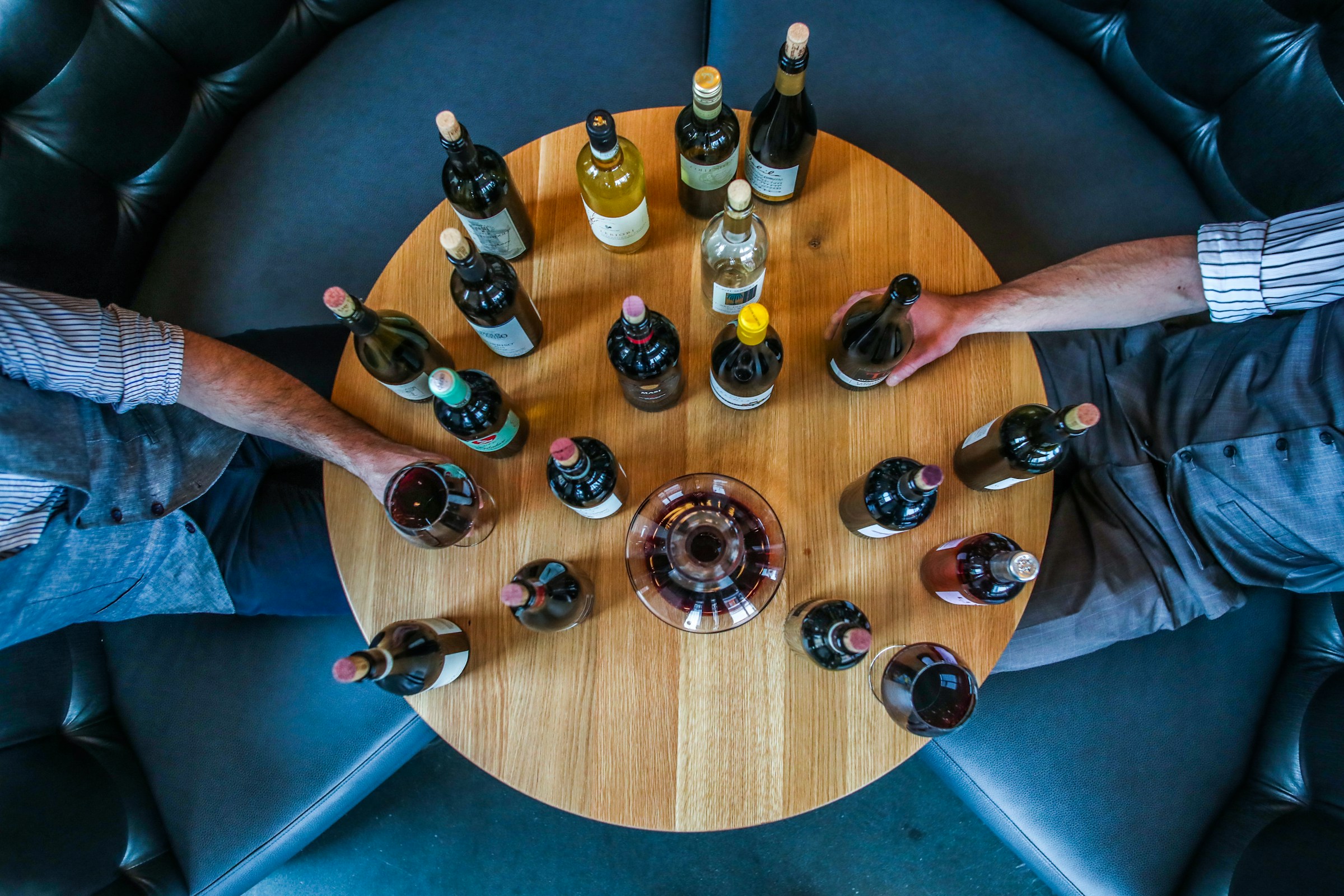
On the wine lists that have started paying attention, the half-bottle section is no longer a polite afterthought tucked between the dessert wines and the digestifs. It is its own page, or its own column, or in the more deliberate programmes its own short folded insert: a tight selection of 375ml bottles arranged with the same care as the full list, often by the same hand. Read it carefully and a pattern emerges. The producers repeat. The appellations repeat. What sits on the half-bottle page is, in most cases, a compressed version of what sits on the full one: the same point of view, edited down to a single column.
The format itself has been around forever. Half-bottles were the standard packaging for restaurant service for much of the twentieth century, the way a single diner ordered wine before BTG became universal. After the BTG era took over, they survived mostly as airline novelty or geriatric concession, a small selection of stalwarts that nobody bought and nobody updated. The change in the last several years is that a particular kind of restaurant has started rebuilding the section with intent. The economics make sense in ways the BTG list cannot match, and the customer-side use case has changed underneath the format faster than most wine programmes have updated for it.
The sub-list as index, not afterthought
Ferdinando Mucerino runs the wine programme at Rustic Canyon in Santa Monica. Speaking to SevenFifty Daily about how he treats his half-bottle selection, he described it as ‘basically a short representation of everything I have in full bottles.’ The framing is worth pausing on. The half-bottle list, at Rustic Canyon and at the restaurants that have followed the same logic, is not a separate inventory category run off a different set of buying decisions. It is the long list, compressed. Whatever the buyer’s hand is (the Loire bias, the Jura attention, the German Riesling spine, the natural-leaning Etna selection), the half-bottle page is meant to render the same hand at smaller scale.
Like this? The TERROIR Letter arrives every Thursday.
This changes what the section is for. A grab-bag of half-bottles is a service-floor convenience: something to suggest to a single diner who wants more than a glass. A curated short list is a statement of intent. The guest who opens it is being told, in shorthand, what the rest of the list is saying at length. For the programme, that is editorial work.
The supply problem is real. Producers bottle in 375ml only when they choose to, and many of the most interesting growers in any given category do not. A serious half-bottle page is therefore a curation problem before it is an inventory problem: the buyer chooses among producers who package in the format at all, then makes that subset cohere with the larger list. The pages that work are the pages where someone has done that work.
The operator math
Sommelier Business reports that Michele Orbolato of Los Mochis sees half-bottles driving higher per-head spending as guests trade up from the by-the-glass list. The mechanism is straightforward. A guest who would have ordered a single glass at twenty dollars and stopped is the guest most likely to commit to a 375ml at the next tier up: the price ceiling is bounded, and the wine in the bottle is almost always better than what was pouring by the glass. The check moves from one pour to two-and-a-bit pours; the average ticket rises; the wine on the table is, by design, more interesting than the BTG inventory permits.
There is a second mechanism behind the first. Half-bottles let restaurants stock producers and appellations that do not move in full-bottle volume: the small Mosel grower, the Jura outlier, the unfamiliar grape from an unfamiliar village. Samantha Madden of Ruby Wines has framed the format as the lowest-friction path to getting guests to try ‘something more unique and interesting.’ A guest who hesitates at a fifty-dollar bottle of something they have never heard of will commit to a thirty-dollar half-bottle of the same wine without breaking stride. The format buys curiosity at half the financial commitment.
The half-bottle page becomes the place where adventurous selections can live with the least sales resistance: the curatorial sandbox of the wine list. Producers who would not survive at full-bottle pace earn their place through 375ml turnover.
What the staff actually do with it
The most interesting move on the half-bottle question does not happen on the printed page at all. Haley Fortier, who runs the wine-driven Boston bar haley.henry, told SevenFifty Daily: ‘The real reason I decided to do the half bottle program was to open up the options for our customers.’ The phrasing inverts what the format is usually thought to be for. The half-bottle programme, at haley.henry, is not primarily about stocking 375ml inventory. It is about the staff’s permission to open any full bottle on the list when two guests each commit to a glass; the half-bottle becomes the unit, but the bottle being poured is the full one.
The implication runs deep. A wine list that operates this way is no longer constrained by what producers happen to package in 375ml. Every line on the full list is, in effect, available as a half-bottle, provided two seats at the table agree. The supply problem dissolves; the curatorial scope of the programme expands to the entire list. What the guest experiences is a list with no false bottom, every wine on the page reachable at a smaller commitment, without the staff having to apologise for the format’s narrowness.
This requires a particular kind of floor. The staff has to do the math at the table, make the offer cleanly, and absorb the breakage risk on the unpoured second half. Few programmes operationalise this fully; the ones that do tend to be small, owner-operated, and confident enough in their BTG rotation to risk the leftover. The format is not a template. It is a posture toward the guest.
Where the format names itself
Three trends in dining have converged on the 375ml. Solo dining has risen sharply in the major restaurant cities, with reservation platforms reporting solo-cover share trending up over multiple consecutive years; mindful drinking has shifted the average table’s intake downward without lowering its interest in what is being drunk; and the high-end pairing menu has trained a meaningful share of the dining public to think about wine at the per-course scale rather than the per-bottle scale. The half-bottle sits at the intersection of all three. It is the right unit for the diner who wants a serious wine but not a full bottle, for the table that wants two wines across a meal rather than one, and for the kitchen that wants the wine to track the food at finer resolution than a single bottle allows.
Read the half-bottle page of a careful programme with these three diners in mind and the selections start to make sense as a system. The Chablis at the top, the Beaujolais cru in the middle, the off-dry Riesling at the end: a tasting menu’s pairing arc rendered as a bottle list. The solo diner orders one and gets the whole point of the cellar in a single 375ml; the table of two orders two and reads the buyer’s hand in stereo; the pairing menu uses the same selections as the supplemental flight for the guest who wants the proper bottle and not the laboratory pour.
The half-bottle revival is not a packaging story. It is a wine-list-architecture story. The page that started as a polite afterthought has become, for the programmes that have rebuilt it on purpose, the cleanest expression of what the cellar is for. The 375ml is not a smaller bottle. It is a tighter argument.
The TERROIR Letter
The story behind every bottle.
One feature. One dispatch. One bottle worth opening. Every Thursday — free.