

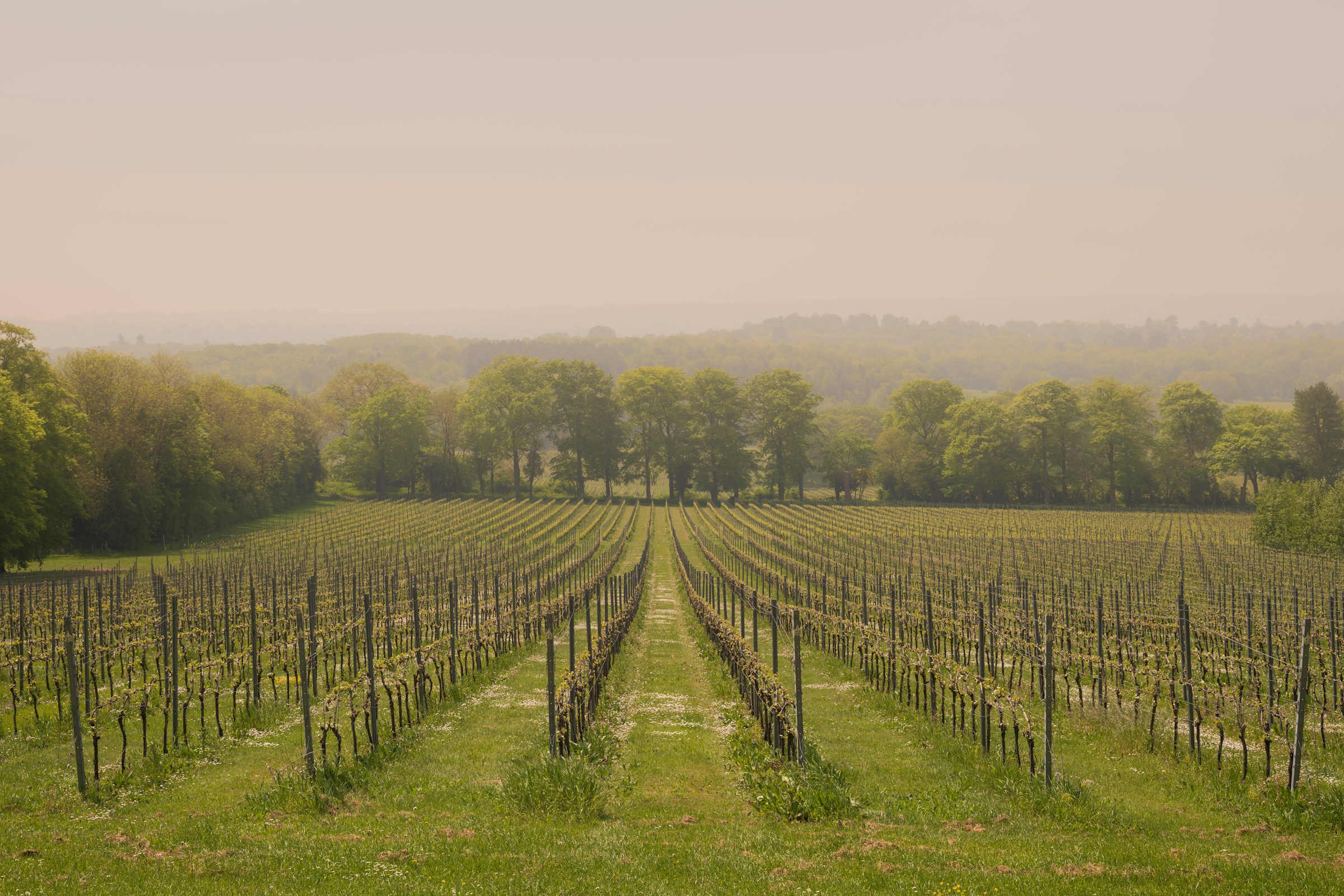
Every young wine region needs a founding story, and England’s is unusually good. The chalk hills of Champagne, the telling goes, dip beneath the Channel and surface again in Sussex, Hampshire, and Kent. Same rock, same latitude arithmetic once the climate shifted, same grapes. A region with that story does not have to argue it belongs. The geology argues for it.
The story is not false. It is doing considerably less work than it appears to.
What the Rock Actually Says
Start with the part that holds. The chalk under Hampshire and Sussex is Newhaven Chalk, formed, as World of Fine Wine puts it, “at the intersection of the Santonian and Campanian ages of the Upper Cretaceous.” Champagne’s chalk belongs to the French Senonian, and the Senonian “includes both the Santonian and the Campanian.” The overlap is real and it is not a coincidence of marketing. These are the same seas, the same era, the same slow rain of coccoliths.
Like this? The TERROIR Letter arrives every Thursday.
Ian Kellett of Hambledon puts the claim at its strongest. It is, he says, “the same chalk that is found in Avize and Cramant,” naming the two Côte des Blancs villages that anchor Champagne’s blanc de blancs reputation. What matters, he adds, is not the pedigree but the plumbing: “what counts, what makes it so good, is the way it handles water.” Chalk drains hard and holds moisture in reserve, which spares a vine both waterlogging and drought in a climate that can deliver either.
Notice, though, whose claim that is. It belongs to a producer describing his own vineyard, and it is a claim about a specific site rather than about a country.
The Part the Story Skips
World of Fine Wine, having laid out the geology, declines to let the seam carry the argument. Much English sparkling wine, the piece observes, “isn’t grown on chalk at all.” Greensand, clay, and various sands account for a great deal of the acreage, including at estates whose wines win the same competitions. If chalk were the explanation, those wines would be the exception. They are not exceptional enough for that.
Christian Seely offers the sharper qualification, which is that the category itself is too coarse. “Chalk can’t just be chalk,” he says. “You can have soils that are too chalky and almost impossible for vines.” A shared formation name spans an enormous range of depth, purity, fracturing, and overburden, and those differences decide whether a vine thrives or struggles. Two sites can sit on Newhaven Chalk and share very little that matters.
Even the sensory case is offered more carefully than it is usually repeated. Cherie Spriggs, who makes the wines at Nyetimber, frames it as an impression rather than a finding. “My impression is that when vines are grown on chalk, the acid perception is different,” she says. The difference she describes is one of shape rather than force: acidity that runs “more even from the beginning to the back of the palate,” against greensand wines with “powerful fruit.” Chalk, in her account, is “more soft, gentler.” That is a winemaker reporting a pattern she trusts, and it is worth having. It is not a soil map predicting a flavor, which is how the chalk story tends to get retold.
What Is Actually Driving the Rise
Set the geology aside and the growth is easier to explain, because it is counted rather than inferred. Land under vine has reached 4,841 hectares in WineGB‘s tally, up 510 percent since 2005 and roughly 15 percent in the most recent year alone. There are 1,104 vineyards and 238 wineries. Of 10.7 million bottles in the latest reported year, sparkling accounted for 69 percent.
The distribution is shifting as fast as the total. Kent leads on plantings, followed by West Sussex, and then, newly, Essex, which has overtaken both East Sussex and Hampshire. Essex is typically warmer and drier than the South Downs sites, and many of its vineyards sit on clay-rich or otherwise mixed soils rather than chalk. The money is moving toward the climate, not toward the seam.
Institutions have followed. Sussex became the first English wine region to hold Protected Designation of Origin status on July 5, 2022, the post-Brexit successor to the EU appellation framework, covering East and West Sussex, with hand harvesting required for the estate and single-vineyard designations and yield ceilings set by category rather than one blanket cap. An application lodged in 2015 took seven years and a change of legal regime to land. Roughly a quarter of all UK wine now comes from the two counties it covers.
The Story and the Substance
None of this diminishes the wines, which have earned their standing on the glass rather than the brochure. It does relocate the explanation. Warming moved southern England into the ripeness band that traditional-method sparkling requires, capital arrived, expertise arrived with it, and a regulatory architecture assembled itself around the result. The chalk was always there. It did not do anything new.
What the seam offers is legitimacy, which is a real thing for a region with no long record to point at. Champagne spent three centuries building the association between chalk and fine sparkling wine, and southern England can borrow it in a sentence. That is efficient. It is also the kind of borrowed authority that deserves examining, because a region that explains itself by geology alone will struggle to explain why so many of its most interesting new plantings are going in off the chalk.
The TERROIR Letter
The story behind every bottle.
One feature. One dispatch. One bottle worth opening. Every Thursday — free.