

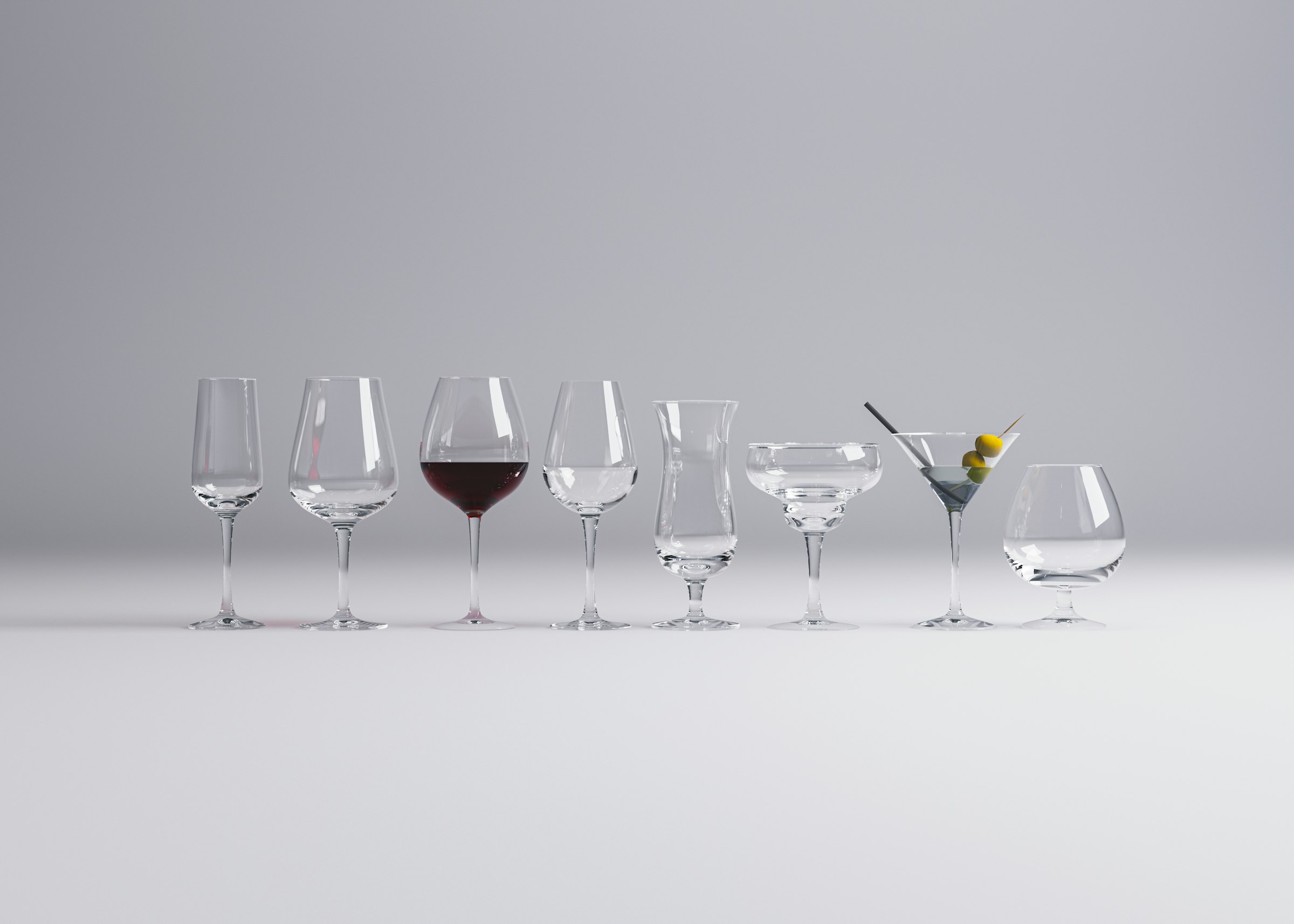
In a lab at Tokyo Medical & Dental University, Kohji Mitsubayashi and his colleagues spent the better part of a decade building an apparatus that lets you watch alcohol evaporate. They call it the sniff-cam: a bio-fluorometric imaging rig that converts ethanol vapor into visible light. Set a glass of wine on the platform, and the screen shows you what your nose is supposed to be doing, mapped in two dimensions and frame-by-frame.
In 2015, Takahiro Arakawa and Kohji Mitsubayashi published the results in the Royal Society of Chemistry’s journal Analyst. They had photographed the vapor signatures of half a dozen drinking vessels poured with the same wine. The straight tumbler showed ethanol pooling indifferently across the surface. The martini glass funneled it straight up the central axis. The wine glass, alone among the shapes tested, produced a clear ring of ethanol vapor around the rim, with a low-alcohol pocket in the centre of the bowl.
This is not, as it happens, a small finding. It is the first time anyone has photographed what wine writers have asserted for forty years.
Like this? The TERROIR Letter arrives every Thursday.
Where the evidence holds
The Arakawa-Mitsubayashi paper validates one specific Riedel claim: bowl geometry affects how ethanol distributes above the wine, and rim geometry affects where that vapor reaches the nose. A tulip-shaped bowl that narrows at the rim concentrates aromatics in a band just below the lip, while the low-alcohol centre lets the drinker sniff above the ethanol burn rather than through it. This is mechanics, not marketing. The same physics governs why a brandy snifter cupped in the hand smells different from one poured into a juice glass.
What the paper does not validate is the next step in the marketing argument: that bowl shape A is optimal for Pinot Noir while bowl shape B is optimal for Nebbiolo. The sniff-cam shows that some glass shapes concentrate aroma at the rim and others do not. It does not show that two well-designed wine glasses, both with tulip bowls and inward-tapering rims, will deliver perceptibly different experiences with the same wine.
That second question was tested separately, and the answer is the one Riedel has spent twenty years trying to talk around. A 2001 study published in the Journal of Wine Research asked trained tasters to evaluate the same wines in Riedel’s varietal-specific glasses versus standard tasting glasses. The Burgundy-shaped glass did register higher aromatic intensity. But the intensity gains did not correspond to any specific sensory attribute. Tasters could not reliably say what they were smelling more of. They just smelled more.
Where the marketing departs
Riedel’s catalogue currently lists more than thirty varietal-specific shapes, with separate glasses for Côte-Rôtie and Hermitage, for Montrachet and Chablis, for Riesling Grand Cru and Riesling Kabinett. The company commissions tastings, runs producer panels, and publishes glossy comparative findings showing how each shape transforms its assigned grape. The tastings are real. The comparisons are reproducible inside the company’s own protocols.
What the broader academic literature shows is that those protocols do not survive blinding. Once a taster cannot see which shape they are drinking from, the differences between two well-designed wine glasses collapse to within the margin of individual variation. Whether the Riedel Sommeliers Burgundy Grand Cru is meaningfully better for red Burgundy than the Riedel Sommeliers Bordeaux Grand Cru is not a question the sniff-cam can answer. The sniff-cam separates wine-glass-shaped objects from non-wine-glass-shaped objects. It does not separate Riedel’s catalogue from itself.
The honest line runs through the middle. Glass shape matters. The number of glass shapes that matter is small.
What a serious drinker actually needs
The sommelier trade has known this for a long time, which is why the standard professional service kit, even at restaurants with thousand-bottle lists, tends to converge on three glasses. A universal wine glass for everything still and red and most still whites, sized somewhere between 450ml and 600ml with a tulip bowl and an inward-tapering rim. A Bordeaux-shape glass for tannic reds that benefit from a wider opening and a longer pour-to-rim distance. A Champagne flute or tulip for sparkling, where the narrow column preserves bead and protects the delicate bouquet from the ethanol bloom the sniff-cam photographs so clearly.
That kit costs less than two of Riedel’s varietal-specific Sommeliers stems and handles essentially every wine a serious drinker is likely to open. It is not glamorous advice. It is also what most of the wine professionals who have read the literature do at home.
Back in the Tokyo lab, the sniff-cam keeps running. Mitsubayashi’s group has since extended the apparatus to other volatile compounds and other vessel shapes, and the field is incrementally filling in what the 2015 paper opened up. None of the newer work has overturned the original finding. None of it has rescued the thirty-shape catalogue either. The ring at the rim is real. The line between research and product line still runs roughly where the 2001 study drew it.
The glass matters. It just matters less ornately than the marketing wants.
The TERROIR Letter
The story behind every bottle.
One feature. One dispatch. One bottle worth opening. Every Thursday — free.