

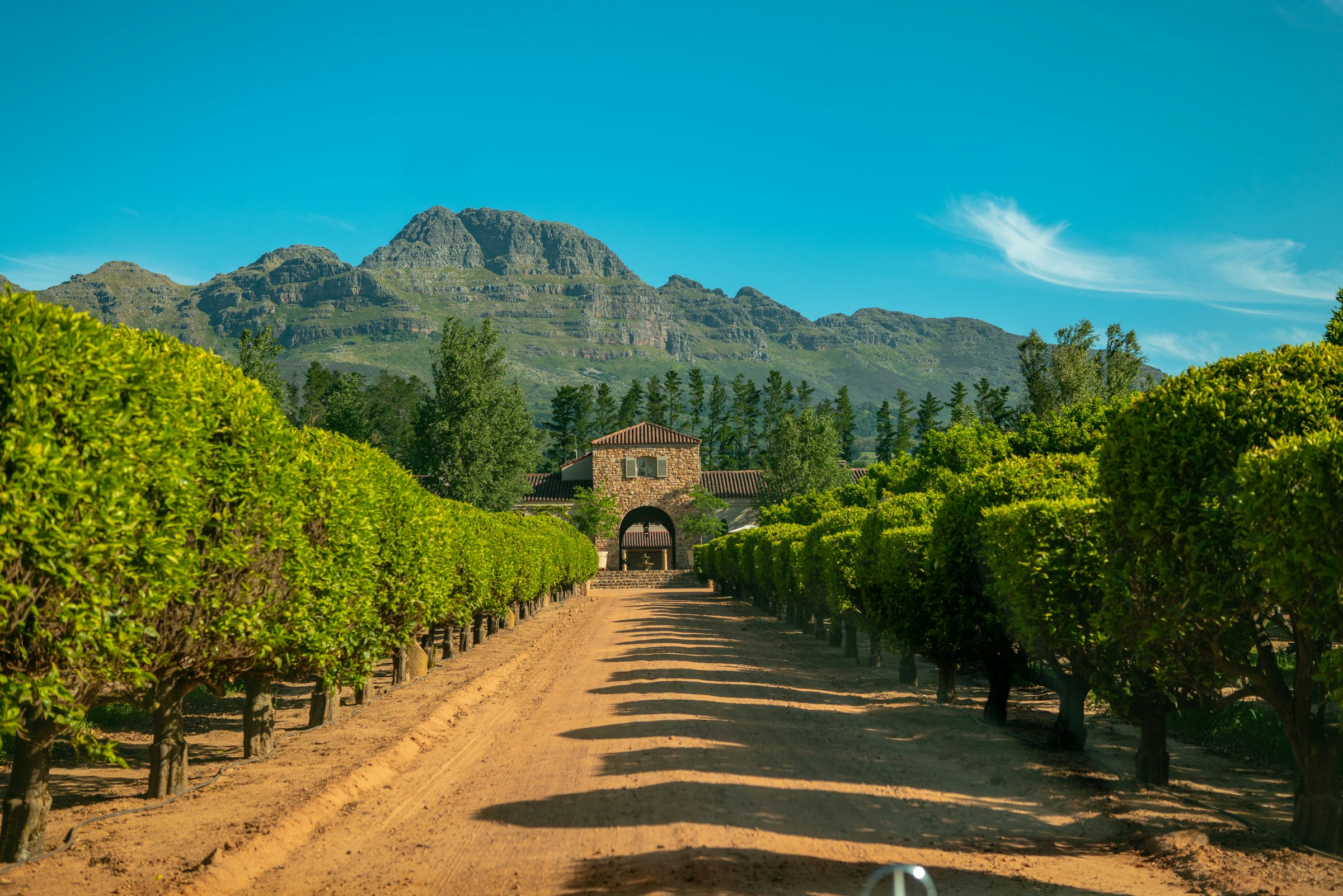
In November 2010, a small festival opened in Riebeek Kasteel, a wheat-and-wine village ninety minutes north of Cape Town. There was no marquee sponsor, no judging panel, no ribbon cutting. A few dozen winemakers poured side by side under the name The Swartland Revolution, a title they had chosen for themselves with a straight face. The organisers were three producers working within twenty kilometres of one another: Eben Sadie of Sadie Family Wines, Adi Badenhorst of AA Badenhorst Family Wines, and Andrea Pretorius, who would within a few years take her husband’s name and run Mullineux Family Wines with him. Sixteen years later, in 2026, the gathering that started as a manifesto-with-a-bottle reads as the cleanest inflection point in South African wine. Almost everything the country is now praised for internationally was, in 2010, an argument the Revolution producers were still making.
Bordeaux templates and the Rhône argument
To understand what changed, it helps to remember what the country looked like to outside critics through the 1990s and early 2000s. South African red wine, at the export tier, was built around a Bordeaux template: Cabernet Sauvignon and Merlot, trellised rows, supplemental irrigation, new French oak. The model came partly from the country’s late re-entry into world markets after 1994 and partly from where the prestige money sat: Stellenbosch, the historic estate belt below the Helderberg, where European varietals had been planted to fit a Bordeaux frame.
The Swartland, an hour to the north, sat outside that frame. The soil was decomposed granite and schist on rolling hills, the climate dry and warm, the planting history dominated by bush-trained vines that no one had irrigated because no one had ever needed to. For most of the late twentieth century, the Swartland’s job was to grow Chenin Blanc and table-wine reds for the volume co-operatives. The grapes left in tanker trucks. The vineyards were old, planted by farmers in the 1960s and 1970s and earlier, with no one paying attention to the age except as a productivity problem.
Like this? The TERROIR Letter arrives every Thursday.
Sadie’s flagships, Columella and Palladius, reframed the productivity problem as the asset. Both wines came out of an explicit reading of the southern Rhône rather than Bordeaux. Columella is a Syrah-led red blend with Mourvèdre, Grenache, Cinsault, Tinta Barroca and Carignan in the mix; Palladius is a white blend built around Chenin Blanc with a long supporting cast of Mediterranean whites. The Rhône framing carried with it a different agronomy: bush-vine and dry-farmed, no trellising, no irrigation, fruit concentrated by climate rather than by a winemaker’s hand. The argument, more or less, was that the Swartland had been doing southern-Rhône agronomy for decades by accident, and that the wines waiting to be made there were not Stellenbosch-template Cabernets but Mediterranean-template blends from the bush vines already in the ground. Columella’s first vintage in 2000 made the case in a bottle. By 2010, the Revolution festival made the case as a movement.
Mullineux’s single-soil Syrahs and Badenhorst’s Raaigras
Chris and Andrea Mullineux founded Mullineux Family Wines in 2007 with a thesis that pushed the soil argument one level deeper. Where Sadie’s blends drew from multiple sites and multiple soil types into a single bottle, the Mullineuxs released a set of single-soil Syrahs, each vinified separately from a different geological substrate within the Swartland: a Schist bottling from the iron-rich shales around Riebeek-Kasteel, a Granite bottling from the decomposed granite of the Paardeberg, an Iron bottling from the ferricrete-bearing soils, and in some vintages a Quartz bottling from the quartzite-flecked hills. The wines were made identically, varietally identical, harvested in the same window. The only variable was rock. The lineup functioned as a working argument that Swartland terroir was real at a granularity the country’s wine map had never previously catalogued.
AA Badenhorst Family Wines, founded by Adi Badenhorst on the Kalmoesfontein farm in the Paardeberg, took a third path. The flagship bottlings, the Family Red (a Rhône-style blend) and the Family White (Chenin-led), built the same case as Sadie’s Columella and Palladius. But Badenhorst’s most distinctive bottling is a single-vineyard Grenache called Raaigras, drawn from a parcel of bush-trained Grenache planted in 1952. It is, by durable reporting in the South African wine press, the oldest single-vineyard Grenache in the country, a seventy-three-year-old block that was already in the ground when most of the South African industry was still planting trellised European varietals. Raaigras gets bottled as a varietal precisely because the vineyard is old enough to make the point without help.
The Old Vine Project and the seal on the back label
The Revolution’s loose framing got an institutional spine in 2018 with the launch of the Old Vine Project, a producer-led certification that recognises vineyards thirty-five years and older as Certified Heritage Vineyards. The OVP seal goes on the back label of qualifying wines, printed with the planting date of the source vineyard. A bottle of Raaigras carries the 1952 date; a Sadie Old-Vine Series bottling carries the date of the individual block it came from. The seal does the work of a regional appellation in a country that does not yet, formally, recognise old-vine sites as a tier of its own.
The Swartland holds roughly two thousand acres of Certified Heritage Vineyards, the second-largest concentration in South Africa after Stellenbosch by total area, and the largest at the bush-vine, dry-farmed end of the country’s old-vine population. The OVP framework has formalised what the Revolution producers had been doing informally for a decade: identifying the old blocks, paying farmers a premium for their fruit so the blocks stayed in the ground, and putting the vineyard’s age on the bottle rather than the cellar’s history.
What’s in the glass in 2026
The bottles to look for are the producers’ entry tiers as well as their flagships. Sadie’s Old Vine Series, released annually since 2009, walks through the Swartland and the neighbouring Piekenierskloof one block at a time, each bottle naming the cultivar, the site, the soil and the planting year. Mullineux’s single-soil Syrahs sit at the prestige end; the Kloof Street range covers the approachable tier. Badenhorst’s Family Red and Family White are the cleanest single-bottle entry into the Revolution’s stylistic ground: dry-farmed bush-vine fruit, Mediterranean blending, no over-extraction, no over-oaking, fresh acid kept intact.
What the Revolution producers built, and what the next generation (Chris and Suzaan Alheit, Donovan Rall, Callie Louw at Porseleinberg, Mick and Jeanine Craven) has extended, is a regional identity that did not exist on the wine map in 2009. South African red wine in 2026 is no longer Bordeaux-template Stellenbosch with a Swartland footnote. The footnote is now the headline.
The festival in Riebeek Kasteel in 2010 lasted two days. The producers poured their wines, gave their talks, and went back to their cellars. The festival itself was wound down in 2015, the work done. What stayed was a small group of producers, twenty kilometres of granite and schist hills, and a generation of bush-trained vines that the country had been ready to remove and replant. Sixteen years later, the same vines are on the back labels with their planting dates printed in full. The argument that opened in a village hall in 2010 has become, quietly, the working definition of what South African wine sounds like at its best.
If you buy through a link in this article, TERROIR may earn a commission. Disclosures
The TERROIR Letter
The story behind every bottle.
One feature. One dispatch. One bottle worth opening. Every Thursday — free.